Friday, February 8, 2013

Game Night Recap: Ascension

With a handful of former Magic players among our ranks, and my general enthusiasm for what I've dubbed "reactive-strategy card games," it's no surprise that Ascension is at the very top of my gaming group's rotation and a game we keep coming back to. I won't give a full review or analysis of the game here, but briefly, Ascension is a deck-building game that sits right at the intersection of Magic: the Gathering and Dominion in card game design space. Toss in a little San Juan/Race for the Galaxy, and you have a reliably fun card game that features plenty of ways to win and never feels like you're playing the same game.

We played a ton of Ascension last weekend; I won some and lost some, but I was left with some interesting rules and strategy questions that I'll pose here.

Why is Nemesis not unbanishable?

The "big bad" monsters from both the base set, Avatar of the Fallen, and the Return of the Fallen expansion, Sammael, were unbanishable, both thematically enhancing their status as the set's "boss" monster and mechanically giving Power/monster-killing strategies a more compelling goal to aim for. Nemesis, who fills the same role in the Storm of Souls expansion, is not unbanishable. Is that a deliberate result of the balancing and playtesting process, or is it simply an oversight? Not everything is lost; a player pursing the Power strategy can mitigate Nemesis's banishing with Sadranis, Dark Emissary (if the two decks are shuffled together; see below). But it does seem a deterrent when the ultimate thing your strategy can do can be derailed by a host of relatively inexpensive cards.

What's the proper interpretation of Emri, Soulslayer's effect?

Plenty of cards allow you to banish from your hand or discard pile, like Arbiter of Fate. There, the text is unambiguous: you can banish exactly one card, and it can come from either your hand or discard pile. If Arbiter of Fate had intended you to banish from both your hand and discard pile, it might have said "You may banish a card from your hand and/or your discard pile." That's unambiguous too.

Emri, Soulslayer, is a lot harder to read. "You may banish up to two cards from your hand and/or discard pile." can legitimately mean two different things. It could be "You may banish up to two cards from your hand and up to two cards from your discard pile," a total of four cards. Or, it could be "You may banish up to two cards, which may come from your hand and/or your discard pile," a total of two cards. We used the first interpretation, and it felt way too good, though at 8-cost, there's not a lot of direct comparisons for how good the card "should be".

How well do the two "blocks" interact?

In principle, the base block and the Storm of Souls block should be able to be shuffled together and played as a single game. The rules don't explicitly condone this mixture, but we tried it for the first time last weekend, and it seems to work well for the most part.

I'm a little skeptical of the Mechana Construct versus Construct-destroying monster balance. In the base block, Mechana Constructs worked better when you already had a lot in play; in Storm of Souls, they worked better when you put them in play. Stacking both bonuses seemed a little overpowered, especially combined with a relative dearth of Construct-destroying monsters. One player had both Weapon 303V and Hedron Cannon (plus a handful of other Mechana Constrcuts) in play, and with four Sea Tyrants lonely among a deck of 220+ cards, he became an unstoppable monster-killing machine.


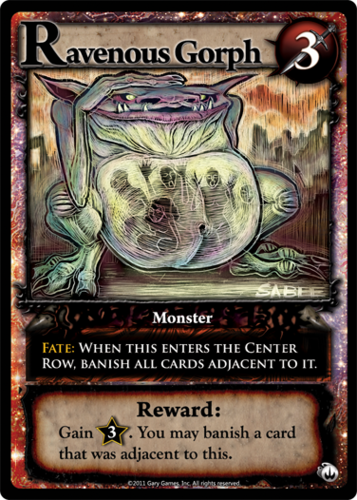
Events were also diluted; the five Event cards came up much less frequently, making cards that interact with events such as Elemental Adept incrementally worse. But that didn't present that much of a problem; cards like this tended to just stick around the center row until they were banished (or Gorphed).


One interaction that never came up but I'm nevertheless curious about is what happens when a player controls Sammael and defeats a Trophy Monster. Since Sammael's effect is clearly a "may," I would interpret that the player can choose whether to claim the trophy or to add the defeated monster to his deck. Such a choice would introduce some interesting decision-making: Unchained Fates is the most powerful trophy effect in the game, but what's better: drawing two cards at a time of your choosing, or having 7 Power every time you draw this card?


What's the optimum number of players for Ascension?

I'm pretty sure the answer is not five or six, and that has nothing to do with the mechanics. Ascension scales surprisingly well from two through six players. Instead, the five- or six-player game simply becomes very long--and each player spends most of that length doing nothing but watching everyone else take their turn. Furthermore, because the board state changes so rapidly in Ascension, it's nearly impossible to plan a turn during that down time.

Ascension works much better with four players. The game is length is pared down and its downtime reduced, but there's still enough space at the table for two players to pursue similar strategies, especially if they're seated across from each other. Three seems to work less well; a three-player game doesn't feel much faster than a four-player game, but the option to pursue similar strategies is effectively removed.

Two-player Ascension is great but in a fundamentally different way. Assuming the two players are both reasonably skilled and not especially lucky or unlucky, the two-player game is as much about the competing players as about the competing strategies. (How does pure Mechana match up against Lifebound/Enlightened? Here's how to find out!) And I haven't played the single-player variant, but I assume it's sufficiently different from the multiplayer game that it's tough to compare.

For all all the Ascension fans out there: have you encountered any of these issues in your game? Have you combined the base set with Storm of Souls, and how did it work? Do your five- and six-player games drag as much as mine?

Thursday, February 7, 2013

Quick Impressions: Bang!

It had been a few years since I'd last played Spaghetti Western: the Card Game (not the official subtitle), but in a weekend full of gaming that also included San Juan and tons of Ascension, Bang! was a great way to end with a... high note.

Bang is absolutely, positively, not a strategy game. Instead, it's a "social engineering" game probably most similar to Mafia in that each player has a secret role, balancing the need to accomplish his game goal with his desire to remain hidden in that role. The "good guys," the Sheriff and Deputies, win when the Sheriff is alive at the end of the game. The "bad guys," the Outlaws, win when the Sheriff dies. And the Renegade wins when he outlasts everyone else.

The "game" in Bang! isn't one of optimization decisions and strategic development like you'd see in a classic Euro game. Instead, it's almost a "purer" game dictated by game theory and trying to determine the correct relationships among a group of (presumably) rational actors. There's plenty of chance in Bang!--lots of card-drawing and a random assignment of a "character" that grants you a small special ability--but it's nearly impossible to construct a strategy around any of them. The cards are instead tools to help you survive and to take down your enemies, once you've figured out in the real game exactly who your enemies are. For such a high-variance game, surprisingly seldom is Bang! decided by luck alone; more often, the game is won by whoever had the keenest social insight and stuck to their role the best.

As is pretty obvious from the artwork and other production value, Bang! is a lighthearted game, as might be expected from a card game set in the Wild West that's about shooting your friends. At least half of the fun in Bang! comes from the silliness of having to say phrases like "I'm banging Ryan," and most of the rest is in affecting terrible Italian accents and reading the game rules and card text aloud. Add in a dash of political incorrectness (let's just say the "Indians" card doesn't exactly refer to the subcontinent) and you've got a nicely hilarious theme to mitigate what could otherwise be pretty serious psychological warfare.

Bang! works best as a party game where all the players are comfortable enough with each other not to be offended when the bullets start flying. It shines in games with enough players (six or more seems best) to make the position-based mechanics mean something. And though the run time can vary widely with what cards are drawn, at an average of 30 or 40 minutes, it's easy to get in multiple games so everyone can experience being on both sides of the law.

4-7 players (best with 6+), 30-45 minutes, $20 at a game shop or $19 on Amazon.

Wednesday, February 6, 2013

Strategy Spotlight: San Juan

Yesterday, I published February's Game of the Month post about San Juan. I mentioned that it seemed there were a finite number of paths to victory, maybe one involving production and another involving buildings, and that was all. My own strategy was a heavy "violet building" strategy spiked with just enough low-cost production to keep the cards flowing in. Though my strategic experience with San Juan is still limited, I was pretty happy with this line. Here's how it played out.


Violet-card cards


I was lucky enough to get a Quarry in my opening hand, and Quarry is one of those cards best played at the beginning of the game so you can maximize its advantage throughout. I picked Builder with my first action and played Quarry at the cost of the rest of my hand. A few turns later, City Hall wandered into my hand, and given that it was relatively cheap for me to build violet buildings, I knew I had a strategy. It took me a while to build City Hall, but there was no rush.


Producer-phase cards


The second card I was able to build was Aqueduct. I was torn about Aqueduct at first: it was cheap because I already had Quarry, but it didn't immediately fit into my "build lots of violet buildings" scheme. Instead, it encouraged me to build production buildings, but fortunately, I didn't need to build so many of them. I had my starting Indigo Plant and added a Sugar Mill a few turns later, and that was all. This way, I never had to select the Producer role, but I still produced an Indigo and a Sugar every time someone else did.

Frankly, I would have preferred a second Indigo Plant to a Sugar Mill. The expected trader value for Sugar is 1.4 cards compared to 1 card for Indigo, making the "break-even" point between the two 2.5 Trader phases. While I'm certain the Trader phase happened at least three times, the extra card I could have saved by building an Indigo Plant rather than a Sugar Mill early on would have been more helpful than the extra 0.4 cards per Trader phase were in the late game.

The biggest mistake I made all game was not building Well when I could have. It was complete oversight on my part--I mistakenly discarded Well to pay for City Hall instead of Tower (I swear it wasn't because the picture looked similar. Really.)

Trader-phase cards


Market Stand plus Trading Post is the game's best synergy, at least so far as I've found. This way, as long as you've produced two goods (which I always did), you can always sell them both and you always get the bonus, even if you didn't choose the Trader role. Market Hall wasn't an integral part of the strategy--it was more additive than synergistic, as us science-types might say--but it was some nice icing on the cake.


How it worked out

In any Producer phase, I produced both an Indigo and a Sugar (and I should have been able to draw a card, had I not screwed up). In any Trader phase, I sold my two goods for an average of 4.4 cards. The best part of the strategy was that I never had to select either of these phases myself, freeing me to pick Builder basically every turn. Finally, my freedom to pick Builder, combined with the early Quarry, meant that I was making most violet buildings at -2 cost, and City Hall ensured I was getting a nice return on those violet buildings.

I'm curious: to those of you who actually know what you're doing in San Juan, was I playing a legitimate strategy, or did it just happen to work because none of us had ever played the game before? What's the best counter to a strategy like this one? And are there other variations on this theme that work, or is basically every game of San Juan I every play going to end up with something along these lines?

Tuesday, February 5, 2013

February Board Game of the Month: San Juan

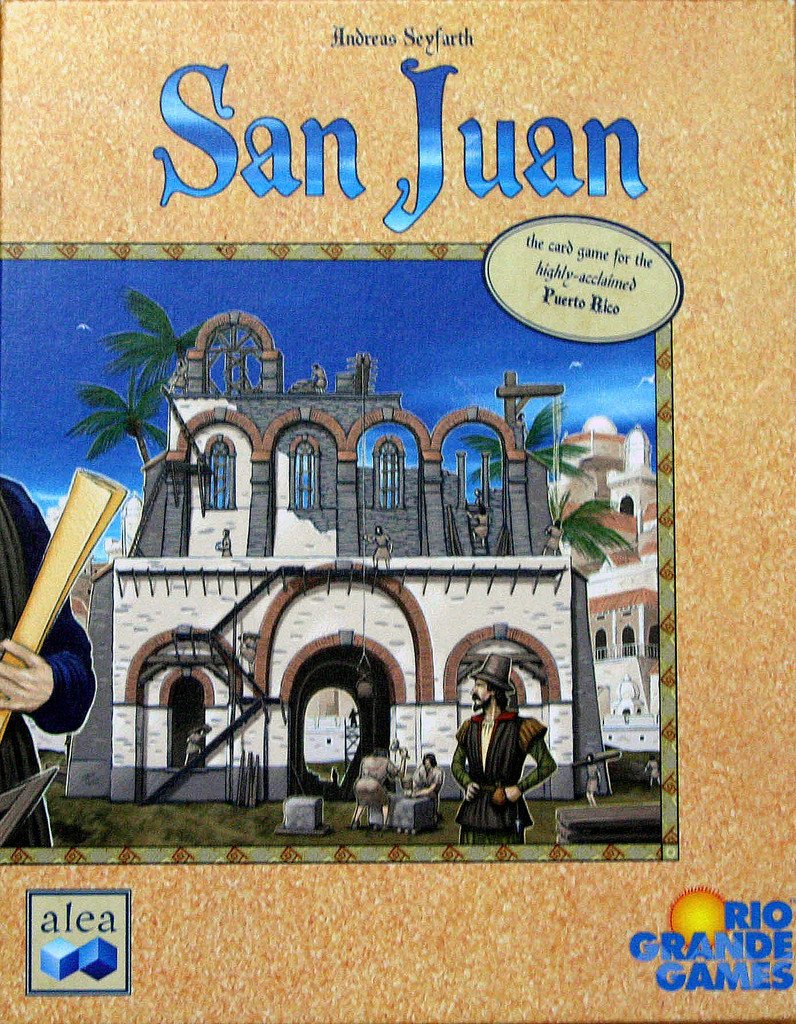
Over the Christmas holidays, I had no fewer than three people independently tell me that San Juan was an awesome game, and given my deep and abiding love for Race for the Galaxy and my impressed (if fearful) admiration for Puerto Rico, I'd especially love it. After a fortuitous run-in with my department's normally stingy key office, I found myself with a bonus $40 in my pocket. I decided there was a worse way to spend it than on San Juan and a latte, and though the latte was drunk long ago, I finally got a chance to play San Juan last weekend.


Style and Gameplay

San Juan is a tableau-building card game (not really a board game, despite the post title) and was among the first card game to use the "role selection" mechanic that has now been adapted by Race for the Galaxy and a handful of other games. As similar as Race and Puerto Rico are to each other, San Juan is more similar to both: legend has it that both Race and San Juan grew out of an attempt to create a card-game version of Puerto Rico. Indeed, the theme of San Juan is essentially the same as in Puerto Rico: you're a colonial-era governor trying to build the economy of San Juan by constructing buildings and plantations.

San Juan's game play is straightforward: on each turn, every player selects a "role," allowing you to draw cards from a common stock, construct buildings, produce "goods" on your plantations, or sell your goods for more cards. Like in Puerto Rico, once a role is selected, every player can perform an action within the role (i.e., everyone may build when someone selects Builder) but whoever selected the role gets a small "privilege" (like building at a reduced cost). Allowing everyone to act within a given role drastically reduces the "lockout" problem that plagues Agricola, where your entire game may be ruined in turn 3 because someone takes a stone ahead of you.

The most brilliant part of San Juan's design is that is dispenses with two Euro-game mainstays, currency and victory points. Victory points are present, and in fact the way to win the game, but they're entirely contained within your buildings, not as separate tokens. And currency doesn't exist at all: in order to play cards, you must discard other cards. Therefore, the biggest strategic decision (aside from the role selection) in San Juan comes in choosing which cards you want to hang on to for later development and which you're comfortable discarding immediately.

Our first game was a 4-player game; two of us had played both Race for the Galaxy and Puerto Rico, one had played Race but not Puerto Rico, and the fourth had played neither. The three of us who had experience with Race and/or Puerto Rico grasped the game immediately; it took our fourth a few turns to figure out what was going on, but the game started running smoothly at around turn 4. It clocked in at under an hour, right in line with the box's prediction of "45-60 minutes".

Analysis and Anecdotes

Given its nearly identical play style, it's hard not to compare San Juan directly with Race for the Galaxy. Judging from the discussion at BoardGameGeek, it seems almost imperative that you pick sides and prefer one game over the other, but in reality the two games are so similar that there's no reason not to like them both. The crucial difference between the two, aside from some rather minor mechanical differences, is that there are more cards in Race--the decks are almost exactly the same size, but Race has far more kinds of cards and fewer repeats.

Therefore, San Juan is less disposed to random variance than Race for the Galaxy might be, a fact that delighted the "gamier" gamers among our group. If you need a certain card as the lynchpin of your strategy, you're proportionally more likely to get it in reasonable time. But both San Juan and Race for the Galaxy are "reactive strategy" games, rewarding you more for adapting your strategy to the board state rather than trying to chart a course a priori.

On the flip side, the number of viable strategies for winning San Juan seems like it could be small: basically, you need to pursue some variation of either the production route or the building route. One of the best parts of Race (or other card games with lots of cards, like 7 Wonders) is discovering small but clever interactions; San Juan's deck is sufficiently limited that in any given game, each player is likely to see all the cards that exist in the whole deck.

San Juan worked fine with four players. The rules are identical for three and four, with some alterations for two. Normally, rules alterations are a surefire reason to assume the game would be less good under that condition, but there seems to be a fair amount of consensus that San Juan actually "shines" with two people instead of three or four.

The one mechanic I'm least crazy about (incidentally, the one that's most different from Puerto Rico or Race) is the trading market. The first few times that produced goods are sold, the prices are semi-random, but afterwards, the prices cycle, introducing a memory-game element into trading. In a reasonably fast-paced game that rewards reactive strategy, it's tough to see how the additional requirement to memorize strings of numbers makes the game any more fun.

Overall Impressions

At the moment, I'm really into San Juan. I strongly prefer reactive to proactive strategy games, and shorter games to ridiculously long games (though I've vowed to reexamine that in 2013!) so everyone who told me I'd love San Juan, you were correct. And I feel like I can't give an adequate strategic analysis until I've seen about a dozen more games of it because there's probably a vast depth to the game that I haven't even begun to scratch yet.

But the biggest reservation I have about San Juan is how long I'll continue to be really into it. While I could see it holding my interest (and a spot near the top of my games rotation) for years, I can also see it getting stale in a few months, if the strategic options really are as limited as I fear they might be.

Even if San Juan ceases being the Next Big Thing in my game collection quickly, though, it has a lot going for it that I won't stop appreciating, including straightforward instructions, elegant mechanics, and a low profile (literally all you need to play: a deck of 110 cards and a handful of role and market tiles!). At the very least, San Juan's floor is an easy and quick "gateway" game for Euro-style card games, the same function Carcassonne and Settlers of Catan often fulfill for Euro board games. And if Race for the Galaxy is any comparison at all, San Juan's ceiling is much higher than that.

2-4 players, 45-60 minutes, $30 at a game shop or $21 on Amazon.

Monday, January 21, 2013

The Compounded Effect of Themes on Marketing

Link to Game on BGG
I stumbled across a new game worth mentioning on Ludi Berkeley for several reasons, but at the moment I'm intrigued about marketability. Take for moment to review the description of the game provided (from BGG) below:

"Compounded is a game about building chemical compounds through careful management of elements, a fair bit of social play and trading, and just a bit of luck. In Compounded, players take on the roles of lab managers, hastily competing to complete the most compounds before they are completed by others – or destroyed in an explosion. Some compounds are flammable and will grow more and more volatile over time; take too long to gather the necessary elements for those compounds and a lot of hard work will soon be scattered across the lab."

It sounds exciting, but does this theme severely limit the potential audience in an already niche market of designer board games?

The answer is yes, it most certainly does. This does not mean however, that the success is limited more than say the most universally accessible theme of a train game based in ancient Egypt.

All themes constrain marketability due to player taste, accessibility or cultural relevance. I would argue in cases such as Compounded, it actually strengthen the potential of success.

While we cannot yet evaluate the the quality of the game, we can make several observations: 
  • Chemistry is a relatively uncommon as a theme in gaming; the novelty of the idea was enough to intrigue me to write a blog post about it. The board game market has long been known to support well executed ideas regardless of theme. We've seen commercially successful board games about German politics, irrigation, and bureaucratic paper pushing.
  • The game has made it this far through play testing without a theme change, indicating either the mechanics mesh well with the Chemistry theme or the designer is at least content with the design and finds this theme most fitting.
With the game in preparation for publishing, Compounded seems to already have its audience. At the moment I became aware of it on Kickstarter it had gained 398 backers in 24 hours and as I publish this blog post it has gained 577 backers in four days of support. I'm thoroughly looking forward to Compounded and many more exciting themes in 2013.

The theme of Compounded is already showing its own growing interest.

Sunday, January 13, 2013

D&D Encounters: War of Everlasting Darkness (Part 3: Magic-Item Mathematics)

This post is the last in a series of three discussing the most recent season of D&D Encounters. I've already posted my recap of how the season unfolded and a discussion of how the "adventuring day" math in 4th Edition affects the narrative character of the game. One of the conclusions I drew was that the math behind roleplaying games uniquely, and distinctly from most other categories of games, affects both the mechanics and narrative of the game.

If you were to distill the central mechano-narrative concept of just about any RPG, it might look something like this: when you do cool stuff, the numbers go up. Of course, every RPG defines "cool stuff" differently, and every one has its own method for making the numbers go up. In D&D, "cool stuff" might be slaying a monster, surviving a trap, or solving a puzzle. From there, you get two rewards, experience points and treasure. Finally, the numbers go up once you've accumulated enough experience points to gain a level or if you find a magic item in all that treasure.

Every edition of the game has worked like this, but the relative contribution of level- and item-derived bonuses to a character's statistics has changed with every incarnation of D&D.

3rd Edition

In 3rd Edition, at sufficiently high level, a character would likely have no fewer than half a dozen magic items that granted static, constant-effect bonuses to his numbers. The preponderance of such items gave rise to the derisive nicknames "Christmas tree" or "mannequin" effect, suggesting that the primary purpose of a character was to act as a stand to hang his magic items on.

There were two big problems with the Christmas tree effect, one narrative and one mechanical. The narrative problem was that a huge fraction of the magic items in 3E went entirely unused. Though the designers and developers tried their hardest to make items interesting enough to compete with bigger numbers, it just didn't work. As a 3E player, given a choice between outfitting your character with an intriguing though limited-use and situational item and one that boosts a number that your character uses often, it was the utilitarian "make the numbers go up" every time.

And the mechanical problem was that the math behind magic item contributions to character numbers was obscured to both players and DMs. There was presumably some internal idea of an "assumed magic item power" vs. "character level" graph, but we couldn't see it. We could posit a function's existence and set its upper and lower bound but had no idea what its shape or intermediate values were.

In that respect, DMing 3rd Edition was a bit like being an auto mechanic who was charged with taking care of a car's engine but couldn't lift the hood. You knew you needed to operate the car under a certain set of conditions, and you knew you needed to give the engine the right kind of oil. But you didn't know what kind, or how much, or how frequently, and you often resorted to making adjustments once things had started making too much noise.

4th Edition

As it was wont to do, 4E fixed most of 3E's problems by introducing some of its own. 4th Edition made two major simplifications to how the item structure worked. First, it reduced the number of types of items that could give a static bonus to a score from at least eight in 3E to only three. That change helped to alleviate the narrative problem from 3rd: no longer did you have to choose between a ring that granted you a brief moment of invisibility and a ring that enhanced your armor--because there was no such thing as a ring that enhanced your armor in 4th Edition. Instead, the ring slot was free to do all sorts of other interesting things besides just provide a numerical benefit.

So far, so good. 4th Edition's other big reform was to codify the exact character level for which each magic item was appropriate. In general, a +1 item (i.e., one that adds 1 to a d20 roll, or a 5% bonus to your attack or defense) was deemed appropriate for a 1st-level character, +2 for a 6th-level character, and so on up to +6 for level 26. So in 4th Edition, a DM had a much better idea of what magic items that characters should have at what time; for example, if your 7th-level fighter already has a +3 sword, he's slightly more powerful than average for his level.

But what if a DM doesn't give out magic items at that canonical rate? What if he built his world to be comparatively low-magic, or he decides there's not a situation where the characters realistically would have found a magic sword in the past few levels? In the original conception of 4E, he would have broken the game. It +3 vs. +2 doesn't seem like a big number, but for every "unit" of each magic item lower than where you "should be" for your level, combat becomes 10% more difficult.

The much worse problem was a newly introduced narrative one. As the magic item math became more transparent and more tightly integrated with the character power math, DMs and players alike began to think more acutely about the "correct" magic item to have at a certain level. As a result, magic items felt less exciting, less mysterious--frankly, less magical--and more utilitarian, more simple tools to make the numbers go up.

Essentials (and looking forward to Next)

Sometime when we weren't looking, but probably around the time that the Essentials rules started worming their way into 4E, the "inherent bonuses" rule showed up, and it's a much better addition to the game than most of the rest of Essentials. All the rule does is decouple the "numbers going up" function of magic items from their narrative interest. The "expected" numerical increases from magic items just get rolled into level-derived bonuses. The reason that "inherent bonuses" is good is that it frees the DM even more to give or withhold magic items as he sees fit, or to make them focus on their special properties instead of just what they do for the characters' numbers.

War of Everlasting Darkness was the first Encounters season to mandate the use of inherent bonuses rather than assuming a glut of magic item-based numerical increase, and it worked beautifully. Only a handful of magic items existed in the season, and all of them served a deeper narrative purpose than simply making the characters more able to survive combat. My players really got into it, getting more excited about the items' ability to break the eponymous darkness than about their game statistics.

And that seems to be a more authentic expression of what a magic item in D&D should be, dating back to its Tolkien-esque roots. Sure, Sting was probably a little sharper and better balanced than the average short sword, but that's not why we remember it. Sting is a notable installation in the fantasy repertoire because it glows blue when goblins and orcs are around. Orcrist wasn't interesting because it gave Thorin Oakenshield a bonus to his attack rolls; it was interesting because the orcs and goblins knew of its might and feared it.

Next seems to be moving back toward the "interesting effects" function of magic items instead of the "numerical bonuses" function; its most recent set of playtest rules limits the highest bonus from a magical weapon (even ones of legendary rarity) to +3. Meanwhile, the rules are full of neat descriptors of who created the item, what it's made from, how it's used, and what its properties and "quirks" might be.

That's exactly the direction D&D should be going: making the math behind magic items both transparent and decoupled from the game's core mechanics. The holy avenger sword is a part of D&D lore because of its epic history with the forces of good, not because of some number it adds to your attack rolls.

Friday, January 11, 2013

Game Ratings: Measuring Quality in Gaming (Part II)

As a quick review of Part I, I went over five of the seven criteria I use to evaluate board games. This is a scale with a maximum score of  five broken down by the following categories:

Originality (0 - 1 pt) - How exciting is the unique combination of ideas that bring this game off the shelf? Does it stand out from similar games?
Theme (0 - 0.5 pt) - Do the thematic elements blend into the game play? Is the theme fitting? Does it increase my interest in playing or is it a last minute addition?
Pure Fun (0 - 1 pt) - Do I enjoy the game? Is it a go to game when I have the necessary player count? Does the game play move along or does it often move too slow?
"Re-play-ability" (0 - 1 pt) - Do I feel the need to revisit it in order to try new options and strategies? Is it predictable? Do I want to play again immediately?
Strategy to Luck Ratio (0 - 0.5 pt) - Does the game present itself well as far as the impact of strategy vs. luck? Is the amount of "luck" adequate for the game length?

Now the final two categories:

Player Scaling (Up to 0.5 pt)
When I'm looking to acquire a new game one of the first items I look at is the intended number of players. 2-4 is limiting when you've game nights of five or six people.

There are fun party games that are 4-8+ but they really mean 7+ for an ideal experience. Games that have 2-6 or 3-5 often really need the upper end of the range to put all the player actions or roles into play or the lower end of the spectrum as additional players largely only add time with little to no additional player interaction.

This is a measure of how viable it is to get to the table, a larger "optimal" player range, the better the game under this rating. Two player games do get a pass here unless they are functionally broken. There are no bonus points but I do enjoy when games have different pacing or alternate strategies emerge as more viable with different player counts with the same game. Tongiaki is almost a completely different game when played with two players versus six players.

0.5 - Small World, Wits & Wagers, Coloretto
0.25 - Around the World in 80 Days, Scotland Yard
0.0 - Blokus, Citadels

Parity (Up to 0.5 pt)
This final category is mostly about ensuring there is tension in a game. As I've mentioned in a previous article about final scoring, it is often the final controllable factor of whether the designed experience was enjoyable or not. Scoring shouldn't have a runaway leader problem nor should it transmit to a beginner that twenty minutes in that they are in for the long haul with no shot at the podium.

I have no qualms with defeat normally but if the session commonly turns into "I gotta catch Bill as he rolled three sixes to start" for an hour I have an issue.

Games that have an all or nothing achievement, such as conquering the globe in Risk or bankrupting everyone else in Monopoly, can leave players slightly jaded at the end as one person comes out with a glorious victory while at least several others were more witnesses or victims than participants . This is a negative in my book as it doesn't leave others with a sense of "what if?" that motivates them the next time, a thought of "I see I could have done this for four more points  and that for three more that may have been the difference."

0.5 - Transamerica, In the Year of the Dragon, End of the Triumvirate
0.25 - Kahuna, Jambo, Rosenkonig
0.0 - Risk, Jenga, Monopoly

My BGG ratings distribution
Games Rated
Now the criticisms are fair; I don't exactly follow the standard BGG.com "recommended rating" method and on rare occasions I've received messages that respectfully disagree with my personal rating system, but it does have its own argument to make. Lets look at several examples:

La Citta

Originality (1.0/1.0) - Great blend of mechanics
Theme (0.5/0.5) - Region-building at its best
Pure Fun (1.0/1.0) - Controlling a "mega-city" feels powerful
"Re-play-ability" (1.0/1.0) - Many interesting decisions
Strategy/Luck Ratio (0.5/0.5) - Randomness can be mitigated
Player Scaling (0.5/0.5) - 2-player is fine, Excellent with 3-5
Parity (0.5/0.5) - Runaway victories do occur, but rarely

Overall 5.0/5.0  = 10 out of 10


BGG Recommended Rating:
10 - Outstanding. Always want to play and expect this will never change.

My Rating:
This is of course very fitting as one of my few perfect tens. It holds a special position on the shelf.

Power Grid

Originality (0.75/1.0) - Mechanics mesh well, little innovation
Theme (0.5/0.5) - Plays like I'm supplying energy to cities
Pure Fun (0.75/1.0) - Decisions can get bogged down at times
"Re-play-ability" (0.5/1.0) - Game length a hindrance
Strategy/Luck Ratio (0.5/0.5) - Strategy is strongly rewarded
Player Scaling (0.5/0.5) - Neat intricacies between player counts
Parity (0.5/0.5) - Feels close throughout, strong catch-up mechanic

My Rating:
Overall 4.0/5.0 = 8 out of 10

BGG Recommended Rating:
8 - "Very Good Game. I like to play. Probably I'll suggest it and will never turn down a game."

While Power Grid is a very good game, I'd certainly turn it down if two good shorter games were an alternative. I enjoy playing but there are many games I'd suggest over it, some being rated lower than Power Grid but play much faster.

Ticket to Ride

Originality (0.75/1.0) - Love the mechanics, but very simple
Theme (0.5/0.5) - Solid theme
Pure Fun (0.75/1.0) - Very enjoyable game for its length
"Re-play-ability" (0.5/1.0) - Initial intrigue is short lived
Strategy/Luck Ratio (0.5/0.5) - Great strategy/luck mix
Player Scaling (0.25/0.5) - Race with 2 and logjam with 5
Parity (0.25/0.5) - One player can go unchecked too often

My Rating:
Overall 3.5/5.0 = 7 out of 10

BGG Recommended Rating:
7 - "Good game, usually willing to play."

I would say my feelings about Ticket to Ride match the BGG recommended rating. It is a good game and I'd usually be willing to play, it does need some variety periodically to keep it from getting stale.

Blokus

Originality (0.75/1.0) - Not much like it
Theme (0.0/0.5) - Abstract. Fun, but still an abstract.
Pure Fun (0.5/1.0) - My enthusiasm is weakening
"Re-play-ability" (0.5/1.0) - Little variety between games
Strategy/Luck Ratio (0.5/0.5) - Perfect information
Player Scaling (0.0/0.5) - Purely designed for 4
Parity (0.25/0.5) - If everyone comes your way- you're done

My Rating:
Overall 2.5/5.0 = 5 out of 10

BGG Recommended Rating:
5 - "Average game, slightly boring, take it or leave it."

I probably feel a little more fervor about Blokus than one may think from this rating but that is because it suffers in getting to the table. With 4 players being optimal player count, it brings a competitive field of games for 4 players that have more depth and intrigue. It loses out as an abstract, but overall I probably enjoy this game at about a 5.5 or 6.0 level.

Saint Petersburg

Originality (0.5/1.0) - Ahead of its time, similar games are superior
Theme (0.0/0.5) - I just don't feel it, could have been any theme
Pure Fun (0.25/1.0) - Theme probably carries over here, feels stale
Replayability (0.25/1.0) - Repetitive and cumbersome
Strategy/Luck Ratio (0.25/0.5) - Interesting decisions rarely show
Scalability (0.5/0.5) - Works nicely with 2, 3 & 4 Players
Parity (0.0/0.5) - Arguable, but I see too many blowouts

Overall 1.75/5.0 = 3.5 out of 10

BGG Recommended Rating:
Somewhere between:
3 - "Likely won't play this again although could be convinced. Bad." and
4 - "Not so good, it doesn't get me but could be talked into it on occasion."

I fall right between these two descriptions as it has never been a game I've particularly enjoyed and if given nearly any other option I'd probably elect it over this. I should clarify, this is not a bad game at all though, very functional and sound design for what it is intended to do, it just doesn't captivate my interests.

Conclusion


Imperial

Originality (1.0/1.0) - A true pioneer in many ways
Theme (0.5/0.5) - I'll give it the benefit of the doubt
Pure Fun (0.75/1.0) - The fun value has decreased
"Re-play-ability" (0.75/1.0) - The excitement has faded
Strategy/Luck Ratio (0.5/0.5) - No luck
Player Scaling (0.5/0.5) - An interesting experience with each player count
Parity (0.5/0.5) - With plenty of common property, its hard to break free

Overall 4.5/5.0 = 9 out of 10

BGG Recommended Rating:
9 - "Excellent game. Always want to play it."
 
As I mentioned briefly in the intro, I've recently come to terms with a loss of affection for Imperial. It has served its purpose masterfully, but I no longer reach for it at each gaming opportunity. Underneath the investment wargame fasade exists an investment game that uses war to determine the market valuations. Imperial isn't enough of an investment game for the time it takes to play it, and the military actions literally go around in a circle and have begun to feel like a chore. I hope to get Imperial back to the table several times this year and re-evaluate, but for now it is trending downward.

Now in hindsight it seems kind of silly to write two articles over lowering a game rating by 10%, but I'm done and I need to go start my taxes now. Thanks for reading.