Showing posts with label San Juan. Show all posts

Saturday, February 9, 2013

Strategy Spotlight Seconds: San Juan

Link to Matt's Strategy Post 
San Juan at an initial glance appears to have a myriad of strategic decisions but what is often learned after just a few plays is that it is a game of two primary strategies, with a distinct selection of sub-strategies.

The idea that there is simply two primary routes in San Juan is initially a concern for lack of variety but in reality San Juan simply has an early demand on players to pick a strategy and run with it. I have always felt San Juan requires the ability to play both the "purple buildings" strategy and the "production buildings" strategy although in order to play either optimally one must adapt to cards dealt and play whichever strategy presents itself first.

While San Juan has some awesome cards with neat abilities, it comes as no surprise it is a game about victory point and key action selection. While I can't get into everything here, I have some tips which are the primary themes while executing the expanded ideas below (focusing on three or four player):
  • We are aiming for at least 35 points. You can win San Juan with fewer and you can lose with more, but 35 points often puts you in a comfortable spot.
  • What we build needs to either be VP/cost efficiency of 2/3 or better (Archive is 1/1, Tobacco Storage is 2/3) or offer a cost savings/income increase that will pay for itself within a few rounds (Quarry or Smithy with -1 cost reduction). We have 12 investments to select and we're looking for a good return on investment and/or quick payback period.
  • Role selection is optimal early in the game in this order: Prospector, Builder, Councillor, Producer/Trader. This is probably commonly how it plays out but selecting producer/trader is drastically inefficient unless you have several silver smelters.
  • With rare exception I will usually pass on the first build opportunity, this game is not about building your 12th building, its about having the most points when someone else does. I'm aiming to finish with 10 or 11 buildings although if a good combination of cards (explained below) come in succession it is possible to finish first with a large margin of victory due to superior income flow throughout the game. Try not to fall behind by more than two buildings to anyone as it is very difficult to stay within range.
"The City Hall Strategy"

Our first strategy is the more grandiose and technical to execute, but has more potential secondary strategies available. Our key opportunity cards here are the Carpenter and Quarry

I find this to be the most desirable combo in the game, as you can build several of our other VP/cost efficient cards such as the Gold Mine, Archive and Smithy without a quantity change to your hand. This enables you to select an alternate role selection such as Prospector or Councillor and still build when others select Builder. If dealt both, pass on building until you can build one without having to discard the other. The Carpenter is slightly better than the Quarry overall, but I'll never complain about having one over the other. The Carpenter is still worth building late in the game while Quarry is not.

Ideally we can build either of the Carpenter/Quarry early (skipping the first build opportunity to preserve options) and add the other at some point later in the game. At this point we are increasing our hand by looking for the low cost, points efficient cards listed above below in order to keep up with the pace of building while positioning ourselves better than our opponents via greater options.
Gold Mine is one of the best cards in the game as it often will pay for itself several times over in the game. The Archive is nice but here for the low cost and VP ratio. I realize the Smithy seems out of place as we don't intend to build any production buildings once we've selected our purple building path, but it is cost efficient and an easy build if it comes up in your hand.
The Prefecture, Tower and Market Hall are the next layer of this strategy. The Prefecture is an excellent piece of the puzzle, as it doubles our income from one of the frequently selected roles each turn, whether we select it or (hopefully) not. The tower is included here as it is efficient and with our selective approach to building, the income will be rolling in and the last thing we want to do is discard down to seven at the end of the round (a devastating offense in San Juan).

The Chapel is one of the secondary strategies in San Juan, although it has two prerequisites to make full use of it:
  • A hand of at least 4 cards that is growing each turn even as you are building, making this an alternative to the Tower.
  • A slower game pace in which players are building less frequently and with more efficiency (this is how you can beat an opponent using the very same build order I am listing here).
Keep in mind using the Chapel comes second to actually building each round, if your hand runs low don't utilize it as you may be a card short on building next turn. Even if you don't use it, the Chapel is not technically a bad building, but there is frequently an opportunity cost involved in building it.
The Statue, Victory column and Hero are the primary elements of the Monuments secondary strategy. At this point their points efficiency should be apparent, but as we have hopefully reduced their cost they are among the elite cards we can build late in the game. I would be willing to build the Statue as early as the fourth or fifth build if necessary but would hold the Hero until at least the ninth build assuming these actions would not diminish my hand entirely. They become more powerful with the Triumphal Arch although it is not necessary if hand size is limited.
The final layer of this strategy is to build at least one of the prized "Super Six" cards. The City Hall should come as no surprise as it will be worth 9-10 points at the end of the game if just a few things fall into place. The Palace may be worth 5-7 points which isn't bad if you haven't seen a City Hall all game. The Triumphal Arch really needs at least two of the monuments to be in place to be worthwhile, but you often don't have the luxury of picking and choosing in some games and it is an okay build in many situations.

"The Guild Hall Strategy"


Our second strategy is probably the simplest to execute, and I prefer it as vanilla as the strategy can be. Our key opportunity card is a Smithy, building it immediately or passing in the first build opportunity if it is not available. As cards accumulate, assuming the City Hall strategy option isn't present, we'll build Tobacco storage, Indigo plants or in dire cases Silver Smelters until we can get a Smithy.

I'm not fond of the Sugar Mill or Coffee Roaster. While they can likely pay for their added cost over the course of the game, their VP/cost ratio is below our expectation. I'm going to be selecting Producer/Trader as little as possible and I expect other players to do the same.
If it is called the Guild Hall strategy, at some point we need a Guild Hall. I'm not opposed to building it early, especially if I have the Smithy in place as the low costs presented by the Indigo Plant and Tobacco storage will allow me rebuild my hand in the following turns after the Guild Hall wipes it out. The key here is to hang on to it once you find one, as players will put them under their Chapels as the game goes on or you may never see one again.

The Gold Mine is always an acceptable build in San Juan and with the Guild Hall strategy I would be willing to build the Chapel when income is flowing. Monuments such as the Statue or Hero probably aren't as effective as usual as the Guild Hall makes Tobacco storage and Indigo plants points monsters with the added benefit of a potential income source but I wouldn't rule them out. I would not build anything else not listed here.
Cards to Burn

The Black market and Library are the best of the remaining cards. I find the Black market marginally useful with the City Hall Strategy but not the Guild Hall strategy. The Library really dominates as the player count decreases as among the two roles strengthened most, Prospector & Builder, one will be available the majority of the time in a three player game and always in a two player game for you to select. I find the Library to be too large a cost commitment to be especially powerful with four players.

Aqueduct is in this upper category simply because it passes the points efficiency requirement. I should elaborate here as the Aqueduct is one of the most unique cards in the game as it can both eliminate the need to ever select Producer while also creating some neat synergies with Market Stand & Trading Post for when you come to the Trader role. It also has some neat uses with the Black market with the Guild Hall Strategy, allowing you to use Producer but never Trader and have an extra source of income that is inaccessible to your opponents when it comes time to build. But it doesn't fit well with our City Hall Strategy and thus I relegated it to the bottom tier of available cards.

The Poor house is probably a moderate opening card, but it is conditional in the build phase. Cards should be selected to build based on consistency and predictability rather than possible utilization.
I'll preface this by saying there is no perfect strategy in San Juan, certainly not the two I've listed above, but between these two strategies neither has a purpose for the cards below. None of these cards are VP/cost efficient and offer little utility to make up for it. 
I'm at a loss to explain my dissatisfaction for the Crane, I don't like to rebuild over buildings that have already been selected for efficiency over the course of the game. Trading post, Market stand and Well each require either sub-optimal role selection (Producer or Trader) or synergy with another card in my sub par grouping (Market stand/Trading post and Well/Aqueduct) in order to succeed.

Conclusion

So what strategy is better, and which route would we take if given a strong opening hand such as Quarry, Carpenter, Smithy, Tobacco storage? I may defer to purple buildings as the potential for a Chapel strategy in a slower game, although the Smithy path churning out Indigo plants and Tobacco storage is fast paced and incredibly effective if others fall behind early and a Guild Hall falls into your sights. 

I do think being a well rounded San Juan player is the most important aspect as I've rarely had the luxury of choosing, and San Juan always delivers its own twists and turns to your game plan.

Wednesday, February 6, 2013

Strategy Spotlight: San Juan

Yesterday, I published February's Game of the Month post about San Juan. I mentioned that it seemed there were a finite number of paths to victory, maybe one involving production and another involving buildings, and that was all. My own strategy was a heavy "violet building" strategy spiked with just enough low-cost production to keep the cards flowing in. Though my strategic experience with San Juan is still limited, I was pretty happy with this line. Here's how it played out.


Violet-card cards


I was lucky enough to get a Quarry in my opening hand, and Quarry is one of those cards best played at the beginning of the game so you can maximize its advantage throughout. I picked Builder with my first action and played Quarry at the cost of the rest of my hand. A few turns later, City Hall wandered into my hand, and given that it was relatively cheap for me to build violet buildings, I knew I had a strategy. It took me a while to build City Hall, but there was no rush.


Producer-phase cards


The second card I was able to build was Aqueduct. I was torn about Aqueduct at first: it was cheap because I already had Quarry, but it didn't immediately fit into my "build lots of violet buildings" scheme. Instead, it encouraged me to build production buildings, but fortunately, I didn't need to build so many of them. I had my starting Indigo Plant and added a Sugar Mill a few turns later, and that was all. This way, I never had to select the Producer role, but I still produced an Indigo and a Sugar every time someone else did.

Frankly, I would have preferred a second Indigo Plant to a Sugar Mill. The expected trader value for Sugar is 1.4 cards compared to 1 card for Indigo, making the "break-even" point between the two 2.5 Trader phases. While I'm certain the Trader phase happened at least three times, the extra card I could have saved by building an Indigo Plant rather than a Sugar Mill early on would have been more helpful than the extra 0.4 cards per Trader phase were in the late game.

The biggest mistake I made all game was not building Well when I could have. It was complete oversight on my part--I mistakenly discarded Well to pay for City Hall instead of Tower (I swear it wasn't because the picture looked similar. Really.)

Trader-phase cards


Market Stand plus Trading Post is the game's best synergy, at least so far as I've found. This way, as long as you've produced two goods (which I always did), you can always sell them both and you always get the bonus, even if you didn't choose the Trader role. Market Hall wasn't an integral part of the strategy--it was more additive than synergistic, as us science-types might say--but it was some nice icing on the cake.


How it worked out

In any Producer phase, I produced both an Indigo and a Sugar (and I should have been able to draw a card, had I not screwed up). In any Trader phase, I sold my two goods for an average of 4.4 cards. The best part of the strategy was that I never had to select either of these phases myself, freeing me to pick Builder basically every turn. Finally, my freedom to pick Builder, combined with the early Quarry, meant that I was making most violet buildings at -2 cost, and City Hall ensured I was getting a nice return on those violet buildings.

I'm curious: to those of you who actually know what you're doing in San Juan, was I playing a legitimate strategy, or did it just happen to work because none of us had ever played the game before? What's the best counter to a strategy like this one? And are there other variations on this theme that work, or is basically every game of San Juan I every play going to end up with something along these lines?

Tuesday, February 5, 2013

February Board Game of the Month: San Juan

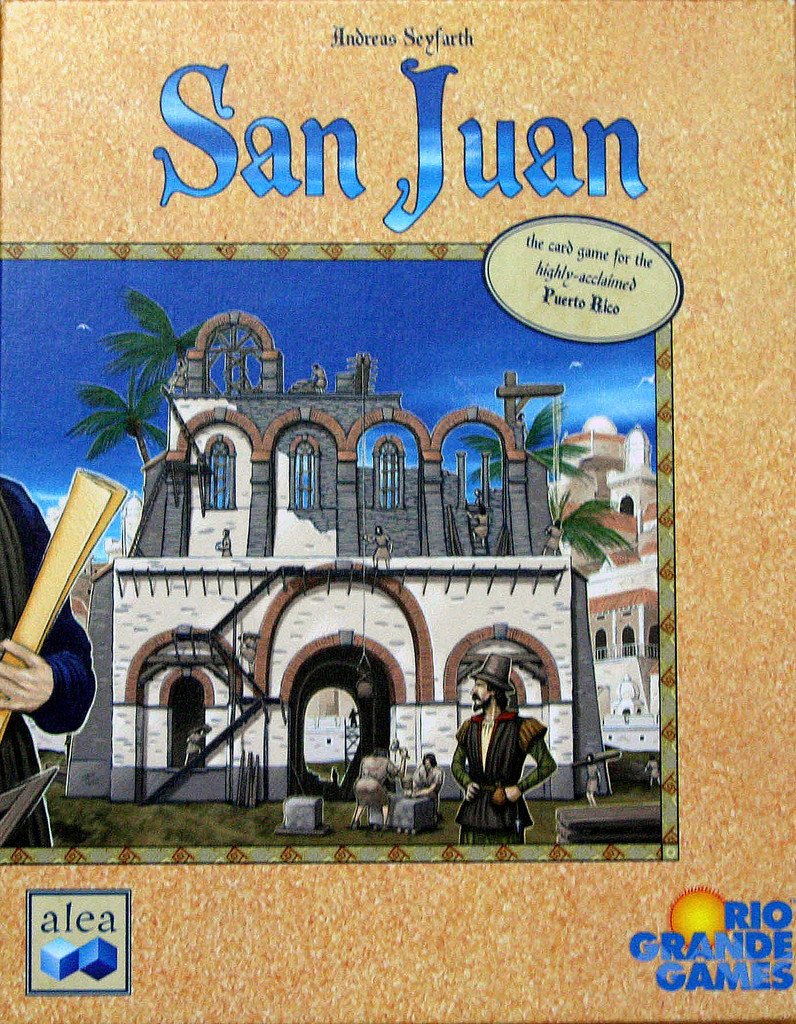
Over the Christmas holidays, I had no fewer than three people independently tell me that San Juan was an awesome game, and given my deep and abiding love for Race for the Galaxy and my impressed (if fearful) admiration for Puerto Rico, I'd especially love it. After a fortuitous run-in with my department's normally stingy key office, I found myself with a bonus $40 in my pocket. I decided there was a worse way to spend it than on San Juan and a latte, and though the latte was drunk long ago, I finally got a chance to play San Juan last weekend.


Style and Gameplay

San Juan is a tableau-building card game (not really a board game, despite the post title) and was among the first card game to use the "role selection" mechanic that has now been adapted by Race for the Galaxy and a handful of other games. As similar as Race and Puerto Rico are to each other, San Juan is more similar to both: legend has it that both Race and San Juan grew out of an attempt to create a card-game version of Puerto Rico. Indeed, the theme of San Juan is essentially the same as in Puerto Rico: you're a colonial-era governor trying to build the economy of San Juan by constructing buildings and plantations.

San Juan's game play is straightforward: on each turn, every player selects a "role," allowing you to draw cards from a common stock, construct buildings, produce "goods" on your plantations, or sell your goods for more cards. Like in Puerto Rico, once a role is selected, every player can perform an action within the role (i.e., everyone may build when someone selects Builder) but whoever selected the role gets a small "privilege" (like building at a reduced cost). Allowing everyone to act within a given role drastically reduces the "lockout" problem that plagues Agricola, where your entire game may be ruined in turn 3 because someone takes a stone ahead of you.

The most brilliant part of San Juan's design is that is dispenses with two Euro-game mainstays, currency and victory points. Victory points are present, and in fact the way to win the game, but they're entirely contained within your buildings, not as separate tokens. And currency doesn't exist at all: in order to play cards, you must discard other cards. Therefore, the biggest strategic decision (aside from the role selection) in San Juan comes in choosing which cards you want to hang on to for later development and which you're comfortable discarding immediately.

Our first game was a 4-player game; two of us had played both Race for the Galaxy and Puerto Rico, one had played Race but not Puerto Rico, and the fourth had played neither. The three of us who had experience with Race and/or Puerto Rico grasped the game immediately; it took our fourth a few turns to figure out what was going on, but the game started running smoothly at around turn 4. It clocked in at under an hour, right in line with the box's prediction of "45-60 minutes".

Analysis and Anecdotes

Given its nearly identical play style, it's hard not to compare San Juan directly with Race for the Galaxy. Judging from the discussion at BoardGameGeek, it seems almost imperative that you pick sides and prefer one game over the other, but in reality the two games are so similar that there's no reason not to like them both. The crucial difference between the two, aside from some rather minor mechanical differences, is that there are more cards in Race--the decks are almost exactly the same size, but Race has far more kinds of cards and fewer repeats.

Therefore, San Juan is less disposed to random variance than Race for the Galaxy might be, a fact that delighted the "gamier" gamers among our group. If you need a certain card as the lynchpin of your strategy, you're proportionally more likely to get it in reasonable time. But both San Juan and Race for the Galaxy are "reactive strategy" games, rewarding you more for adapting your strategy to the board state rather than trying to chart a course a priori.

On the flip side, the number of viable strategies for winning San Juan seems like it could be small: basically, you need to pursue some variation of either the production route or the building route. One of the best parts of Race (or other card games with lots of cards, like 7 Wonders) is discovering small but clever interactions; San Juan's deck is sufficiently limited that in any given game, each player is likely to see all the cards that exist in the whole deck.

San Juan worked fine with four players. The rules are identical for three and four, with some alterations for two. Normally, rules alterations are a surefire reason to assume the game would be less good under that condition, but there seems to be a fair amount of consensus that San Juan actually "shines" with two people instead of three or four.

The one mechanic I'm least crazy about (incidentally, the one that's most different from Puerto Rico or Race) is the trading market. The first few times that produced goods are sold, the prices are semi-random, but afterwards, the prices cycle, introducing a memory-game element into trading. In a reasonably fast-paced game that rewards reactive strategy, it's tough to see how the additional requirement to memorize strings of numbers makes the game any more fun.

Overall Impressions

At the moment, I'm really into San Juan. I strongly prefer reactive to proactive strategy games, and shorter games to ridiculously long games (though I've vowed to reexamine that in 2013!) so everyone who told me I'd love San Juan, you were correct. And I feel like I can't give an adequate strategic analysis until I've seen about a dozen more games of it because there's probably a vast depth to the game that I haven't even begun to scratch yet.

But the biggest reservation I have about San Juan is how long I'll continue to be really into it. While I could see it holding my interest (and a spot near the top of my games rotation) for years, I can also see it getting stale in a few months, if the strategic options really are as limited as I fear they might be.

Even if San Juan ceases being the Next Big Thing in my game collection quickly, though, it has a lot going for it that I won't stop appreciating, including straightforward instructions, elegant mechanics, and a low profile (literally all you need to play: a deck of 110 cards and a handful of role and market tiles!). At the very least, San Juan's floor is an easy and quick "gateway" game for Euro-style card games, the same function Carcassonne and Settlers of Catan often fulfill for Euro board games. And if Race for the Galaxy is any comparison at all, San Juan's ceiling is much higher than that.

2-4 players, 45-60 minutes, $30 at a game shop or $21 on Amazon.