Showing posts with label Roleplaying games. Show all posts

Saturday, August 24, 2013

Design Lessons from the D&D Next Playtest (Part 3)

The last post in this series examining the design overlap between tabletop roleplaying and strategy games will discuss the third installment of the Against the Slave Lords playtest from July 19 and podcast from July 23. Catch up on the first and second posts in the series if you missed them earlier. As always, we'll focus on interesting design decisions reached over the course of D&D Next playtest and how they might relate to more general design principles.

1. Expendable and constant-effect abilities need to be balanced carefully and in general, the formula of "effect equals probability times consequence" doesn't necessarily hold true. An effect that always works but is nominally less powerful is often more useful in practice than one that has a massive effect if successful but only a small chance of working. Therefore, effects that incorporate mechanical variance--die rolls, card draws, or whatever else--need to both be substantially powerful and have a way to mitigate that variance (or have a lesser effect even on a "failure") to be worth using in comparison to "always works" abilities.

The classic D&D example of this sort of balancing is the low-level wizard spell magic missile, which always works when it's used. Often, there's no need to use any other spell of the same level because magic missile is so reliable that it's automatically preferable--even if there are other spells that might be nominally more powerful. Among strategy games, Ascension does a pretty good job of constant-effect (construct)/expendable (hero) balancing: not only are construct effects not overwhelmingly powerful compared to heroes, but they do a good job of complementing hero abilities in creative ways.

2. The "flow" of a complex game has a large effect on its perceived complexity. Even though the same time might elapse over the course of one very long turn as in a few shorter turns, more shorter turns tend to feel faster as there's less time spent waiting for another action. There's an implication for actual complexity as well: fewer actions can be accomplished in a shorter turn than in a longer one, making turns more straightforward but at the potential cost of some strategic depth.

In both roleplaying games and strategy games, the best designs have enough turn-by-turn strategy that each turn features interesting and important decisions but little enough time between turns that time doesn't feel wasted. And regardless of how long a game actually takes, it's rare to walk away from the game wishing it had felt like it lasted longer. Rodney and Mike discuss this point in the context of a particularly climactic fight that took a few hours, but through sufficiently short turns to keep the action moving, the fight never felt bogged down yet offered enough complexity for the players to accomplish their goals.

3. Gaming should be fun. Always. It's a fitting point to end on because it's the most important design rule of all. Mechanical, strategic, and aesthetic considerations exist only to make the game more enjoyable. While designing a game, every decision should be made in the spirit of increasing how much fun the game will be to play.

Monday, August 5, 2013

Design Lessons from the D&D Next Playtest (Part 2)

Continuing from last week's post, today we'll talk more about some of the design decisions made in the D&D Next open beta playtest and how they relate to strategy game design or design in general. This post will cover the live stream game from July 12 and the ensuing discussion on the July 18 podcast.

A well-designed game is reasonably intuitively able to be played even without looking at the rules. It's an interesting point, one that dovetails nicely from our recent discussions of approachability. Rodney and Mike assert that a marker of good game design is that if you open the box--literal for board games, more figurative for roleplaying games--you have at least some idea of how to play the game. You don't necessarily grasp all the complexities of the rules, and you certainly don't understand optimal strategies. But you have a decent idea of where pieces might go and how the board might look in its setup, early game, and end game.

There are two important implications of this design principle. First, it explains the enduring popularity of certain motifs in game design: moving spaces around a track by die rolls, winning tricks from hands of cards, completing sets of shapes or colors. Games that contain those elements make it relatively easy to predict the rules or gameplay just by looking at the parts. Second, making sure that games play the way you think they should play simply by looking at them removes barriers to approachability and encourages players to dive straight into the mechanics.

Two strategy games that do very good jobs of this intuitive leap into playing are Kingdom Builder and Carcassonne. Both games have boards that are easy to set up and pieces that clearly go places on those boards. If a new player opened the box to either game for the first time, she'd be able to reason through what the game was supposed to look and feel like almost immediately, even if she didn't instantly grasp the scoring or strategic nuances.

Mechanics should feel like tools in the hands of the players and not limitations. In some ways, this is an expansion of the previous point; if you feel like you should be able to do something in a game, the best games give you ways to do that. In roleplaying games, this is relatively simple: even if a situation isn't covered by the rules, the game master can pretty easily make a decision or institute a rule on the fly. For strategy games, though, rules tend to be harder coded, meaning good design requires a better forecasting of what naturally follows from a game's theme and mechanics.

For example, Settlers of Catan is about building a civilization, but it's not really a war or conquest game. There's no way to invade someone else's territory or steal their cities--but given the focus of the game, players don't really expect there to be, so it's not a limitation. At the same time, it does feel like there should be a way to defend your territory, which is why the knight/soldier card is so common. Settlers also handles resource trading exceptionally well, since it's natural for competing civilizations to want to specialize in what goods they produce. In contrast, when other resource management games that don't allow trading, that mechanic (or lack thereof) feels like an artificial limitation on something you'd naturally expect to be able to do. In this example, disallowing trading isn't necessarily a wrong design decision, but it's one that needs to make both mathematical and thematic sense before it's included in the game.

A game's numbers should mean something inside the game. Here's another nod toward theme, without which we'd just be throwing dice or drawing cards with increasingly abstract and complex rules constructions on top of them. Many, perhaps most, design decisions are made simply because it makes mechanical sense to do so. Maybe you draw three cards at the beginning of your turn to deplete the deck and to replenish your hand. That's fine; to be a good or even a great game, not every element of every turn needs to have deep thematic significance.

But it never hurts--and often greatly benefits--a game for its mechanics to have an in-universe, narrative reason to happen. In La Citta, citizens move from city to city because those citizens think they'll be better educated if they live elsewhere. In Tongiaki, ships sink if there aren't enough experienced captains among them to navigate the seas, and some routes are tougher than others. Perhaps Antoine Bauza designed 7 Wonders to have three ages because he thought that gave the right combination of brevity and strategic depth, but as a player, it's a lot more fun to think of it as pre-modern history getting divided into the ancient, classical, and medieval eras.

Next week, I'll be back with the third and (for now) final post in the series as the live stream game wraps up and the D&D design team offers its perspective on the game's conclusion.

Tuesday, July 30, 2013

Design Lessons from the D&D Next Playtest (Part 1)

As part of the ongoing playtest for the next edition of D&D, Wizards of the Coast's designers and developers have broadcast playtest sessions and recorded some fascinating podcasts delving into the design decisions underlying the current iteration's mechanics. While most of the discussion focuses on roleplaying games, and D&D in particular, there are a few principles discussed that are good points for game design in general. This is the first post in a series describing the application of the D&D Next design principles to strategy game design, covering the July 5th podcast and the June 28th live stream.


A mathematically perfect game is not the same thing as a perfect game particularly if it's not fun to play. This blog has covered design principles like approachability and theme quite a lot, and a game's aesthetics, mechanical flavor, and difficulty have just as profound an effect on a game's quality as how sound the scoring system is and how well the game scales for multiple players. If every die roll, card draw, or move of a token needs to be modified based on the number of players, the stage of the game, and the outcome of the previous turn to ensure mathematical balance, then you may have created an exquisitely designed game that nobody wants to play.

Good playtests operated in different "modes" to achieve different results. Most strategy game players and designers are familiar with "standard" play testing, where the game is played without a particular goal in mind, letting the action unfold and potentially confusing situations occur organically. Rodney Thompson and Mike Mearls describe a second "mode" of playtest, called a "stress test". A stress test strips away the theme, continuity, and other trappings, dealing only with the troublesome situations that showed up during the standard playtest. These trouble spots are worked through repeatedly and without context to smooth out the underlying math or contradictory rules.

Mechanics that tend to arise together should be analyzed together. Sometimes, mechanics that seem innocuous enough on their own can synergize in unexpected ways. In the podcast, Mike Mearls describes a monster that can make more attacks than an average monster, though its attacks are weaker. That's fine balance, except that the attacks can also cause paralysis; if an attack paralyzes its victim, the relative weakness of the remaining attacks is rendered moot because the victim is defenseless.

The situation described in the podcast is similar to my biggest critique of Seasons, a game I otherwise like very much. Plenty of cards in Seasons allow you to reduce the cost of paying for other cards--again, by itself, that's a fine mechanic, and it exists in probably every other resource-based card game from Magic: the Gathering to 7 Wonders. But in Seasons, the relative rarity or abundance of certain resources is a central mechanic. In effect, the "pay less cost" mechanic changes both the number and the rarity of the resources required because it doesn't discriminate among which type of resource you get a discount on. It's a subtle combinatorial effect, but a powerful one, and an unfortunate one because it skirts a central motif that most makes the game distinct from other tableau-builders.


It's fascinating so far to see roleplaying game and strategy game designers speaking so much of the same language and teaching so many of the same lessons, even if the application of those lessons is a bit different depending on the type of game being designed. And it's obvious that guys like Mike Mearls and Rodney Thompson are talented game designers in general, not merely roleplaying game designers, because they've capably balanced the need for strong narrative with the need for strong mechanics that is essential in a roleplaying game. Check back for discussions of the other podcasts in the series as we continue to explore the overlap between board game and roleplaying game design.

Sunday, June 30, 2013

Action Economy in D&D Next

A few weekends ago, I finally fulfilled one of my long-standing gaming goals by playing in the D&D Next open beta as part of D&D Worldwide Game Day. As a roleplayer, I couldn't have been happier with the new rules--my wonderful and patient non-roleplayer girlfriend got to endure at least five minutes of me singing its praises.

Many of the mechanical and narrative high points in D&D Next are really only relevant in the context of roleplaying game design, but a few mechanics have some interesting implications for strategy game design too. In particular, the way that "actions" work in Next, sometimes called the "action economy," is vastly streamlined in comparison to D&D's earlier incarnations.

The 3rd Edition of the game, released in 2000, came with a veritable smorgasbord of them: standard, move, swift, immediate, full-round, free. 4th Edition kept most of them and added minor, interrupt, reaction, and the maddeningly vague "no action". Next simplifies things a lot. Most of those action types do indeed still exist in Next, but in keeping with the "modular" theme of the rules, not every action type is necessarily attached to every character, so the core rules don't assume every player needs to understand all the action types.

For example, the core rules account for exactly two "actions," the action (what used to be called the "standard action") and the move (which is no longer an action proper but a distance). Swift actions and reactions exist in Next, but not every character has something that can be accomplished in a swift action, so the swift action isn't described in the core rules. Instead, the description of how it works is included in every ability that needs it.

Going along with our recent discussions of complexity and approachability, the takeaway here for strategy game design is that if a game must be complex, it's better to move complexity to where it's required than to assert it in a game's basic rules. How many times have you unwrapped a new Euro-style board game to find a twenty-page manual describing every corner case of each rule variant that might exist but that doesn't tell you how to determine who goes first?

Of course, in designing a game, those rules variants and corner cases are important. It's essential to think about any situation that might possibly arise during both mechanical balancing and playtesting. But if a given piece of information is only relevant some of the time, the best games find ways to introduce that information when it is needed and not a moment sooner.

Friday, April 26, 2013

RPG Report: Fate of the Norns

Fresh off a successful Kickstarter campaign, the Fate of the Norns RPG system is gearing up to release its core rulebook. In advance of it, the guys behind Fate of the Norns put out a quick mid-level adventure showcasing the system, which my friend Joe picked up and started running. We had our first session yesterday, and it seems promising so far.

Character Creation

The Fafnir's Treasure module included pre-generated characters--and the core rulebooks that describe how to make a character don't seem to exist yet--so we didn't get much experience with character creation. Each of the pre-gens came with six combat attack powers, six allocated skill ranks, and a handful of passive abilities. Presumably, during actual character creation, you could choose which combat powers or skills you character was trained in. Because the characters started at level 10 (where a commoner might be level 1, and an important figure in town might be level 5), they were a little complicated to understand at first, and without seeing the underlying mechanics, it was impossible to figure out exactly how level affects a character's abilities.

One choice we did get to make was the "Void Rune" power, which is a lot like a theme in D&D 4th Edition. It gives a character one additional combat power and one additional skill training, plus it binds your character to either the Physical, Mental, or Spiritual attribute. Interestingly, unlike in virtually every RPG system out there, there are no ability scores, only skill trainings and the Void Rune binding.

Core Mechanics

Another huge departure from tabletop RPG convention is a complete lack of dice. Instead of making checks (as in D&D) or building dice pools (as in Burning Wheel or a host of other d6 games), whenever a task is attempted, a character casts his runes. drawing a certain number of marked tokens from a pool. (With the 10th level characters, that number, called Destiny, was 2; it presumably increases with level.) For each token that matches the attribute that the GM determines, the character logs a success, with an automatic success granted for the Void Rune's binding and for skill ranks.

For example. say a character wanted to interpret an omen. The GM might say to test Spirit against difficulty 3. The character's Void Rune is bound to Spirit (1 automatic success), he is trained in Omens and Portents (1 automatic success), and he draws one Physical rune (nothing) and one Spiritual rune (1 success). The character passes the test and is able to interpret the omen correctly. Whether intentionally or not, the system mimics that of D&D Next in that it decouples stats from skills--a GM could just as easily call for a Mental test to read the omen, and a character would still be able to apply the skill training--and it makes skill training valuable in that automatic successes are very powerful.

Combat

With no dice, combat becomes a lot more about doing things than trying to do them. It can be a welcome change from a system like D&D, where between one third and one half of your actions are wasted because of poor die rolls. At the start of each round of combat, each character's runes are cast, determining which abilities can be used that round. Limiting which abilities are available in a given round is a bit of a two-edged sword: it cuts down analysis paralysis at the expense of reducing a player's ability to plan his character's turn ahead of time.

One of the more innovative elements of combat in Fate of the Norns is the option to attach runes to others and create "rune chains". Depending on the power, a rune chain might allow a power to affect more targets or ones farther away, to increase its damage, or to maintain it beyond the current round. The rules are still a little rough, so it's occasionally difficult to determine the proper application of these "meta tags," but it's a neat mechanic that gives a productive out to an otherwise-useless ability. Having no dice to dictate "misses," extra runes can also be expended to defend against attacks.

When you do get hit, your runes start slowly migrating towards death, meaning that your combat effectiveness decreases once you've been wounded a lot. It's a system that lots of D&D house rules have tried to implement, mostly unsuccessfully, but that feels natural and intuitive here. The game's "difficulty" can be adjusted on the fly by changing the number of spaces on a character's wounds must progress before dropping into the "death" zone.

Fate of the Norns uses a hex grid battle mat. It's my first experience with a hex grid system, and frankly, it makes a lot more sense than the square approach favored by recent editions of D&D, fixing the diagonal problems of 3rd Edition (too much math) and 4th Edition (unrealistic geometry).

Flavor and Roleplaying

Nordic, Viking-flavored games are easy sells, and rightly so. Sagas of adventure, iconic monsters, and epic conflicts permeate the mythos, making an ideal setting for a roleplaying game. We haven't gotten into--and probably won't get much into--advancement or getting too deeply invested in the game world, which is fine for a one-off adventure but a critical part of a more fleshed-out roleplaying system. The description of the Nordic archetype for each character is nice, giving at least a glimmer of personality to get you started, plus giving each character a clear lineage from the myths.

Bottom Line

Fate of the Norns still has some work to do. Even beyond the absent character creation and advancement rules, the rules are inconsistent in a few places and undefined in others--for example, there appear to be no rules for suffering wounds outside of combat, and it's completely unclear how long certain effects last in battle. But those rough patches aren't unexpected given that Fafnir's Treasure is essentially an open beta for the system.

The runecasting mechanic is novel if nothing else, but at least at first glance, it seems plenty capable of supporting a full-fledged roleplaying system every bit as well as dice. Expending unused runes to perform miscellaneous actions or to enhance attacks in combat takes some getting used to at first but ends up working smoothly and logically. Skill tests seem unnecessarily subject to variance since every rune drawn gives only a 1/3 chance of success, but the bright side is that your character really does excel at thing she's trained in.

I'm looking forward to playing through the rest of Fafnir's Treasure; if the system continues to hold up after a few sessions (and if the core rulebook ever actually shows up), it would be interesting to delve deeper into character creation and customization. The group I played with consists of four veteran gamers, and we picked up the rules in about half an hour--it's not the elegant simplicity of "roll a twenty-sided die and add a number to it," but it came together reasonably quickly, it was easy to get excited about, and I enjoyed my first session with the game enough to at least see what else it can do.

Sunday, January 13, 2013

D&D Encounters: War of Everlasting Darkness (Part 3: Magic-Item Mathematics)

This post is the last in a series of three discussing the most recent season of D&D Encounters. I've already posted my recap of how the season unfolded and a discussion of how the "adventuring day" math in 4th Edition affects the narrative character of the game. One of the conclusions I drew was that the math behind roleplaying games uniquely, and distinctly from most other categories of games, affects both the mechanics and narrative of the game.

If you were to distill the central mechano-narrative concept of just about any RPG, it might look something like this: when you do cool stuff, the numbers go up. Of course, every RPG defines "cool stuff" differently, and every one has its own method for making the numbers go up. In D&D, "cool stuff" might be slaying a monster, surviving a trap, or solving a puzzle. From there, you get two rewards, experience points and treasure. Finally, the numbers go up once you've accumulated enough experience points to gain a level or if you find a magic item in all that treasure.

Every edition of the game has worked like this, but the relative contribution of level- and item-derived bonuses to a character's statistics has changed with every incarnation of D&D.

3rd Edition

In 3rd Edition, at sufficiently high level, a character would likely have no fewer than half a dozen magic items that granted static, constant-effect bonuses to his numbers. The preponderance of such items gave rise to the derisive nicknames "Christmas tree" or "mannequin" effect, suggesting that the primary purpose of a character was to act as a stand to hang his magic items on.

There were two big problems with the Christmas tree effect, one narrative and one mechanical. The narrative problem was that a huge fraction of the magic items in 3E went entirely unused. Though the designers and developers tried their hardest to make items interesting enough to compete with bigger numbers, it just didn't work. As a 3E player, given a choice between outfitting your character with an intriguing though limited-use and situational item and one that boosts a number that your character uses often, it was the utilitarian "make the numbers go up" every time.

And the mechanical problem was that the math behind magic item contributions to character numbers was obscured to both players and DMs. There was presumably some internal idea of an "assumed magic item power" vs. "character level" graph, but we couldn't see it. We could posit a function's existence and set its upper and lower bound but had no idea what its shape or intermediate values were.

In that respect, DMing 3rd Edition was a bit like being an auto mechanic who was charged with taking care of a car's engine but couldn't lift the hood. You knew you needed to operate the car under a certain set of conditions, and you knew you needed to give the engine the right kind of oil. But you didn't know what kind, or how much, or how frequently, and you often resorted to making adjustments once things had started making too much noise.

4th Edition

As it was wont to do, 4E fixed most of 3E's problems by introducing some of its own. 4th Edition made two major simplifications to how the item structure worked. First, it reduced the number of types of items that could give a static bonus to a score from at least eight in 3E to only three. That change helped to alleviate the narrative problem from 3rd: no longer did you have to choose between a ring that granted you a brief moment of invisibility and a ring that enhanced your armor--because there was no such thing as a ring that enhanced your armor in 4th Edition. Instead, the ring slot was free to do all sorts of other interesting things besides just provide a numerical benefit.

So far, so good. 4th Edition's other big reform was to codify the exact character level for which each magic item was appropriate. In general, a +1 item (i.e., one that adds 1 to a d20 roll, or a 5% bonus to your attack or defense) was deemed appropriate for a 1st-level character, +2 for a 6th-level character, and so on up to +6 for level 26. So in 4th Edition, a DM had a much better idea of what magic items that characters should have at what time; for example, if your 7th-level fighter already has a +3 sword, he's slightly more powerful than average for his level.

But what if a DM doesn't give out magic items at that canonical rate? What if he built his world to be comparatively low-magic, or he decides there's not a situation where the characters realistically would have found a magic sword in the past few levels? In the original conception of 4E, he would have broken the game. It +3 vs. +2 doesn't seem like a big number, but for every "unit" of each magic item lower than where you "should be" for your level, combat becomes 10% more difficult.

The much worse problem was a newly introduced narrative one. As the magic item math became more transparent and more tightly integrated with the character power math, DMs and players alike began to think more acutely about the "correct" magic item to have at a certain level. As a result, magic items felt less exciting, less mysterious--frankly, less magical--and more utilitarian, more simple tools to make the numbers go up.

Essentials (and looking forward to Next)

Sometime when we weren't looking, but probably around the time that the Essentials rules started worming their way into 4E, the "inherent bonuses" rule showed up, and it's a much better addition to the game than most of the rest of Essentials. All the rule does is decouple the "numbers going up" function of magic items from their narrative interest. The "expected" numerical increases from magic items just get rolled into level-derived bonuses. The reason that "inherent bonuses" is good is that it frees the DM even more to give or withhold magic items as he sees fit, or to make them focus on their special properties instead of just what they do for the characters' numbers.

War of Everlasting Darkness was the first Encounters season to mandate the use of inherent bonuses rather than assuming a glut of magic item-based numerical increase, and it worked beautifully. Only a handful of magic items existed in the season, and all of them served a deeper narrative purpose than simply making the characters more able to survive combat. My players really got into it, getting more excited about the items' ability to break the eponymous darkness than about their game statistics.

And that seems to be a more authentic expression of what a magic item in D&D should be, dating back to its Tolkien-esque roots. Sure, Sting was probably a little sharper and better balanced than the average short sword, but that's not why we remember it. Sting is a notable installation in the fantasy repertoire because it glows blue when goblins and orcs are around. Orcrist wasn't interesting because it gave Thorin Oakenshield a bonus to his attack rolls; it was interesting because the orcs and goblins knew of its might and feared it.

Next seems to be moving back toward the "interesting effects" function of magic items instead of the "numerical bonuses" function; its most recent set of playtest rules limits the highest bonus from a magical weapon (even ones of legendary rarity) to +3. Meanwhile, the rules are full of neat descriptors of who created the item, what it's made from, how it's used, and what its properties and "quirks" might be.

That's exactly the direction D&D should be going: making the math behind magic items both transparent and decoupled from the game's core mechanics. The holy avenger sword is a part of D&D lore because of its epic history with the forces of good, not because of some number it adds to your attack rolls.

Thursday, January 10, 2013

D&D Encounters: War of Everlasting Darkness (Part 2: the Adventuring Day)

In the previous post, I discussed my experience DMing the War of Everlasting Darkness season of D&D Encounters. In this and the next post, I'm delving a bit deeper into the math behind 4E--and why some of the season's grand experiments worked better than others.

War of Everlasting Darkness's "schtick" was that it would play around with some of the "sacred cows" of 4th Edition, especially the concept of the fixed-encounter adventuring day and the contributions of magic items to character statistics. It was a noble experiment, attempting to feature the "exploration" and "interaction" pillars of D&D as heavily as the "combat" pillar, and using magic items more for their flavor than for their mechanical effect, two concepts that feature heavily in D&D Next.

4E (and to a lesser extent, every edition of D&D that has preceded it) is based around the concept of the "adventuring day," the idea that the characters have a certain slate of abilities they can use every day, and once those are exhausted, it's time to go to sleep and get back into it tomorrow. Therefore, DMs face a tight balancing act: too many combat encounters in one day, and the difficulty ramps exponentially with each; too few, and each is trivially easy. Most "adventuring days" in 4E are assumed to have four combat encounters, give or take, and Encounters has dutifully implemented exactly three to five combat encounters per adventuring day in nearly every season until this one.

It turns out that 4E is exquisitely balanced to handle exactly the right number of combats per day: characters have just enough powerful daily-use abilities to make it through the day, but not so many that combat becomes far too easy. When the system works, it works brilliantly: at every level of the game, combat has a flavor of peril and a sense that things could go terribly awry, but rarely does it become overwhelmingly and frustratingly difficult.

War of Everlasting Darkness, though, turned this assumption on its head, to mixed results. Each adventuring day had a number of combat encounters that could happen. But sometimes combat only triggered if the characters acted a certain way or said a certain thing. Sometimes a usually-hostile monster wouldn't be so bent on killing the characters if they'd handled a past situation particularly deftly. And sometimes, three branches of the same tunnel could lead to an easy combat, a hard combat, or no combat at all, essentially at random.

As a result, most adventuring days this season had too few combat encounters compared to the "four per day" heuristic. That typically resulted in one of two outcomes. In some cases, when the players knew they'd only be facing one or two combats of any significance in the day, all the characters could use their most powerful daily-use abilities at once, and combat was over practically before it started. On the other hand, sometimes the module over-compensated for this eventuality by making that once-daily encounter far too difficult.

In 4E, you gain around a 3-4% increase per level to the average d20 roll, not to mention increases in damage and new powers that let you do cool things. An encounter four levels above the characters' level is entirely winnable but on the order of 30% more difficult--since you're less prepared to deal with the monster, and the monster is simultaneously more prepared to deal with you. That translates into a lot of battles won or lost more on luck than on clever strategy or careful planning. Winning because of luck is the least satisfying way to win, and losing because of it is the most frustrating way to lose. 4E in its "sweet spot" is very good at avoiding those outcomes. It's clear that War of Everlasting Darkness saw 4E operate quite far from that comfort zone.

In other words, if your game is a heavily structured one, based on definite combats that will absolutely happen, then 4E is a fantastic rule set for your game. For other situations, it works less well. What if the characters are on a long journey and the DM wants them to have one single combat encounter in a given day, fighting some trolls in a roadside ambush? What if the characters are in some tight spots but opt to talk through them or run away rather than fight it out? Or what if the characters have a bellicose streak and create combat where you didn't plan on one existing?

4th Edition is much more poorly suited to running those sorts of games. And there's a lot to be said for those sorts of games: they appeal to players who are interested in non-combat situations. They give characters who are built around something rather than fighting a chance to shine. Most importantly, the game feels a lot more organic when the characters are working things out their own way rather than being conducted along the DM Railroad.

Being witness to this great experiment has led me to appreciate something unique about roleplaying games compared to other categories of games. When you alter the math in a board game, you're altering the mechanics, and that's it. If you make the starting cost of coal in Power Grid 2 Elektro rather than 1, all you've done is make coal power plants a comparatively worse early-game strategy. You haven't changed the narrative tone of the game.

In D&D and in other roleplaying games, though, when you alter the math, you've altered not only the mechanics but also the narrative tone. In making 4E so explicitly structured around the correct number of combat encounters per adventuring day, 4E became very much about combat encounters. That, in turn, encourages players to create characters best served to engage in combat encounters. A version of D&D less carefully balanced on the precipice of the perfect adventuring day would result in not only the (mechanical) change in how the adventuring day played out but also the (narrative) change in what the experience of playing 4E is like.

This isn't a knock on 4th Edition. To its credit, its balance really is very good, as long as its strictures about including the correct number and difficulty of combats per adventuring day are obeyed. But because in a roleplaying game, the math is intrinsically tied to both the mechanics and the narrative, 4th Edition is simply more capable of handling certain styles of gaming than others. In the third and final post in the series, we'll look at how another D&D concept, the math behind magic items and "inherent bonuses," and how it might affect the look and feel of D&D Next.

D&D Encounters: War of Everlasting Darkness (Part 1: the Season)

Last December, D&D Encounters concluded probably its most ambitious experiment yet: an arc of three seasons that told different sides of the same (very drow-y) story. The first, Web of the Spider Queen, started the story with the PCs as crusading anti-drow heroes; the second, Council of Spiders, turned the tables and had the PCs play as a bunch of villainous drow. The third and most recent (and most ridiculously named), War of Everlasting Darkness, wrapped things up by putting the PCs back on the anti-drow side, though the drow were mostly a background, behind-the-scenes threat for a sizable chunk of the season.

This seven-month-long drow arc saw quite a few D&D firsts for me: the first time I've played the game with my girlfriend (!), the first time in my twelve-year history with the game that I've actually played as a drow character, and the first time I've DMed an extended 4th Edition campaign. I was an early supporter of 4th Edition, believing that it was just as fun as the game's previous incarnations (albeit in a different way), but the constant Encounters grind of "make a 1st-level character, advance to 3rd, and do it all again" started to get old. When our usual Encounters DM, Matt, offered to let me DM this season, I jumped at the chance, mostly to get to do something different for a change.

The Season

Structured entirely differently from previous Encounters seasons, this one had us play eight sessions, with each character gaining a level after every one. That meant we actually got to explore levels 4-8, unprecedented in Encounters-land. The leveling schedule was clearly accelerated, with all the experience-point math hand-waved, but neither players nor DM seemed to mind too terribly much. It was yet another piece of evidence in favor of a DMing strategy I prefer: keep the XP behind the scenes, and tell players when they've gained a level. No player likes being 50 XP short of a new level, and no DM wants to have to design his game around that possibility.

I found the game exceedingly easy to run, though that's not saying much since the War of Everlasting Darkness module told me what to do at every turn. To keep the game dynamic, I did go "off-module" more than most DMs might have: if the characters had a clever solution to an ostensible combat encounter that didn't involve fighting, I let them pursue it. If they had a creative skill to use in a skill challenge that wasn't explicitly enumerated in the module, I let them use it.

My table composition changed more drastically from week to week than I might have liked: one week, we had twelve people show up with all the combat roles at least doubly covered, and we had to split into two tables. The next week, without warning, we were down to three (naturally, two of whom were playing strikers). But lack of continuity is a hallmark of Encounters, often leading to more humorous self-effacing comments (looks like Marshall's character was too busy drinking with his new dwarf buddies to join us this time!) than actual confusion. And in a season like this one, where each session happens in a different place and time, it's even more plausible that a certain character might be missing.

All in all, I had a fantastic time DMing. Of course, the situations I created and the story I told was only part of it. A far bigger reward was knowing my players had a good time. Comments like "we quit our other weekly game because Encounters here has much better DMs" and "I really appreciate all the extra work you've put into this game beyond just what's in the book" make me know I've done a good job.

Wednesday, January 2, 2013

Thirteen Gaming Resolutions for 2013

Happy 2013 from Ludi Berkeley! To ring in the new year, and to celebrate the start of the Ludi Berkeley's full year, here are thirteen gaming resolutions I'll try to follow in 2013.
    1. Host and attend more game nights. I'm in an engineering graduate program in the San Francisco Bay area. It's likely that at no time in my life will I be in such a board-game friendly situation, and I've done a less good job taking advantage of that in 2012 than I did in 2011. There is no reason that my apartment shouldn't be packed to the walls with board gaming at least once per month.


    2. Expand my collection. It's always the goal of any board gamer--or video gamer, movie buff, or avid reader--but in 2012, the only new additions to my collection were Pandemic: On the Brink and Kingdom Builder. The grad student stipend isn't one of fantastic wealth, but neither is it a shackle to poverty, and acquiring three or four new games in the new year seems reasonable. I already have my eye on Seasons, which is beautifully designed, has similar mechanics to 7 Wonders and Ascension, and has been recognized as the best new game of 2012.

     

    3. Play the Spiel des Jahres winners and nominees. Either the Spiel des Jahres overall winner (Kingdom Builder in 2012, Dominion in 2009, and so on) and/or the Kennerspiel des Jahres ("Enthusiast Game of the Year"; 7 Wonders in 2011, Agricola in 2008, and so on) tends to be very, very good and a lasting fixture in board game years after its award. I'm making a point of getting in on the ground floor with both the Spiel des Jahres and the Kennerspiel des Jahres, and the more of the nominees I can also play, the better.
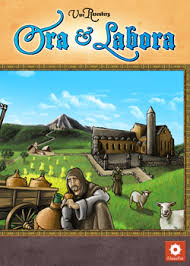
     

    4. Tackle more of the BoardGameGeek top 20. Despite the changing tastes of gamers and the weekly entries of new games, the top 20 games on BoardGameGeek remain surprisingly constant from year to year. I've played Agricola, Power Grid, Dominion (and its expansion Intrigue), 7 Wonders, and Race for the Galaxy, and I was able to add Puerto Rico this year. Some of the games on there are expensive (Eclipse at $99 MSRP) or don't look like my cup of tea (Twilight Struggle, a two-player war game). But they're all at the top of their game (so to speak) for a reason. At the top of my list among these games include Le Havre, Caylus, and Ora et Labora.

    5. Be less scared of very long games. Agricola isn't my favorite board game out there, but that has as much to to with its length as its unforgiving mechanics. Power Grid is without a doubt one of my five favorite board games. I end up enjoying every minute of it every time I play, but all too often I veto it because it takes too long. And I adore the immersive aesthetic and beautiful artwork in La Citta, but all too often I let it get vetoed because it takes too long. It's time to dust off these evening-killers and accept that we're only going to get one game in.

    6. Get around to playing video games I purchased in 2012 (or longer ago). I'm not as huge a video gamer as I was in middle or high school, but I own a Playstation 3 and a PC well-suited to playing video games, plus plenty of games to play on both. I started but didn't finish Skyrim's Dawnguard expansion (and haven't scratched Dragonborn yet). I loved Mass Effect 1 and 2 but haven't even installed 3 yet despite having pre-ordered it back in the spring. And that used copy of Bioshock I picked up along with my PS3 has been sitting patiently on the shelf for more than two years now.

    7. Delve deeper into low-leverage indie gaming. Heartfelt storytelling, innovative gameplay, fantastic aesthetics, and a focus on experience rather than difficulty are a set of ideals very much in vogue in independent game design these days--and a set of ideals that very much appeals to me. I've been unfortunately out of the loop playing this sort of game for the past several years, and I want to get back into it. In particular, I'm interested in getting hooked on a point-and-click adventure game, King's Quest or Monkey Island style.

    8. Play at least one game of 1000 Blank White Cards. Essentially do-it-yourself Fluxx, 1kBWC is the ultimate in creative party gaming. Artists have a chance to create pretty pictures, comedians and raconteurs can entertain and engage, and us gaming geeks can play around with clever mechanics and rules interactions. I've loved the game since high school and have played it scant few times since college.


    9. Play-test D&D Next. Here's a chance to do something exactly in my wheelhouse: delve into the underlying design decisions behind the next iteration of the greatest and most popular tabletop RPG out there. I've followed the open beta since its beginning back in May but, despite my best efforts to organize a group, haven't been able to actually sit down and play it. 2013 might give me a better chance, as the next season of Encounters includes the D&D Next beta among its optional rules.
    10. Play a D&D Lair Assault. The name "Lair Assault" has always put me off: it implies that it's going to be a session of combat and nothing else, within a version of D&D that's soundly criticized (sometimes fairly) as focusing too much on combat. However, all of my D&D-playing friends who have done Lair Assaults have reported having a great time, and with 4th Edition starting to make its exit, now is as good time as any to give one a shot.

    11. Attend more puzzlehunts. September and October gave me the chance to play through two, one hosted by my friends in real life, another hosted by Ken Jennings and the Smithsonian online. I had an incredibly fun time with both, and I'm excited to try playing a live-action hunt on a larger scale, like MIT's or Berkeley's.


    12. Blog more about game strategy. One idea I had starting this blog was to relate specific situations and anecdotes from games and pose them to the blog's readers, asking for a wider audience to consider the optimum strategy. (Exactly how much is power plant 13 worth in Power Grid?) Ludi Berkeley has been all too light on that sort of post so far.


    13. Redesign the blog. The neutral gray was a placeholder layout I picked back in June when I started the blog, and unfortunately I haven't had time to make it more interesting-looking. Expect an aesthetic explosion in the New Year!

    Let me know what your gaming resolutions for 2013 are, and I wish you good luck in fulfilling all of them! I appreciate everyone who's followed along with the blog so far, and I encourage you to follow the blog and spread the word about it if you've enjoyed reading.

    Thursday, October 25, 2012

    D&D Encounters: Council of Spiders

    I was incorrect when I called the last season of D&D Encounters "the Drow Season". That moniker should have been reserved for this season, the drow-iest thing that Wizards possibly could have conceived. As a sort of sequel to Web of the Spider Queen, Council of Spiders had us take a look at the same events and conflict from the other side. It was actually a nice storytelling move, tying two seasons of Encounters together with the same plot thread, and it gave both seasons a narrative consistency unprecedented in Encounters so far.

    It also called for the characters all to play as drow.

    My Character

    Okay, playing as a drow wasn't per se required. We could have also played as one of the drow "servitor" races--svirfneblin, goblin, duergar, and the like. But I wasn't about to mess around with any of that. If we were playing a drow campaign, it was time to go big or go home and play my first drow character ever. Striker was the next role in my character rotation, and obviously the drow aren't well-suited to be the sort of striker that swings around a massive two-handed greatsword. Plus, it was whispered that this season was going to be a bit more roleplaying-heavy than the recent seasons. I decided to go with a rogue, a stealthy character just as comfortable her stabbing enemies in the back as sneaking around and stealing treasure or secrets.

    Ilivara Melarn, I decided, would be the daughter of Garam Melarn, a great captain who slew many elves in the wars a hundred years ago. A female of the noble House Melarn, she was originally intended for the priesthood, but (as the proud owner of 8 Wisdom) she was pretty terrible at it, decided to enroll in Melee-Magthere, and followed in her father's martial footsteps. She had a bit of an authority problem, thinking that being a female of noble blood, she should be in control of every situation, and she pointedly acted in the interests of her House, even if it meant going against the rest of the party.

    And, I have to admit, I really enjoyed playing her. She did insane amounts of damage, befitting her role as a 4E striker. She didn't get to steal as many things as I might have liked, but it was a lot of fun to act out her sass and rebellious streak. And it was hilarious to be able to play up every drow stereotype that exists, a chance I haven't gotten often but really dug into with some delightful irony. Even if we're enjoying the game ironically, we're still enjoying it!

    The Season

    It was a short season, only eight sessions instead of the usual eleven to thirteen, but it didn't feel like much was missing. By now, every Encounters player has gone through the levels-1-through-3 motions enough times that it seems routine if not necessarily stale. Rather than padding an eight-session story with extraneous encounters to bring it up to "normal" length, this season told a faster-paced (if slightly shorter) story, and it worked out well.

    Definitely the most original and fun part of Council of Spiders was the "secret orders" mechanic. New to Encounters, these orders came up as part of which of three factions each character decided to align himself (or herself!) with. The secret orders led to a lot of chicanery among the party, and our DM was kind enough to provide us with "skullduggery" index cards where we could write actions unseen by the rest of the table and accomplish our goals unbeknownst to anyone else.

    The combat encounters were pretty unremarkable, but it's worth pointing out that unlike many seasons, Council of Spiders had a pure-roleplaying session, when our characters were trying to convince the eponymous Council of the right course of action toward the end of the season. It was a refreshing change from the pure-combat nature of most Encounters seasons, but at the same time, it felt unorganized, an obvious departure from the style of the system. Those obvious departures are only going to become more frequent next season, as Encounters clearly gears up for a full-blown transition to D&D Next.

    Final Thoughs (and Outlook)

    It wouldn't be too dramatic to say that the drow arc of Encounters (spanning last season, this one, and next season) is the beginning of the end of 4th Edition. We're seeing the freest experimentation with the format in Encounters' history coupled with a storyline that purports to create actual permanent change in D&D's most iconic campaign setting. These three seasons have been devoid of any new "crunch" content for new character classes, races, or anything else. All of that put together suggests that the times are changing in Encounters. It's exciting to be part of it.

    Given that the days of 4E Encounters might be numbered, I'm taking the opportunity to make a change of my own: I'll be DMing the next season! I've DM'ed exactly one session of 4th Edition, and that was about four years ago. Next season, War of Everlasting Darkness (yep, it's actually called that), promises to feature the "exploration" and "interaction" pillars of D&D in equal measure with "combat," which sounds like exactly my thing.

    Friday, August 24, 2012

    D&D Encounters: Web of the Spider Queen (and a short essay on the drow)

    I'll admit it: I've never seen the appeal of the drow.

    I've never found them particularly compelling or alluring. It's never made sense to me why so many D&D players are so fascinated by them. It's at least partially the fault of R.A. Salvatore, whose mediocre but prolific fiction thrust the drow into a spotlight in the late 1980s that they haven't relinquished since then.

    And they've certainly made their mark on the game. Every group has their Drow Guy, who insists on playing a dark elf for every character, who has drow lore memorized, and who's approaching fluency in Undercommon. They've become an iconic villain of the game, nearly as notorious as the titular Dragons themselves. But the drow have become so ubiquitous, so overused--so mainstream, the hipster gamer in me wants to say--that they're not even interesting anymore.

    We have a stridently matriarchal, capriciously evil, underground-dwelling, spider-worshiping society of dark elves with magical powers over light and darkness... and somehow, that's become cliche. Yet, a sizable and vocal population of D&D players continue to adore all things drow. So it was only a matter of time before we got the Drow Season of Encounters.

    My Character

    As a player, I have a mild dislike of the drow. What if, I decided, I made a character who well and truly despised the drow? Thus was born Molgar, Seer of the Deep, a svirfneblin druid whose tribe of peace-loving, fungus-eating deep gnomes was utterly destroyed by a band of drow raiders. The only survivors of the raid were Molgar and his trusty she-wolf Josephine, who escaped to the surface and vowed revenge against the drow.

    Molgar ended up being one of those characters whose conception was much more interesting than his implementation. It was my "turn" to play in the leader role, so I went with the druid, a class I liked in 3rd Edition and hadn't gotten around to playing in 4th yet. Unfortunately, I didn't realize two things when I picked the druid class. First, the sentinel druid (the "leader build" of druid) really wants to be a striker, but because it's nominally a leader, it has a few heals and a few simple buffs. The result is a class that lacks a fully developed role in combat: not as good a healing leader as the cleric, not as good a tactical leader as the warlord, and not as good a damage-dealer as any striker.

    Second, the sentinel druid is an Essentials build. I've realized over the last three or four seasons of Encounters that I do not like Essentials builds. They value simplicity over personalization and customization, and they don't let you do enough different interesting things in combat.

    A third thing I realized as I played Molgar is that I'm not a fan of how the animal companion mechanics work. Josephang (as she was quickly and cleverly nicknamed by the rest of the party) was porcelain-fragile, and as soon as she went down in any given battle, my ability to both lead and strike suffered tremendously.

    So, while Molgar had his moments, he was probably the last Essentials character I'll play. And out of all the leader-role classes I've played or seen played, none of them really match the cleric or warlord in terms of healing or tactical prowess.

    The Season

    Hopefully my anti-drow bias didn't subconsciously influence my opinion, but this wasn't one of the better Encounters seasons I've played. Drow showed up in literally every encounter but one. When the same enemies are part of every encounter, the same mechanics are part of every encounter, and they get stale. (If I never have to hear the phrase "he drops a cloud of darkness" again, that would be completely fine by me.)

    Worse, nearly the entire season took place in the same subterranean tunnels, making this the least "interactive" season of Encounters I think I've played. As a player who values the "interaction" pillar of D&D nearly as much as the "exploration" pillar (and perhaps even more than the "combat" pillar), that came as a disappointment. Essentially, the season played out as
    • an extended dungeon crawl
    • in an organized-play system that already under-emphasizes roleplaying
    • within a version of D&D not exactly known for its attention to the out-of-combat game.
    Dungeon crawls can be cool, if there's lots of interesting stuff to do in the dungeon--places to explore, decisions to make, creatures to encounter. Or they can be tedious when all the rooms look the same, and the same monster lurks behind every door.

    Final Thoughts (and Outlook)

    While neither the theme nor execution of this past season was terribly exciting, the season demonstrated an important silver lining about D&D (and any RPG, tabletop or computer): the party makes all the difference in the world. We have a surprisingly solid and coherent group of Encounters "regulars" at Eudemonia, and because it's Encounters, you never know who is going to show up. Maybe it's a couple of awesome eighth-graders. Maybe it's your girlfriend. But it makes for a fun, low-leverage game, and if your poor wolf dies in two hits this week, she'll be tearing into dudes again next week.

    Next season: Drow Season Part II. I will be playing an actual drow character for the first time in my D&D history.

    Monday, June 25, 2012

    D&D Next: Thoughts on the first beta

    This is the second in a series of posts about D&D Next, the forthcoming new set of rules for Dungeons and Dragons. In the first post, I discussed why I expect D&D Next to look a lot like Third Edition. Today's covers my take on the first set of beta rules.

    The first D&D Next beta has been live for about a month, and while I haven't gotten a chance to fully playtest it yet, I have read through the rules a few times. Most of it clearly isn't in a finalized, playable form yet, but a few elements of the rules jumped out as particularly encouraging, worrisome, or simply intriguing.


    Best rule change: Ability scores, skills, and saves

    The six ability scores (Strength, Constitution, Dexterity, Intelligence, Wisdom, and Charisma) are a cornerstone of D&D, and it's tough to imagine any version of the game without them. In 3E and 4E, basically every number on a character sheet was derived, in part, from an ability score, but the emphasis was on the derived stats rather than the root scores. So there was often a sense of "shoehorning" a desired action into a skill: "I want to take a running jump across the chasm and grab onto the rope... is that Acrobatics or Athletics?" "I know you said you wanted to use Diplomacy on the nobles, but that came across as more of an Intimidate."

    In D&D Next, or at least in this iteration of it, that shoehorning appears to be gone. There's no such thing as a "skill check" anymore, just an ability check; a skill is now a special attribute that might give small situational bonuses to ability checks or allow the use of certain skills for unusual applications. It becomes up to the players and DM to decide what abilities are "appropriate" to roll in a given check.

    Saves are a curious part of D&D in that they've been a part of virtually every edition but did something completely different in each. Most recently, they were yet another derived stat representing reactive defenses in 3E and a much more narrow mechanism for ending ongoing effects in 4E. D&D Next (unsurprisingly) more closely mirrors the 3E approach, but instead of deriving a save from some of the ability score, saves exist in base form for every ability score. This instantly re-balances the ability scores--Dex and Con were far and away the two most "powerful" scores in 3E, not the least because they supported Reflex and Fortitude saves.

    Both of these new rules have an interesting and subtle implication: unless ability scores grow substantially with level (which seems unlikely), skills and saves won't change substantially over a character's career either. That implies simpler math and a reduced sense of compartmentalizing the game based on level, two changes that have the game headed squarely in the right direction.


    Best rule change, honorable mention: Hit dice

    At first, I assumed the return of hit dice meant the return of rolling HP at every level, which would have been maddening. Hit dice used in that way suck. It's possibly the worst mechanic of any roleplaying game ever, randomness for the sake of randomness, and a surefire way to unbalance two otherwise identical characters. (Remember all the house rules for determining HP in 3E? There was a reason for them.)

    My fears were completely allayed, though, upon seeing that new hit dice would be used to represent innate ability to heal. They're more organic than the bizarre "healing surge" mechanic in 4E but still accomplish the goal of reducing the party's need for a dedicated healer.


    Worst rule change, facetious version: Electrum pieces

    Electrum pieces (EP) were last part of D&D in Second Edition, meaning they haven't been part of the game at any point this century. They're an archaic monetary unit, apparently worth 5 silver or 1/2 gold, which is cute because electrum is an alloy of silver and gold. The real question: how does adding them back into the game make it more fun? Did someone at Wizards think it was much more satisfying to have 14 electrum than 10 silver and 2 gold?


    Worst rule change, actual version: "Vancian" spellcasting

    Spellcasting in old versions of D&D was divided into a number of mostly arbitrary "levels" (which, naturally, did not map to character level). It was confusing and inconsistent: the same spell might be 7th level for a druid (meaning he could cast it at 13th level) but 9th level for a wizard and sorcerer (who could then cast it at 17th and 18th level). A direct quote from the 4E design/development process was "that doesn't make any sense; why can't you cast 9th level spells at 9th level?" And among players, the opinions of so-called "Vancian" spellcasting (named in honor of author Jack Vance, whose fantasy works inspired the system) ranged from ambivalent to despised.

    So who was in such a hurry to resurrect it? About the best anyone ever said about Vancian spellcasting was that it was D&D tradition and that you got used to it... but nobody really seemed enthusiastic about it. There's a bit of silver lining here: there now appear to be seven spell levels, not nine, which might cut down the complexity a bit; and most spellcasters can now do things at will, eliminating the "well, guess I'm useless for the rest of the day" problem that 3E wizards often ran into. But it's still unclear why we needed it back in the same in the first place.


    Most intriguing new rule: Advantage and disadvantage

    While looking at D&D Next through a 3E lens has proven insightful so far, here's a rule that came out of left field as much as it did from 4E. Briefly, if you have advantage on a check, you roll two dice and take the better one; if you have disadvantage, you roll two dice and take the worse. It's easy to trace its name--4E created the catch-all category of "combat advantage" to represent generic bonuses in combat--and even its provenance; a number of powers allow you to roll two dice and take the better result. But nowhere in D&D (at least in recent D&D) has a rule ever forced you to take the lower of two rolls.

    When a roll is very likely to succeed anyway (say you only fail on a 1, or you're 95% to succeed), advantage makes failure vanishing unlikely (99.75% to succeed). When a roll is very likely to fail (needing a 20, or 5%), advantage only makes success a bit more likely (9.75%). It's in the middle where the big swings happen: advantage turns a coin flip into a 75% chance of success while disadvantage turns it into 25%. But it's easy to calculate probability and speculate; it'll be fascinating to see how the mechanic plays out in practice.

    Two more things on (dis)advantage: it seems more loose than most mechanics in older editions, allowing the DM to rule broadly if advantage or disadvantage seems appropriate. And, like one of the developers pointed out, these conditions are easy to "retroactively" apply: if you forgot you had advantage on a given roll and failed it, just roll again!


    Where did that rule go?: Flanking and positioning

    Another mainstay of D&D has long been physical positioning on the battlefield, allowing maneuvers like flanking to gain combat advantage or performing attacks of opportunity if an enemy ran past you. One of the many emphases of Next is to eliminate the presumption that every battle will take place on a mat or with a physical illustration. It's a neat idea to again simplify battle, but it does eliminate a part of the game that plenty of games really enjoy. This first beta came with a caveat that certain rules and concepts were intentionally left out to see how their absence changed the complexion of the game. Of course, it remains to be seen how this game will play in practice, but getting rid of flanking, attacks of opportunity, and related tactical maneuvers does seem like it would change the complexion a lot.


    Check back throughout the playtest for my reaction to each beta iteration, hopefully including some playtests of our own eventually. And ff anyone has gotten a chance to do a more legitimate playtest of this version, we'd love to hear about your game! Does my assessment fit with what you experienced?

    Wednesday, June 20, 2012

    D&D Next: Divining Wizards' Angle

    The big news in the tabletop roleplaying world lately has been the announcement and open beta of D&D Next, the "next version" or "next iteration" of D&D.  Deliberately not called "5th Edition," D&D Next is supposed to be the "edition-less edition" or the "edition that unites the editions".  One of the big themes in its development is trying to make fans of all versions of the game feel comfortable with and excited about it.  To accomplish that goal, Wizards unleashed a massive open playtest.  It's an especially savvy move on their part: it does give the fans some say in how the next version of their game develops, and it gives Wizards a boatload of free market research data.

    Of course, it's completely transparent that Wizards really wants "unite the editions" to mean "get players who used to play older editions back playing our game".  Figuring out exactly which players they're targeting provides a fascinating lens to view the development of D&D Next through.

    Surely, there are groups of players who are stuck somewhere in the 20th century, who still play various expressions of 1st and 2nd Edition. It's safe to say that these aren't the gamers Wizards is looking for. It's nearly impossible to say how many of these gamers exist, but it's conventional wisdom that there aren't many of them--and from personal experience, you need to hang around a local gaming scene for an especially long time before anyone seriously brings up playing 1st or 2nd Edition. And even more to the point, if they haven't taken the plunge and switched to either 3rd or 4th Edition by this point, it's unlikely they'll be lining up to switch to a new game.

    At the opposite end of the spectrum are the 4th Edition players, who it's probably assumed will naturally switch over to Next without much hesitation. It's a good assumption for a couple of reasons. First, 4th Edition players already play the version of D&D that's arguably the most different of any of the versions out there, so they're relatively likely to accept changes to their game in the interest of a more fun, consistent gaming experience. Second, while 4th Edition is played and enjoyed by many thousands of people, its fans have never been the sort of fervently defend it and therefore seem like they'd be more accepting of switching to a new system.

    That leaves one category of players, ones who do fervently defend their system and have proven to be less accepting of switching to a new one: 3rd-Edition people. Some are still playing "vanilla" 3E; probably more are playing Pathfinder, a licensed derivative. Pathfinder fans are disproportionately likely to be apologists, readily reminding you that Pathfinder has now surpassed 4E in terms of sales and has a more vibrant organized play scene. It's a big group of gamers, one that until three or four years ago played on the cutting edge of D&D but were turned off by some of 4th Edition's bigger revisions.

    I won't go as far as saying that D&D Next is a ploy to get Pathfinder advocates and 3E adherents back into the fold. But those are the most natural segments of gamers for Wizards to try to appeal to with the new set of rules. And it explains why a lot of the mechanics in D&D Next might have a very 3rd-Edition feel. Some of that distinctly 3E feel is already present in the playtest rules; check back for a first-glance reaction to the first beta.

    Friday, June 8, 2012

    Games I Like (Matt)

    As I mentioned in the introduction, my taste in gaming these days mostly comes in three flavors: board games, roleplaying games, and video games.

    Board gaming is the sort I find myself doing most often.  I tend to play a lot of so-called "Euro" style games--we'll call Pandemic, Dominion, La Citta, and 7 Wonders a representative (but certainly not exhaustive!) list.  I prefer games that reward adapting a strategy to changing game states rather than ones that insist you develop a strategy at the beginning and ride it as far as it will take you, so I'll probably always prefer Race for the Galaxy over Agricola.  (I also tend to prefer games that play in 1 hour rather than 3.)  Outside of Euro-land, I'm a fan of trivia and word games of all sorts.  Wits and Wagers, Scrabble, and Scattergories are a few favorites, and I will beat you at Taboo.

    I've been playing roleplaying games since about 2000, when I started Dungeons and Dragons right when its 3rd Edition was released.  Since then, I've played about a dozen incarnations of and variations on D&D as well as a few other RPGs.  Right now, I'm a regular at a local game shop's D&D Encounters (4th Edition) game, and I play in a couple of Burning Wheel games as well.  I'm also interested in the next version of D&D, and I'll be blogging some of the beta test process over the next few months.

    Finally, I don't play nearly as many video games as I did ten or fifteen years ago, but I'm still a somewhat frequent video gamer.  The video games I do play tend to be huge console or computer RPGs (think the Elder Scrolls and Mass Effect games), or quick, multiplayer-friendly games along the lines of Mario Kart.  I'm not a huge shooter fan, which might explain my recent ambivalence toward the video gaming scene, but I still follow the gaming news at least a little.

    One big gap in my gaming preferences is card games.  I've played Magic: the Gathering a total of four times in my life (and generally enjoyed it, but never really got into it), and I know exactly zero about poker.  That sort of thing will be the province of my co-authors, but look for a healthy amount of board game and roleplaying game coverage from me.