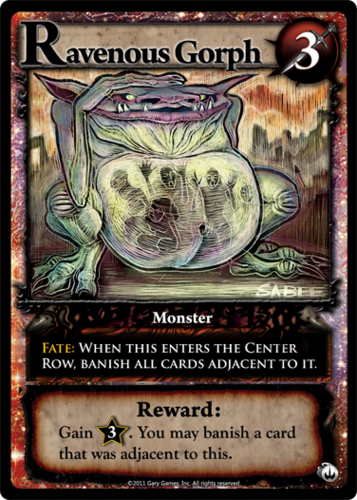
I've posted about Ascension before; it remains one of our game night standbys, and with a new expansion debuting in the last month, it was inevitable that we'd pick it up. Rise of Vigil, like Storm of Souls before it, adds a new mechanic to the game. But this one is far more disruptive than Storm of Souls' Events, and it's not clear how much better it makes the game.
Style and Gameplay
Briefly, Ascension is a deck-building card game that might invoke comparisons to Dominion or Magic: the Gathering, depending on if you come from a Euro game or a competitive trading card game background. Cards in the deck are used to either get points (called Honor) or to get new cards, which are more efficient at getting points. The premise is simple, but the variation among the different cards is sufficiently big that it would be tough to cover here.
Rise of Vigil may or may not count as a proper "expansion"--it can either add to the base game or stand alone and be played by itself. Its new mechanics are Treasure and Energize, which work in the following way: when a Treasure card would be added to the center row, keep flipping cards until a non-Treasure appears, then put all the accumulated Treasure under it. When the non-Treasure is acquired or defeated, all the accumulated Treasure comes with it.
Treasure becomes part of a deck, but each Treasure card (in Rise of Vigil, there is only one card of type Treasure, the Energy Shard) replaces itself when drawn, so decks appear much larger than they really are. Energy Shards grant 1 Energy--that's a new resource type, in addition to Runes and Power, and a handful of Heroes and Constructs also grant Energy. If a certain Energy threshold is passed, some cards' Energize feature trigger. Energize triggers can be anything from reducing card acquisition costs to manipulating the size of the Honor pool.
Rise of Vigil therefore becomes heavily focused on the Energize mechanic, so much so that individual strategies (Lifebound Heroes, Mechana Constructs, etc.) are almost obsoleted. Having so many Energy Shards in your deck, while not decreasing deck velocity, does increase shuffling frequency to a surprisingly frustrating degree. Even so, a game of Rise of Vigil tends to be about as long as one of base Ascension: the "30 minutes" on the box is a clear lie, but 45-60 seems more reasonable.
Analysis and Anecdotes
We're not sure if we like Treasure and Energize yet, but we're leaning toward "no". Its biggest effect is to ramp up the game's variance. Absent any Treasure, a certain Hero in the center row may a moderately attractive proposition, but with a nice stack of five or six Shards under it, it can become game-breakingly good. The same goes for Energize triggers: sometimes you have twenty Shards in your deck and need three of them to make your deck function like it's supposed to, and you draw two.
Similarly, the high-end mechanics, many of which also depend on Treasure, seem way too good compared to those in previous sets. One acquires or defeats the entire center row; another destroys all opponents' Constructs. These "marquee" effects are few and far between, such that the average effect of a card is comparable to ones we're used to, but the deviation is broader. For a game that was already a little swingy in a design community where high-variance is a four-letter word, it's not a mechanical change that's appreciated.
In one game we played, I killed Herald of Doom after a particularly lucky Treasure draw (I had maybe 9 or 10 Energy in my deck and happened to draw 7 of them). I got all the cards in the center row. Then, as a replacement for one of the cards, our buddy Oziah here flipped, which I also acquired for free, since I was still at 7 Energy. There wasn't much question that I would end up winning that game, but it wasn't a particularly satisfying or exciting victory in that I didn't feel rewarded for either pursuing a dedicated strategy or adapting well to the changing game state.
Another time, someone (not me) picked up Lifebound Muse with seven Energy Shards under it on turn 1. Guess who won?
Rise of Vigil is supposed to integrate with the other Ascension "blocks," but it's unclear how well that would work. On one hand, it might make "get Energy" its own strategy, on parallel with "kill Monsters" or "make a lot of Constructs". On the other hand--and this is the scenario that seems far more likely--it might dilute the Energy Shards and the cards that require them so much to make them useless.
Overall Impressions
I like where Ascension is going with Rise of Vigil, but I fear the inspiration was much better than the execution. It's a way to change up the Ascension experience, which is always nice. but so far it seems like a change-up that simply introduces more randomness. A bit of tweaking might get Rise of Vigil to a more playable state, but for now, it's probably going to end up taking a back seat to Storm of Souls and the base game.
Rating
Aesthetics: 1.5. Ascension's absurdly high-fantasy theme won't be everyone's cup of tea, but it's clear throughout, and the game finally appears to have found its artistic tone.
Adaptability: 1.5. There's enough variety in the cards that you don't feel like you're playing the same game twice. Scales well mechanically from 2-6 players, but 5-6 takes a miserably long time.
Fun per time: 1.5. Usually fast enough that another game doesn't sound like a dreadful proposition. Downtime while waiting for other turns can get boring.
Strategic depth: 1. In principle, there's some strategy to be mined here, but more than any Ascension in the past, Rise of Vigil relies heavily on lucky draws.
Mechanics: 0.5. The new mechanics here have promise but are fraught with balance issues and may not play very nicely with the rest of the game.
Total: 6 / 10. According to BoardGameGeek's recommended rating, this means "Fair. Some fun or challenge at least, will play occasionally if in the right mood." That sounds about right--I'd nearly always prefer other incarnations of Ascension, but I can't rule out playing Rise of Vigil occasionally. Base Ascension gets a 7 / 10 for me.
(I'm experimenting with a new game rating system. If I like it, I'll post in the future about how it works and what some benchmarks are.)
1-4 players (1-6 with other sets), 45-60 minutes, $40 at a game shop or $30 on Amazon.
Showing posts with label Ascension. Show all posts
Saturday, May 4, 2013
Friday, February 8, 2013
Game Night Recap: Ascension
With a handful of former Magic players among our ranks, and my general enthusiasm for what I've dubbed "reactive-strategy card games," it's no surprise that Ascension is at the very top of my gaming group's rotation and a game we keep coming back to. I won't give a full review or analysis of the game here, but briefly, Ascension is a deck-building game that sits right at the intersection of Magic: the Gathering and Dominion in card game design space. Toss in a little San Juan/Race for the Galaxy, and you have a reliably fun card game that features plenty of ways to win and never feels like you're playing the same game.
We played a ton of Ascension last weekend; I won some and lost some, but I was left with some interesting rules and strategy questions that I'll pose here.
Why is Nemesis not unbanishable?
The "big bad" monsters from both the base set, Avatar of the Fallen, and the Return of the Fallen expansion, Sammael, were unbanishable, both thematically enhancing their status as the set's "boss" monster and mechanically giving Power/monster-killing strategies a more compelling goal to aim for. Nemesis, who fills the same role in the Storm of Souls expansion, is not unbanishable. Is that a deliberate result of the balancing and playtesting process, or is it simply an oversight? Not everything is lost; a player pursing the Power strategy can mitigate Nemesis's banishing with Sadranis, Dark Emissary (if the two decks are shuffled together; see below). But it does seem a deterrent when the ultimate thing your strategy can do can be derailed by a host of relatively inexpensive cards.
What's the proper interpretation of Emri, Soulslayer's effect?
Plenty of cards allow you to banish from your hand or discard pile, like Arbiter of Fate. There, the text is unambiguous: you can banish exactly one card, and it can come from either your hand or discard pile. If Arbiter of Fate had intended you to banish from both your hand and discard pile, it might have said "You may banish a card from your hand and/or your discard pile." That's unambiguous too.
Emri, Soulslayer, is a lot harder to read. "You may banish up to two cards from your hand and/or discard pile." can legitimately mean two different things. It could be "You may banish up to two cards from your hand and up to two cards from your discard pile," a total of four cards. Or, it could be "You may banish up to two cards, which may come from your hand and/or your discard pile," a total of two cards. We used the first interpretation, and it felt way too good, though at 8-cost, there's not a lot of direct comparisons for how good the card "should be".
How well do the two "blocks" interact?
In principle, the base block and the Storm of Souls block should be able to be shuffled together and played as a single game. The rules don't explicitly condone this mixture, but we tried it for the first time last weekend, and it seems to work well for the most part.
I'm a little skeptical of the Mechana Construct versus Construct-destroying monster balance. In the base block, Mechana Constructs worked better when you already had a lot in play; in Storm of Souls, they worked better when you put them in play. Stacking both bonuses seemed a little overpowered, especially combined with a relative dearth of Construct-destroying monsters. One player had both Weapon 303V and Hedron Cannon (plus a handful of other Mechana Constrcuts) in play, and with four Sea Tyrants lonely among a deck of 220+ cards, he became an unstoppable monster-killing machine.
Events were also diluted; the five Event cards came up much less frequently, making cards that interact with events such as Elemental Adept incrementally worse. But that didn't present that much of a problem; cards like this tended to just stick around the center row until they were banished (or Gorphed).
One interaction that never came up but I'm nevertheless curious about is what happens when a player controls Sammael and defeats a Trophy Monster. Since Sammael's effect is clearly a "may," I would interpret that the player can choose whether to claim the trophy or to add the defeated monster to his deck. Such a choice would introduce some interesting decision-making: Unchained Fates is the most powerful trophy effect in the game, but what's better: drawing two cards at a time of your choosing, or having 7 Power every time you draw this card?
What's the optimum number of players for Ascension?
I'm pretty sure the answer is not five or six, and that has nothing to do with the mechanics. Ascension scales surprisingly well from two through six players. Instead, the five- or six-player game simply becomes very long--and each player spends most of that length doing nothing but watching everyone else take their turn. Furthermore, because the board state changes so rapidly in Ascension, it's nearly impossible to plan a turn during that down time.
Ascension works much better with four players. The game is length is pared down and its downtime reduced, but there's still enough space at the table for two players to pursue similar strategies, especially if they're seated across from each other. Three seems to work less well; a three-player game doesn't feel much faster than a four-player game, but the option to pursue similar strategies is effectively removed.
Two-player Ascension is great but in a fundamentally different way. Assuming the two players are both reasonably skilled and not especially lucky or unlucky, the two-player game is as much about the competing players as about the competing strategies. (How does pure Mechana match up against Lifebound/Enlightened? Here's how to find out!) And I haven't played the single-player variant, but I assume it's sufficiently different from the multiplayer game that it's tough to compare.
For all all the Ascension fans out there: have you encountered any of these issues in your game? Have you combined the base set with Storm of Souls, and how did it work? Do your five- and six-player games drag as much as mine?
We played a ton of Ascension last weekend; I won some and lost some, but I was left with some interesting rules and strategy questions that I'll pose here.
Why is Nemesis not unbanishable?
The "big bad" monsters from both the base set, Avatar of the Fallen, and the Return of the Fallen expansion, Sammael, were unbanishable, both thematically enhancing their status as the set's "boss" monster and mechanically giving Power/monster-killing strategies a more compelling goal to aim for. Nemesis, who fills the same role in the Storm of Souls expansion, is not unbanishable. Is that a deliberate result of the balancing and playtesting process, or is it simply an oversight? Not everything is lost; a player pursing the Power strategy can mitigate Nemesis's banishing with Sadranis, Dark Emissary (if the two decks are shuffled together; see below). But it does seem a deterrent when the ultimate thing your strategy can do can be derailed by a host of relatively inexpensive cards.
What's the proper interpretation of Emri, Soulslayer's effect?
Plenty of cards allow you to banish from your hand or discard pile, like Arbiter of Fate. There, the text is unambiguous: you can banish exactly one card, and it can come from either your hand or discard pile. If Arbiter of Fate had intended you to banish from both your hand and discard pile, it might have said "You may banish a card from your hand and/or your discard pile." That's unambiguous too.
Emri, Soulslayer, is a lot harder to read. "You may banish up to two cards from your hand and/or discard pile." can legitimately mean two different things. It could be "You may banish up to two cards from your hand and up to two cards from your discard pile," a total of four cards. Or, it could be "You may banish up to two cards, which may come from your hand and/or your discard pile," a total of two cards. We used the first interpretation, and it felt way too good, though at 8-cost, there's not a lot of direct comparisons for how good the card "should be".
How well do the two "blocks" interact?
In principle, the base block and the Storm of Souls block should be able to be shuffled together and played as a single game. The rules don't explicitly condone this mixture, but we tried it for the first time last weekend, and it seems to work well for the most part.
Events were also diluted; the five Event cards came up much less frequently, making cards that interact with events such as Elemental Adept incrementally worse. But that didn't present that much of a problem; cards like this tended to just stick around the center row until they were banished (or Gorphed).
One interaction that never came up but I'm nevertheless curious about is what happens when a player controls Sammael and defeats a Trophy Monster. Since Sammael's effect is clearly a "may," I would interpret that the player can choose whether to claim the trophy or to add the defeated monster to his deck. Such a choice would introduce some interesting decision-making: Unchained Fates is the most powerful trophy effect in the game, but what's better: drawing two cards at a time of your choosing, or having 7 Power every time you draw this card?
What's the optimum number of players for Ascension?
I'm pretty sure the answer is not five or six, and that has nothing to do with the mechanics. Ascension scales surprisingly well from two through six players. Instead, the five- or six-player game simply becomes very long--and each player spends most of that length doing nothing but watching everyone else take their turn. Furthermore, because the board state changes so rapidly in Ascension, it's nearly impossible to plan a turn during that down time.
Ascension works much better with four players. The game is length is pared down and its downtime reduced, but there's still enough space at the table for two players to pursue similar strategies, especially if they're seated across from each other. Three seems to work less well; a three-player game doesn't feel much faster than a four-player game, but the option to pursue similar strategies is effectively removed.
Two-player Ascension is great but in a fundamentally different way. Assuming the two players are both reasonably skilled and not especially lucky or unlucky, the two-player game is as much about the competing players as about the competing strategies. (How does pure Mechana match up against Lifebound/Enlightened? Here's how to find out!) And I haven't played the single-player variant, but I assume it's sufficiently different from the multiplayer game that it's tough to compare.
For all all the Ascension fans out there: have you encountered any of these issues in your game? Have you combined the base set with Storm of Souls, and how did it work? Do your five- and six-player games drag as much as mine?
Subscribe to:
Posts (Atom)