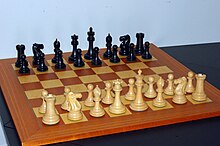
My third and (for now) final follow-up to the game ratings scheme I published a few weeks ago deals with the aesthetics of abstract games. Alex touched on the topic when he discussed approachability, citing the relative simplicity of the rules of chess as part of its beauty. My friend and fellow gamer Josh agrees and puts it more strongly: "abstract aesthetics [like those in] chess should not necessarily be a detractor; I think chess can, in its own way, be very beautiful."
I defined "aesthetics" as a (mostly arbitrary) combination of a game's sensory elements--typically visual and tactile--and its theme. It's tempting to sub-divide the aesthetics score into "sensory" and "thematic" sub-scores, awarding perhaps up to one point for each, to better describe the contribution of each to the game's overall aesthetics.
But I deliberately avoided that level of granularity. It's useful to take a more holistic approach to evaluating aesthetic quality because there's also an implication of integration between the two: the visual
design should reflect the theme (the mechanics should too, but that's a
more complicated consideration). And sensory and thematic design are in that statistical murky ground of being neither perfectly correlated nor truly independent.
Based on the way I've defined aesthetics, a game needs both an attractive sensory design and a compelling theme to earn a high aesthetics score. It would be tough to argue that chess has a compelling theme because it doesn't have one at all--it's entirely abstract. But that doesn't necessarily mean that it has no sensory appeal. As both Alex and Josh both point out, plenty of people find chess not only visually pleasing but among the most beautiful board games that exist, precisely because of its iconic abstractness.
Since this blog is focused on important considerations for game design, what are the takeaways from trying to evaluate the aesthetics of abstract games? First, it's a much tougher task than it appears at first, and in many respects, appropriately evaluating aesthetics becomes tougher as a game becomes more abstract. In a strongly themed game, it's relatively easy to determine how well the visuals fit the theme. In abstracts, particularly the "classic" abstracts, that determination becomes a trickier--and more subjective--proposition.
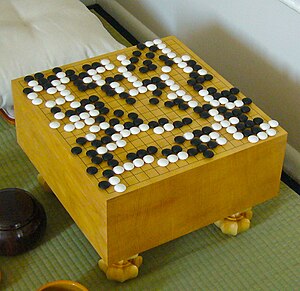
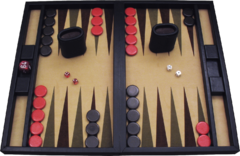
A related point: only a few games flourish as complete abstracts. Chess and go and backgammon have been immensely popular for centuries, but that continued popularity shouldn't give contemporary game designers incentive to avoid the responsibility of coming up with a suitable theme for their games. As this blog has discussed before, a theme is an essential component of developing and marketing a game successfully.
Finally, the prospect of applying a contemporary rating scale to a classic abstract might involve faulty logic on its face. Modern games are often the product of a single designer or team of designers, while the much older games are products of hundreds of years of cumulative development. Chess has apparently been played in Europe since the 1200s, while its rules weren't finalized until the 19th century; Go took more than a thousand years to become the game played today. What does that mean for contemporary game design? Avoid drawing comparisons to classic games, because they've had centuries of playtesting that you haven't.
So was I incorrect in using "completely abstract" as reasoning for giving a "0.0" aesthetics score? I don't think so, but I think I erred in picking chess as the "complete abstract" to illustrate the point. The real lesson here is how difficult it is to use such a well-known and immensely popular game as a basis of comparison. In his rating scale, Alex stipulates that he doesn't rate games played with an ordinary deck of cards because a from-scratch game is necessarily a better design achievement than one used with standard cards. I still believe that, all else being equal, a themed game is necessarily a better design achievement than a pure abstract, but in the future, there's wisdom in avoiding the traditional abstracts as bases for comparison.
Showing posts with label Game Ratings. Show all posts
Sunday, June 23, 2013
Thursday, June 13, 2013
Game Ratings Follow-Up: Complexity
A few weeks ago, I described my system for rating game quality. My "five axes" had two important qualities. First, the descriptors are orthogonal, which is a fancy mathematics word
for "independent". A game with a given strategic complexity has equal
chances of being aesthetically beautiful as aesthetically bland, and
aesthetic quality doesn't correlate at all with strategic quality. Second, all the descriptors are "per se" good things; all other things being equal, a game with greater strategic depth is better than one with shallower strategy.
Of course, no system can capture each and every trait that makes a game good or bad. Two that Alex and I discussed after I published the article are approachability, which Alex and I posted slightly different takes on last week, and complexity, which is the subject of this post. We'll define complexity as the number of things "going on" in a game: the sum of all the rules, mechanics, decisions, design, and implementation.
Complexity works a little differently than the traits I use as my five axes in that it's not orthogonal to the other axes, and it's not per se desirable for determining quality. Complexity is in fact highly correlated to strategic depth (strategically deeper games tend to be more complex) and adaptability (more complex games often have more variety for ways to play), in addition to approachability (more complex games can be less approachable simply because there's more happening).
Further, a more complex game is not necessarily a better game. Sometimes, more complexity makes a game better. For example, tic-tac-toe and Connect Four are nearly identical in aesthetics, mechanics, and general feel, but Connect Four is a better game because it's strategically deeper, and most of that strategic depth comes from its increased complexity.
On the other hand, sometimes more complexity makes a game worse because it makes a game more difficult to play but doesn't improve its strategic experience. I came down pretty hard on Ascension: Rise of Vigil because it takes a good game (Ascension) and adds a mechanic that makes things more difficult to keep track of while simultaneously increasing the game's variance.
And often, a greater-complexity game is neither markedly better or worse, it's just more complicated. For any given play style, there's probably a complexity optimum that's sometimes undershot, sometimes overshot, but often on a complexity plateau where all you're doing by adding more complexity is adding more complexity. In that case, the simplest version of the game that provides the same quality is the best.
A situation that lends itself well to examining where the complexity optimum lies is in games with lots of expansions. Maybe you've noticed this yourself: in your favorite thirty-seven expansion game, you really like playing with a handful of them, there's a few you never want to see opened again, and most of them you could take or leave, right? I'll illustrate the phenomenon with my own favorite thirty-seven expansion game, Dominion.
Logical extensions to existing mechanics promote "good" complexity. That's most evident in Dominion's first expansion, Intrigue. It's loosely themed around secrets and conspiracy, but it mostly contains cards that would be at home in base Dominion. Unlike in later expansions, there are no card types or wildly different card effects added, simply existing mechanics (and tweaks to existing ones) that can be played in different ways. Intrigue adds complexity to Dominion, but it does it in a way that adds strategy without drastically changing substance.
Making the numbers bigger promotes "neutral" complexity. Nothing illustrates that better than Prosperity, whose central theme is "more is better". There's a bigger, better Treasure card (Platinum) and a bigger, better Victory card (Colony) and a handful of other cards that would destroy the ones in the main set by how overpowering they are. Because of the extra tiers, it's certainly more complex than base Dominion, but it's a complexity that almost makes it feel like a different game. Where I'll never hesitate to throw Intrigue into my Dominion game, I think harder if I want to play with Prosperity--not because I dislike it, simply because it's more to account for.
Rules exceptions, conditionals, and single game-altering mechanics promote "bad" complexity. Probably the only Dominion iteration that comes close to "bad" complexity is Alchemy, which relied on entirely different ways of thinking than any of the rest of Dominion. Cards costing multiple types of resources, situations where you can control elements of your opponents' turns, and cards that force you to make dozens of different decisions per turn all turn Alchemy into a high-complexity game without necessarily making it more fun or strategically deeper.
Having said all that about shades of complexity and a hypothetical quality vs. complexity curve, Alex brings up an important point: people tend toward games that are as complex as they like them to be. To a non-board gamer, maybe Dominion in any capacity is too complex. To a chess player or war-gamer, maybe Dominion in any capacity is too simple and too inclined toward variance.
How does that affect a game's quality score? On one level, it subconsciously inclines players away from games that might deserve a higher rating. I rate high-concept warfare games like Diplomacy fairly low in general, ostensibly because I find they take too long and don't feature intriguing mechanics, but really because I find it difficult to wrap my head around every single player's tree of strategic possibilities. In other words, it's too complex for my tastes.
On the other hand, given that I know high-concept warfare games aren't my thing, I tend not to seek them out. Therefore, I'm prevented from polluting their ratings pools with what would be artificially low scores to legitimate fans of the genre. Both are effects designers should be aware of. And although complexity isn't an attribute that's easy to score directly, it has an effect, subtle or overt, on practically every measure of quality.
In conclusion, here are some important considerations on complexity for a game designer: does a mechanic enhance the strategic depth of the game or is it merely clever? Is every decision the player is required to make both interesting and meaningful? Have I made my game so complex that it's no longer approachable? Does changing the number of players substantially alter the rules and the game's ease of implementation?
Of course, no system can capture each and every trait that makes a game good or bad. Two that Alex and I discussed after I published the article are approachability, which Alex and I posted slightly different takes on last week, and complexity, which is the subject of this post. We'll define complexity as the number of things "going on" in a game: the sum of all the rules, mechanics, decisions, design, and implementation.
Complexity works a little differently than the traits I use as my five axes in that it's not orthogonal to the other axes, and it's not per se desirable for determining quality. Complexity is in fact highly correlated to strategic depth (strategically deeper games tend to be more complex) and adaptability (more complex games often have more variety for ways to play), in addition to approachability (more complex games can be less approachable simply because there's more happening).
Further, a more complex game is not necessarily a better game. Sometimes, more complexity makes a game better. For example, tic-tac-toe and Connect Four are nearly identical in aesthetics, mechanics, and general feel, but Connect Four is a better game because it's strategically deeper, and most of that strategic depth comes from its increased complexity.
On the other hand, sometimes more complexity makes a game worse because it makes a game more difficult to play but doesn't improve its strategic experience. I came down pretty hard on Ascension: Rise of Vigil because it takes a good game (Ascension) and adds a mechanic that makes things more difficult to keep track of while simultaneously increasing the game's variance.
And often, a greater-complexity game is neither markedly better or worse, it's just more complicated. For any given play style, there's probably a complexity optimum that's sometimes undershot, sometimes overshot, but often on a complexity plateau where all you're doing by adding more complexity is adding more complexity. In that case, the simplest version of the game that provides the same quality is the best.
A situation that lends itself well to examining where the complexity optimum lies is in games with lots of expansions. Maybe you've noticed this yourself: in your favorite thirty-seven expansion game, you really like playing with a handful of them, there's a few you never want to see opened again, and most of them you could take or leave, right? I'll illustrate the phenomenon with my own favorite thirty-seven expansion game, Dominion.
Logical extensions to existing mechanics promote "good" complexity. That's most evident in Dominion's first expansion, Intrigue. It's loosely themed around secrets and conspiracy, but it mostly contains cards that would be at home in base Dominion. Unlike in later expansions, there are no card types or wildly different card effects added, simply existing mechanics (and tweaks to existing ones) that can be played in different ways. Intrigue adds complexity to Dominion, but it does it in a way that adds strategy without drastically changing substance.
Making the numbers bigger promotes "neutral" complexity. Nothing illustrates that better than Prosperity, whose central theme is "more is better". There's a bigger, better Treasure card (Platinum) and a bigger, better Victory card (Colony) and a handful of other cards that would destroy the ones in the main set by how overpowering they are. Because of the extra tiers, it's certainly more complex than base Dominion, but it's a complexity that almost makes it feel like a different game. Where I'll never hesitate to throw Intrigue into my Dominion game, I think harder if I want to play with Prosperity--not because I dislike it, simply because it's more to account for.
Having said all that about shades of complexity and a hypothetical quality vs. complexity curve, Alex brings up an important point: people tend toward games that are as complex as they like them to be. To a non-board gamer, maybe Dominion in any capacity is too complex. To a chess player or war-gamer, maybe Dominion in any capacity is too simple and too inclined toward variance.
How does that affect a game's quality score? On one level, it subconsciously inclines players away from games that might deserve a higher rating. I rate high-concept warfare games like Diplomacy fairly low in general, ostensibly because I find they take too long and don't feature intriguing mechanics, but really because I find it difficult to wrap my head around every single player's tree of strategic possibilities. In other words, it's too complex for my tastes.
On the other hand, given that I know high-concept warfare games aren't my thing, I tend not to seek them out. Therefore, I'm prevented from polluting their ratings pools with what would be artificially low scores to legitimate fans of the genre. Both are effects designers should be aware of. And although complexity isn't an attribute that's easy to score directly, it has an effect, subtle or overt, on practically every measure of quality.
In conclusion, here are some important considerations on complexity for a game designer: does a mechanic enhance the strategic depth of the game or is it merely clever? Is every decision the player is required to make both interesting and meaningful? Have I made my game so complex that it's no longer approachable? Does changing the number of players substantially alter the rules and the game's ease of implementation?
Friday, June 7, 2013
Game Ratings Follow-Up: Approachability
I've gotten some useful feedback after I posted my draft of a new game rating system last week. Obviously, no one rating system can capture every important aspect of a game, and different reviewers are likely to value different features in assigning a numerical score. One aspect that I touched on briefly in my "mechanics" section, but that deserves a more thorough treatment, is "approachability".
We'll define approachability as the tendency for new players to be able to relate to and pick up the rules of a new game. It shares some things in common with mechanics, which I described in the previous post, and with complexity, which I'll talk about in the next post, but it's not exactly the same as either. So what factors account for a game's approachability, and how should it be scored? I'll answer that question within the context of Carcassonne, a well-known (and notably approachable) game in the genre.
More approachable games have few, intuitive mechanics. Carcassonne does pretty well here. It's essentially the proto-worker placement game, but someone who has never played a worker placement game before can understand its rules just as well as a veteran of the genre. The game has only two rules: each edge of a placed tile has to match existing edges, and a meeple can only be added to a structure that doesn't have a meeple yet.
Approachable games avoid analysis paralysis and limit decisions. A game where each turn involves making half a dozen decisions, each among half a dozen options, tends toward analysis paralysis easily. Carcassonne avoids this pitfall by limiting the number of decisions per turn to two: where to place a tile, and whether to put a meeple on your tile. Often, one or both decisions are made for you; the map's geometry naturally limits where tiles can legally be placed, and the finite number of meeples in each player's supply means you can't necessarily place one even if you want to.
Proactive strategy hurts approachability. This criterion has Puerto Rico specifically in mind as a counter-example. The helpless sensation of seeing Puerto Rico set up for the first time has to be a shared experience among Euro-gamers: there are so many options and so few clues to how to proceed that you have no idea how you're supposed to play the game. Games requiring reactive strategy generally fare better, as you can shape your future actions based on the current board state. Carcassonne doesn't have a particularly reactive or proactive strategic approach--instead, success in Carcassonne depends largely on instantaneous "value plays" that simply require making the best move based on the pieces you can see right now.
Rules exceptions diminish approachability. The easiest games to learn, and therefore the most approachable, are ones where all the rules are applied consistently to all aspects of the game. Carcassonne fares reasonably well here, except in the rules for farmer placement and scoring, which operate entirely differently from the rules for every other worker placement and scoring. Questions about how the farmers operate have been the single biggest source of confusion among new Carcassonne players in my experience.
Approachable games are scored transparently and intuitively. In some games with many paths to victory, not all strategies are created or scored equal, making it difficult for new players to grasp which decision is really the optimal one. Games with nonlinear scoring systems (e.g., one worker gets three points, two workers get five points, three workers get six points, and so on) can be particularly tricky to pick up at first. Carcassonne does introduce a little confusion here in that cities (double points for a completed city) are scored differently from cloisters or roads (where there's no "completion bonus" aside from getting your meeple back).
What are some factors to consider for how to incorporate approachability into a game's overall score?
Approachability is per se good. Like each of the five axes I outlined in the last post, a more approachable game is always better than a less approachable game, just as a more aesthetically beautiful game is always better than a less aesthetically pleasing one.
Approachability alone does not make a game good. Let's say there are two games, Game A and Game B, that are highly approachable but derive their approachability from different methods. Game A has mechanics that are substantially similar to those of Game X, a different, more familiar game. On the other hand, Game B has beautifully intuitive mechanics that allow new players to leap right into it without having played a similar game. Both A and B will earn high scores in approachability, but Game B will earn a much higher score in mechanics than Game A. So, while approachability is always a good quality for a game to have, a mediocre game can nevertheless be highly approachable--and a game that's otherwise very good in terms of strategy and aesthetics and adaptability can lack approachability entirely.
Approachability matters only sometimes. Race for the Galaxy, probably my favorite of any game, admittedly has some approachability issues, notably in the areas of rules exceptions (try explaining the consume/trade rules to a new player) and mechanical overload (the iconography is brilliant once you understand it and useless until then). But difficulties that new players may encounter when playing the game for the first time no longer deter me from playing it.
With all that in mind, how should approachability best contribute to a game's total score or rating? We've identified several reasonably objective factors that define approachability, and it behaves sort of like the rest of the factors I use in scoring in that it's orthogonal to the other axes and is a per se good. But elevating approachability to the same level as the other ratings doesn't seem to make much sense because it becomes progressively less important the more a game is played.
Therefore, it makes the most sense to consider approachability as a secondary element to all the other categories, particularly mechanics but also aesthetics and strategic depth. How easy are the mechanics to grasp for new players? Does the game's visual design serve as an aid to explain how the game is played? Are player aids effective in representing the game's most important mechanics and decisions? Can new players grasp the strategy deeply enough to enjoy the game yet still want to come back to the game to get better at it?
In the next post in this series, I'll discuss complexity, another pseudo-category important for game scoring.
More approachable games have few, intuitive mechanics. Carcassonne does pretty well here. It's essentially the proto-worker placement game, but someone who has never played a worker placement game before can understand its rules just as well as a veteran of the genre. The game has only two rules: each edge of a placed tile has to match existing edges, and a meeple can only be added to a structure that doesn't have a meeple yet.
Approachable games avoid analysis paralysis and limit decisions. A game where each turn involves making half a dozen decisions, each among half a dozen options, tends toward analysis paralysis easily. Carcassonne avoids this pitfall by limiting the number of decisions per turn to two: where to place a tile, and whether to put a meeple on your tile. Often, one or both decisions are made for you; the map's geometry naturally limits where tiles can legally be placed, and the finite number of meeples in each player's supply means you can't necessarily place one even if you want to.
Proactive strategy hurts approachability. This criterion has Puerto Rico specifically in mind as a counter-example. The helpless sensation of seeing Puerto Rico set up for the first time has to be a shared experience among Euro-gamers: there are so many options and so few clues to how to proceed that you have no idea how you're supposed to play the game. Games requiring reactive strategy generally fare better, as you can shape your future actions based on the current board state. Carcassonne doesn't have a particularly reactive or proactive strategic approach--instead, success in Carcassonne depends largely on instantaneous "value plays" that simply require making the best move based on the pieces you can see right now.
Rules exceptions diminish approachability. The easiest games to learn, and therefore the most approachable, are ones where all the rules are applied consistently to all aspects of the game. Carcassonne fares reasonably well here, except in the rules for farmer placement and scoring, which operate entirely differently from the rules for every other worker placement and scoring. Questions about how the farmers operate have been the single biggest source of confusion among new Carcassonne players in my experience.
Approachable games are scored transparently and intuitively. In some games with many paths to victory, not all strategies are created or scored equal, making it difficult for new players to grasp which decision is really the optimal one. Games with nonlinear scoring systems (e.g., one worker gets three points, two workers get five points, three workers get six points, and so on) can be particularly tricky to pick up at first. Carcassonne does introduce a little confusion here in that cities (double points for a completed city) are scored differently from cloisters or roads (where there's no "completion bonus" aside from getting your meeple back).
What are some factors to consider for how to incorporate approachability into a game's overall score?
Approachability is per se good. Like each of the five axes I outlined in the last post, a more approachable game is always better than a less approachable game, just as a more aesthetically beautiful game is always better than a less aesthetically pleasing one.
Approachability alone does not make a game good. Let's say there are two games, Game A and Game B, that are highly approachable but derive their approachability from different methods. Game A has mechanics that are substantially similar to those of Game X, a different, more familiar game. On the other hand, Game B has beautifully intuitive mechanics that allow new players to leap right into it without having played a similar game. Both A and B will earn high scores in approachability, but Game B will earn a much higher score in mechanics than Game A. So, while approachability is always a good quality for a game to have, a mediocre game can nevertheless be highly approachable--and a game that's otherwise very good in terms of strategy and aesthetics and adaptability can lack approachability entirely.
Approachability matters only sometimes. Race for the Galaxy, probably my favorite of any game, admittedly has some approachability issues, notably in the areas of rules exceptions (try explaining the consume/trade rules to a new player) and mechanical overload (the iconography is brilliant once you understand it and useless until then). But difficulties that new players may encounter when playing the game for the first time no longer deter me from playing it.
With all that in mind, how should approachability best contribute to a game's total score or rating? We've identified several reasonably objective factors that define approachability, and it behaves sort of like the rest of the factors I use in scoring in that it's orthogonal to the other axes and is a per se good. But elevating approachability to the same level as the other ratings doesn't seem to make much sense because it becomes progressively less important the more a game is played.
Therefore, it makes the most sense to consider approachability as a secondary element to all the other categories, particularly mechanics but also aesthetics and strategic depth. How easy are the mechanics to grasp for new players? Does the game's visual design serve as an aid to explain how the game is played? Are player aids effective in representing the game's most important mechanics and decisions? Can new players grasp the strategy deeply enough to enjoy the game yet still want to come back to the game to get better at it?
In the next post in this series, I'll discuss complexity, another pseudo-category important for game scoring.
Thursday, May 30, 2013
Game Ratings Redux: Matt's Five Axes
A few months ago, Alex posted his rating scale for games. (If you haven't seen it, be sure to check it out, because it's really well done.) I had never personally been inspired to create my own rating system, preferring instead to ramble on with qualitative reviews. But a few weeks ago, I saw an intriguing review on BoardGameGeek, which I'll paraphrase here:
Agricola's rating on BGG is something like an 8.2, though I'm not sure I'd ever rate it that. As a strategy game, it probably deserves a 10. But I'd rather watch paint dry for three and a half hours than actually play an entire game of Agricola.
That got me thinking: what other dimensions might a game be able to score well on, if not as a strategy game? Slowly, a new ratings framework came together for me, one that shares quite a few attributes with Alex's. Games on my scale won't necessarily describe how technically wonderful a game is--strategic excellence is necessary but not sufficient to make a truly outstanding game. Instead, this scale tends to favor games that look pretty, play quickly, feature novel mechanics, and accommodate a wide variety of players. Think of any discrepancies as features rather than bugs.
The following five scales or "axes" each receive a score from 0.0 to 2.0, generally in 0.5-point increments. A game's total score is simply the sum of all five category scores. I've given examples for each score, trying to rate mostly board games and Euro-style games (but a few "standard deck" card games made their way onto the list too).
Aesthetics: How compelling is the game's theme? Does the theme enhance the strategy or mechanics? How does the visual (or other sensory design) contribute to the game play?
0.0: Chess. Entirely abstract.
0.5: Kingdom Builder. Some attempt at a theme, but the game could be entirely re-skinned with basically no change to the game play. Art is generic and generally uninspired.
1.0: Puerto Rico. The "colonial-era settlement" theme is obvious, but the in-game justification for exactly what you're trying to do could be better fleshed out. Player boards do a decent job of conveying the game state, but the buildings could really use some pictures instead of all that text.
1.5: Hotel Samoa. Simple but effective: improving your hotel feels like you're making real progress, and the color scheming for tourists is a useful layer of abstraction.
2.0: La Citta. Big cities aren't just mechanically powerful, they look and feel powerful too. The Italian Renaissance-esque artwork is gorgeous.
Adaptability: How well does the game scale for multiple players, and does it avoid massive rule changes? Can the game support varying play styles or levels of intensity? Does each time through the game feel like a different and interesting experience?
0.0: Checkers. Supports exactly two people and each game feels almost exactly the same.
0.5: San Juan. Plays with only "the usual" 2-4, and the 2 player game requires a rather significant rule change. Each winning strategy is mostly a derivative of two proto-strategies.
1.0: Carcassonne. It's nice that it supports 2-5 players without harsh scaling, though the 2 player version is a bit flat. Everyone has a hilarious Carcassonne story, but most of them stem from creative interpretations of the game state rather than new mechanical experiences.
1.5: Betrayal at House on the Hill. A rarity in board games in that it's actually better toward the "more players" end of its 3-6 player range. So many possible scenarios that it would take more than 90 games of Betrayal to play them all, but the quality of experience among those scenarios varies wildly.
2.0: Poker. In principle, supports two to a dozen or more players. Each game is subtly different, with different skills required depending on not only the number of players and their strategies but your position relative to them also.
Fun per Time: Most importantly, is the game fun? Does the possibility of two consecutive games still sound fun? Is the game active, or is there a lot of down time? Do early-game decisions change the possibility of fun later in the game?
0.0: Monopoly. Unbounded length, which gets steadily more discouraging as fewer die rolls go your way.
0.5: Agricola. The "30 minutes per player" projection is optimistic (40-45 is more likely), many minutes of downtime can exist between turns, and a missed opportunity two hours ago can weaken your position even now.
1.0: Fluxx. There's not much to Fluxx, but there isn't trying to be. Plays so fast that two or three games can be played without getting tired of it.
1.5: Ascension. Usually fast enough that another game doesn't sound like a dreadful proposition. Downtime while waiting for other turns can get boring, but egging on other players to pick cards that help you is a fun metagame.
2.0: 7 Wonders. Constant decision-making, very little boredom, and lots of action packed into less than an hour.
Strategic Depth: Is variance used responsibly as a way to make the game more interesting and not simply more random? Can variance be mitigated? Do optimization decisions seem intriguing rather than like shores? Are there multiple paths to victory?
0.0: War. Completely random.
0.5: Risk. Between excessive die rolls and card draws, there's a surprising amount of chance in what's sometimes considered a strategy classic.
1.0: Settlers of Catan. Yes, most games do come down to "who can roll the most 5's?" But Catan incorporates negotiation and social engineering in an entertaining way.
1.5: Last Will. Most turns offer many compelling choices, and there's a great assortment of potential strategies to pursue, though not of them are created equal.
2.0: Power Grid. Auction mechanics, a dynamic resources market, and land-development intrigue mean there's a whole lot going on in Power Grid, and all of it is designed brilliantly.
Mechanics: Are the rules intuitive and easy to digest? Is there a particularly elegant or innovative system of rules? Does the game let you do everything you feel should be possible, or does something seem missing? Can new players be introduced to the game relatively quickly?
0.0: Mancala. There's exactly one mechanic; the only decision is where on the board to apply it, and most of the time, that's a trivially easy choice to make.
0.5: Hearts. Probably the best-known of the trick-taking games, but still just a trick-taking game, and it lacks the bidding framework of its cousins Spades and Bridge to give it some mechanical structure.
1.0: Tongiaki. Another game with exactly one mechanic, Tongiaki leverages it to do a lot, including choosing exactly competitive or cooperative you want the game to be.
1.5: Seasons. A veritable explosion of mechanics, Seasons has die-rolling, drafting, card tableaus, and dynamic point tracking on two different axes. It deserves a 2.0 for ambition and a 1.0 for execution, as the game's most innovative mechanics have an unfortunate habit of not taking the spotlight.
2.0: Race for the Galaxy. Along with San Juan, a pioneer of the brilliant "pay for cards by discarding other cards" mechanic. The iconography, once you get used to it, becomes intuitive to recognize by sight.
So how does Agricola, the game indirectly responsible for inspiring these ratings, stack up?
Aesthetics: 1.5. The "Harvest Moon: the Board Game" theme is consistent throughout. Pigs as brown wooden cubes is an abstraction that takes some getting used to, but it's fun to populate your pasture with plants and animals.
Adaptability: 1.5. Works equally well from 2-5 players. I haven't played the 1-player game, but conventional wisdom holds that it's one of the few popular Euro games with a 1-player variant that both works as a game and is substantially close to the multiplayer game. Drafts for improvements and occupations complicate the game but are a nice set of variant rules.
Fun per time: 0.5. From above, the "30 minutes per player" projection is optimistic (40-45 is more likely), many minutes of downtime can exist between turns, and a missed opportunity two hours ago can weaken your position even now.
Strategic depth: 2.0. Agricola is a decision-maker's dream, with as many as dozens of choices presenting themselves every turn, and most of them mattering a surprising amount to the outcome of the game.
Mechanics: 0.5. The fact that another player can steal my action and set me back for half the game is frustrating, and plenty of other games (see also Puerto Rico and Race for the Galaxy) pack in as much strategy without the frustration. Feeding your family adds to the game's verisimilitude but becomes a real chore toward the end of the game.
Total: 6 / 10. Per BoardGameGeek, "Fair. Some fun or challenge at least, will play occasionally if in the right mood." I'll confess: that's maybe a higher score than I would have given Agricola in a vacuum, absent any ratings guidelines, but I'll play by my own rules. I'm not sure if there's a circumstance when I'd proactively suggest playing Agricola; it's just too long and too frustrating to make it worth it.
But, contrary to what my pro-Agricola friends might assume, it's not that I'd never play Agricola. I'm lucky enough to have a group of friends that also enjoy playing Euro-style board games, so the least I can do is play one of their favorites every so often.
My feelings toward Agricola are similar to my thoughts on the IPA style of beer. I'm not saying it's inherently bad. I acknowledge that there's a large population of people, many highly educated about the subject, who like it, and in some way I'm in the minority for not liking it. In the abstract, I see why it's so highly regarded in some circles, and I'd be lying if I said I'd never had a pleasant experience with it.
But it's really just not my thing.
Agricola's rating on BGG is something like an 8.2, though I'm not sure I'd ever rate it that. As a strategy game, it probably deserves a 10. But I'd rather watch paint dry for three and a half hours than actually play an entire game of Agricola.
That got me thinking: what other dimensions might a game be able to score well on, if not as a strategy game? Slowly, a new ratings framework came together for me, one that shares quite a few attributes with Alex's. Games on my scale won't necessarily describe how technically wonderful a game is--strategic excellence is necessary but not sufficient to make a truly outstanding game. Instead, this scale tends to favor games that look pretty, play quickly, feature novel mechanics, and accommodate a wide variety of players. Think of any discrepancies as features rather than bugs.
The following five scales or "axes" each receive a score from 0.0 to 2.0, generally in 0.5-point increments. A game's total score is simply the sum of all five category scores. I've given examples for each score, trying to rate mostly board games and Euro-style games (but a few "standard deck" card games made their way onto the list too).
Aesthetics: How compelling is the game's theme? Does the theme enhance the strategy or mechanics? How does the visual (or other sensory design) contribute to the game play?
0.0: Chess. Entirely abstract.
0.5: Kingdom Builder. Some attempt at a theme, but the game could be entirely re-skinned with basically no change to the game play. Art is generic and generally uninspired.
1.0: Puerto Rico. The "colonial-era settlement" theme is obvious, but the in-game justification for exactly what you're trying to do could be better fleshed out. Player boards do a decent job of conveying the game state, but the buildings could really use some pictures instead of all that text.
1.5: Hotel Samoa. Simple but effective: improving your hotel feels like you're making real progress, and the color scheming for tourists is a useful layer of abstraction.
2.0: La Citta. Big cities aren't just mechanically powerful, they look and feel powerful too. The Italian Renaissance-esque artwork is gorgeous.
Adaptability: How well does the game scale for multiple players, and does it avoid massive rule changes? Can the game support varying play styles or levels of intensity? Does each time through the game feel like a different and interesting experience?
0.0: Checkers. Supports exactly two people and each game feels almost exactly the same.
0.5: San Juan. Plays with only "the usual" 2-4, and the 2 player game requires a rather significant rule change. Each winning strategy is mostly a derivative of two proto-strategies.
1.0: Carcassonne. It's nice that it supports 2-5 players without harsh scaling, though the 2 player version is a bit flat. Everyone has a hilarious Carcassonne story, but most of them stem from creative interpretations of the game state rather than new mechanical experiences.
1.5: Betrayal at House on the Hill. A rarity in board games in that it's actually better toward the "more players" end of its 3-6 player range. So many possible scenarios that it would take more than 90 games of Betrayal to play them all, but the quality of experience among those scenarios varies wildly.
2.0: Poker. In principle, supports two to a dozen or more players. Each game is subtly different, with different skills required depending on not only the number of players and their strategies but your position relative to them also.
Fun per Time: Most importantly, is the game fun? Does the possibility of two consecutive games still sound fun? Is the game active, or is there a lot of down time? Do early-game decisions change the possibility of fun later in the game?
0.0: Monopoly. Unbounded length, which gets steadily more discouraging as fewer die rolls go your way.
0.5: Agricola. The "30 minutes per player" projection is optimistic (40-45 is more likely), many minutes of downtime can exist between turns, and a missed opportunity two hours ago can weaken your position even now.
1.0: Fluxx. There's not much to Fluxx, but there isn't trying to be. Plays so fast that two or three games can be played without getting tired of it.
1.5: Ascension. Usually fast enough that another game doesn't sound like a dreadful proposition. Downtime while waiting for other turns can get boring, but egging on other players to pick cards that help you is a fun metagame.
2.0: 7 Wonders. Constant decision-making, very little boredom, and lots of action packed into less than an hour.
Strategic Depth: Is variance used responsibly as a way to make the game more interesting and not simply more random? Can variance be mitigated? Do optimization decisions seem intriguing rather than like shores? Are there multiple paths to victory?
0.0: War. Completely random.
0.5: Risk. Between excessive die rolls and card draws, there's a surprising amount of chance in what's sometimes considered a strategy classic.
1.0: Settlers of Catan. Yes, most games do come down to "who can roll the most 5's?" But Catan incorporates negotiation and social engineering in an entertaining way.
1.5: Last Will. Most turns offer many compelling choices, and there's a great assortment of potential strategies to pursue, though not of them are created equal.
2.0: Power Grid. Auction mechanics, a dynamic resources market, and land-development intrigue mean there's a whole lot going on in Power Grid, and all of it is designed brilliantly.
Mechanics: Are the rules intuitive and easy to digest? Is there a particularly elegant or innovative system of rules? Does the game let you do everything you feel should be possible, or does something seem missing? Can new players be introduced to the game relatively quickly?
0.0: Mancala. There's exactly one mechanic; the only decision is where on the board to apply it, and most of the time, that's a trivially easy choice to make.
0.5: Hearts. Probably the best-known of the trick-taking games, but still just a trick-taking game, and it lacks the bidding framework of its cousins Spades and Bridge to give it some mechanical structure.
1.0: Tongiaki. Another game with exactly one mechanic, Tongiaki leverages it to do a lot, including choosing exactly competitive or cooperative you want the game to be.
1.5: Seasons. A veritable explosion of mechanics, Seasons has die-rolling, drafting, card tableaus, and dynamic point tracking on two different axes. It deserves a 2.0 for ambition and a 1.0 for execution, as the game's most innovative mechanics have an unfortunate habit of not taking the spotlight.
2.0: Race for the Galaxy. Along with San Juan, a pioneer of the brilliant "pay for cards by discarding other cards" mechanic. The iconography, once you get used to it, becomes intuitive to recognize by sight.
So how does Agricola, the game indirectly responsible for inspiring these ratings, stack up?
Aesthetics: 1.5. The "Harvest Moon: the Board Game" theme is consistent throughout. Pigs as brown wooden cubes is an abstraction that takes some getting used to, but it's fun to populate your pasture with plants and animals.
Adaptability: 1.5. Works equally well from 2-5 players. I haven't played the 1-player game, but conventional wisdom holds that it's one of the few popular Euro games with a 1-player variant that both works as a game and is substantially close to the multiplayer game. Drafts for improvements and occupations complicate the game but are a nice set of variant rules.
Fun per time: 0.5. From above, the "30 minutes per player" projection is optimistic (40-45 is more likely), many minutes of downtime can exist between turns, and a missed opportunity two hours ago can weaken your position even now.
Strategic depth: 2.0. Agricola is a decision-maker's dream, with as many as dozens of choices presenting themselves every turn, and most of them mattering a surprising amount to the outcome of the game.
Mechanics: 0.5. The fact that another player can steal my action and set me back for half the game is frustrating, and plenty of other games (see also Puerto Rico and Race for the Galaxy) pack in as much strategy without the frustration. Feeding your family adds to the game's verisimilitude but becomes a real chore toward the end of the game.
Total: 6 / 10. Per BoardGameGeek, "Fair. Some fun or challenge at least, will play occasionally if in the right mood." I'll confess: that's maybe a higher score than I would have given Agricola in a vacuum, absent any ratings guidelines, but I'll play by my own rules. I'm not sure if there's a circumstance when I'd proactively suggest playing Agricola; it's just too long and too frustrating to make it worth it.
But, contrary to what my pro-Agricola friends might assume, it's not that I'd never play Agricola. I'm lucky enough to have a group of friends that also enjoy playing Euro-style board games, so the least I can do is play one of their favorites every so often.
My feelings toward Agricola are similar to my thoughts on the IPA style of beer. I'm not saying it's inherently bad. I acknowledge that there's a large population of people, many highly educated about the subject, who like it, and in some way I'm in the minority for not liking it. In the abstract, I see why it's so highly regarded in some circles, and I'd be lying if I said I'd never had a pleasant experience with it.
But it's really just not my thing.
Friday, January 11, 2013
Game Ratings: Measuring Quality in Gaming (Part II)
As a quick review of Part I, I went over five of the seven criteria I use to evaluate board games. This is a scale with a maximum score of five broken down by the following categories:
Originality (0 - 1 pt) - How exciting is the unique combination of ideas that bring this game off the shelf? Does it stand out from similar games?
Theme (0 - 0.5 pt) - Do the thematic elements blend into the game play? Is the theme fitting? Does it increase my interest in playing or is it a last minute addition?
Pure Fun (0 - 1 pt) - Do I enjoy the game? Is it a go to game when I have the necessary player count? Does the game play move along or does it often move too slow?
"Re-play-ability" (0 - 1 pt) - Do I feel the need to revisit it in order to try new options and strategies? Is it predictable? Do I want to play again immediately?
Strategy to Luck Ratio (0 - 0.5 pt) - Does the game present itself well as far as the impact of strategy vs. luck? Is the amount of "luck" adequate for the game length?
Now the final two categories:
When I'm looking to acquire a new game one of the first items I look at is the intended number of players. 2-4 is limiting when you've game nights of five or six people.
There are fun party games that are 4-8+ but they really mean 7+ for an ideal experience. Games that have 2-6 or 3-5 often really need the upper end of the range to put all the player actions or roles into play or the lower end of the spectrum as additional players largely only add time with little to no additional player interaction.
This is a measure of how viable it is to get to the table, a larger "optimal" player range, the better the game under this rating. Two player games do get a pass here unless they are functionally broken. There are no bonus points but I do enjoy when games have different pacing or alternate strategies emerge as more viable with different player counts with the same game. Tongiaki is almost a completely different game when played with two players versus six players.
0.5 - Small World, Wits & Wagers, Coloretto
0.25 - Around the World in 80 Days, Scotland Yard
0.0 - Blokus, Citadels
Parity (Up to 0.5 pt)
This final category is mostly about ensuring there is tension in a game. As I've mentioned in a previous article about final scoring, it is often the final controllable factor of whether the designed experience was enjoyable or not. Scoring shouldn't have a runaway leader problem nor should it transmit to a beginner that twenty minutes in that they are in for the long haul with no shot at the podium.
I have no qualms with defeat normally but if the session commonly turns into "I gotta catch Bill as he rolled three sixes to start" for an hour I have an issue.
Games that have an all or nothing achievement, such as conquering the globe in Risk or bankrupting everyone else in Monopoly, can leave players slightly jaded at the end as one person comes out with a glorious victory while at least several others were more witnesses or victims than participants . This is a negative in my book as it doesn't leave others with a sense of "what if?" that motivates them the next time, a thought of "I see I could have done this for four more points and that for three more that may have been the difference."
0.5 - Transamerica, In the Year of the Dragon, End of the Triumvirate
0.25 - Kahuna, Jambo, Rosenkonig
0.0 - Risk, Jenga, Monopoly
Games Rated
Now the criticisms are fair; I don't exactly follow the standard BGG.com "recommended rating" method and on rare occasions I've received messages that respectfully disagree with my personal rating system, but it does have its own argument to make. Lets look at several examples:
La Citta
Originality (1.0/1.0) - Great blend of mechanics
Theme (0.5/0.5) - Region-building at its best
Pure Fun (1.0/1.0) - Controlling a "mega-city" feels powerful
"Re-play-ability" (1.0/1.0) - Many interesting decisions
Strategy/Luck Ratio (0.5/0.5) - Randomness can be mitigated
Player Scaling (0.5/0.5) - 2-player is fine, Excellent with 3-5
Parity (0.5/0.5) - Runaway victories do occur, but rarely
Overall 5.0/5.0 = 10 out of 10
BGG Recommended Rating:
10 - Outstanding. Always want to play and expect this will never change.
My Rating:
This is of course very fitting as one of my few perfect tens. It holds a special position on the shelf.
Power Grid
Originality (0.75/1.0) - Mechanics mesh well, little innovation
Theme (0.5/0.5) - Plays like I'm supplying energy to cities
Pure Fun (0.75/1.0) - Decisions can get bogged down at times
"Re-play-ability" (0.5/1.0) - Game length a hindrance
Strategy/Luck Ratio (0.5/0.5) - Strategy is strongly rewarded
Player Scaling (0.5/0.5) - Neat intricacies between player counts
Parity (0.5/0.5) - Feels close throughout, strong catch-up mechanic
My Rating:
Overall 4.0/5.0 = 8 out of 10
BGG Recommended Rating:
8 - "Very Good Game. I like to play. Probably I'll suggest it and will never turn down a game."
While Power Grid is a very good game, I'd certainly turn it down if two good shorter games were an alternative. I enjoy playing but there are many games I'd suggest over it, some being rated lower than Power Grid but play much faster.
Ticket to Ride
Originality (0.75/1.0) - Love the mechanics, but very simple
Theme (0.5/0.5) - Solid theme
Pure Fun (0.75/1.0) - Very enjoyable game for its length
"Re-play-ability" (0.5/1.0) - Initial intrigue is short lived
Strategy/Luck Ratio (0.5/0.5) - Great strategy/luck mix
Player Scaling (0.25/0.5) - Race with 2 and logjam with 5
Parity (0.25/0.5) - One player can go unchecked too often
My Rating:
Overall 3.5/5.0 = 7 out of 10
BGG Recommended Rating:
7 - "Good game, usually willing to play."
I would say my feelings about Ticket to Ride match the BGG recommended rating. It is a good game and I'd usually be willing to play, it does need some variety periodically to keep it from getting stale.
Blokus
Originality (0.75/1.0) - Not much like it
Theme (0.0/0.5) - Abstract. Fun, but still an abstract.
Pure Fun (0.5/1.0) - My enthusiasm is weakening
"Re-play-ability" (0.5/1.0) - Little variety between games
Strategy/Luck Ratio (0.5/0.5) - Perfect information
Player Scaling (0.0/0.5) - Purely designed for 4
Parity (0.25/0.5) - If everyone comes your way- you're done
My Rating:
Overall 2.5/5.0 = 5 out of 10
BGG Recommended Rating:
5 - "Average game, slightly boring, take it or leave it."
I probably feel a little more fervor about Blokus than one may think from this rating but that is because it suffers in getting to the table. With 4 players being optimal player count, it brings a competitive field of games for 4 players that have more depth and intrigue. It loses out as an abstract, but overall I probably enjoy this game at about a 5.5 or 6.0 level.
Saint Petersburg
Originality (0.5/1.0) - Ahead of its time, similar games are superior
Theme (0.0/0.5) - I just don't feel it, could have been any theme
Pure Fun (0.25/1.0) - Theme probably carries over here, feels stale
Replayability (0.25/1.0) - Repetitive and cumbersome
Strategy/Luck Ratio (0.25/0.5) - Interesting decisions rarely show
Scalability (0.5/0.5) - Works nicely with 2, 3 & 4 Players
Parity (0.0/0.5) - Arguable, but I see too many blowouts
Overall 1.75/5.0 = 3.5 out of 10
BGG Recommended Rating:
Somewhere between:
3 - "Likely won't play this again although could be convinced. Bad." and
4 - "Not so good, it doesn't get me but could be talked into it on occasion."
I fall right between these two descriptions as it has never been a game I've particularly enjoyed and if given nearly any other option I'd probably elect it over this. I should clarify, this is not a bad game at all though, very functional and sound design for what it is intended to do, it just doesn't captivate my interests.
Imperial
Originality (1.0/1.0) - A true pioneer in many ways
Theme (0.5/0.5) - I'll give it the benefit of the doubt
Pure Fun (0.75/1.0) - The fun value has decreased
"Re-play-ability" (0.75/1.0) - The excitement has faded
Strategy/Luck Ratio (0.5/0.5) - No luck
Player Scaling (0.5/0.5) - An interesting experience with each player count
Parity (0.5/0.5) - With plenty of common property, its hard to break free
Overall 4.5/5.0 = 9 out of 10
BGG Recommended Rating:
9 - "Excellent game. Always want to play it."
As I mentioned briefly in the intro, I've recently come to terms with a loss of affection for Imperial. It has served its purpose masterfully, but I no longer reach for it at each gaming opportunity. Underneath the investment wargame fasade exists an investment game that uses war to determine the market valuations. Imperial isn't enough of an investment game for the time it takes to play it, and the military actions literally go around in a circle and have begun to feel like a chore. I hope to get Imperial back to the table several times this year and re-evaluate, but for now it is trending downward.
Now in hindsight it seems kind of silly to write two articles over lowering a game rating by 10%, but I'm done and I need to go start my taxes now. Thanks for reading.
Originality (0 - 1 pt) - How exciting is the unique combination of ideas that bring this game off the shelf? Does it stand out from similar games?
Theme (0 - 0.5 pt) - Do the thematic elements blend into the game play? Is the theme fitting? Does it increase my interest in playing or is it a last minute addition?
Pure Fun (0 - 1 pt) - Do I enjoy the game? Is it a go to game when I have the necessary player count? Does the game play move along or does it often move too slow?
"Re-play-ability" (0 - 1 pt) - Do I feel the need to revisit it in order to try new options and strategies? Is it predictable? Do I want to play again immediately?
Strategy to Luck Ratio (0 - 0.5 pt) - Does the game present itself well as far as the impact of strategy vs. luck? Is the amount of "luck" adequate for the game length?
Now the final two categories:
When I'm looking to acquire a new game one of the first items I look at is the intended number of players. 2-4 is limiting when you've game nights of five or six people.
There are fun party games that are 4-8+ but they really mean 7+ for an ideal experience. Games that have 2-6 or 3-5 often really need the upper end of the range to put all the player actions or roles into play or the lower end of the spectrum as additional players largely only add time with little to no additional player interaction.
This is a measure of how viable it is to get to the table, a larger "optimal" player range, the better the game under this rating. Two player games do get a pass here unless they are functionally broken. There are no bonus points but I do enjoy when games have different pacing or alternate strategies emerge as more viable with different player counts with the same game. Tongiaki is almost a completely different game when played with two players versus six players.
0.5 - Small World, Wits & Wagers, Coloretto
0.25 - Around the World in 80 Days, Scotland Yard
0.0 - Blokus, Citadels
Parity (Up to 0.5 pt)
This final category is mostly about ensuring there is tension in a game. As I've mentioned in a previous article about final scoring, it is often the final controllable factor of whether the designed experience was enjoyable or not. Scoring shouldn't have a runaway leader problem nor should it transmit to a beginner that twenty minutes in that they are in for the long haul with no shot at the podium.
I have no qualms with defeat normally but if the session commonly turns into "I gotta catch Bill as he rolled three sixes to start" for an hour I have an issue.
Games that have an all or nothing achievement, such as conquering the globe in Risk or bankrupting everyone else in Monopoly, can leave players slightly jaded at the end as one person comes out with a glorious victory while at least several others were more witnesses or victims than participants . This is a negative in my book as it doesn't leave others with a sense of "what if?" that motivates them the next time, a thought of "I see I could have done this for four more points and that for three more that may have been the difference."
0.5 - Transamerica, In the Year of the Dragon, End of the Triumvirate
0.25 - Kahuna, Jambo, Rosenkonig
0.0 - Risk, Jenga, Monopoly
| My BGG ratings distribution |
La Citta
Originality (1.0/1.0) - Great blend of mechanics
Theme (0.5/0.5) - Region-building at its best
Pure Fun (1.0/1.0) - Controlling a "mega-city" feels powerful
"Re-play-ability" (1.0/1.0) - Many interesting decisions
Strategy/Luck Ratio (0.5/0.5) - Randomness can be mitigated
Player Scaling (0.5/0.5) - 2-player is fine, Excellent with 3-5
Parity (0.5/0.5) - Runaway victories do occur, but rarely
Overall 5.0/5.0 = 10 out of 10
BGG Recommended Rating:
10 - Outstanding. Always want to play and expect this will never change.
My Rating:
This is of course very fitting as one of my few perfect tens. It holds a special position on the shelf.
Originality (0.75/1.0) - Mechanics mesh well, little innovation
Theme (0.5/0.5) - Plays like I'm supplying energy to cities
Pure Fun (0.75/1.0) - Decisions can get bogged down at times
"Re-play-ability" (0.5/1.0) - Game length a hindrance
Strategy/Luck Ratio (0.5/0.5) - Strategy is strongly rewarded
Player Scaling (0.5/0.5) - Neat intricacies between player counts
Parity (0.5/0.5) - Feels close throughout, strong catch-up mechanic
My Rating:
Overall 4.0/5.0 = 8 out of 10
BGG Recommended Rating:
8 - "Very Good Game. I like to play. Probably I'll suggest it and will never turn down a game."
While Power Grid is a very good game, I'd certainly turn it down if two good shorter games were an alternative. I enjoy playing but there are many games I'd suggest over it, some being rated lower than Power Grid but play much faster.
Ticket to Ride
Originality (0.75/1.0) - Love the mechanics, but very simple
Theme (0.5/0.5) - Solid theme
Pure Fun (0.75/1.0) - Very enjoyable game for its length
"Re-play-ability" (0.5/1.0) - Initial intrigue is short lived
Strategy/Luck Ratio (0.5/0.5) - Great strategy/luck mix
Player Scaling (0.25/0.5) - Race with 2 and logjam with 5
Parity (0.25/0.5) - One player can go unchecked too often
My Rating:
Overall 3.5/5.0 = 7 out of 10
BGG Recommended Rating:
7 - "Good game, usually willing to play."
I would say my feelings about Ticket to Ride match the BGG recommended rating. It is a good game and I'd usually be willing to play, it does need some variety periodically to keep it from getting stale.
Originality (0.75/1.0) - Not much like it
Theme (0.0/0.5) - Abstract. Fun, but still an abstract.
Pure Fun (0.5/1.0) - My enthusiasm is weakening
"Re-play-ability" (0.5/1.0) - Little variety between games
Strategy/Luck Ratio (0.5/0.5) - Perfect information
Player Scaling (0.0/0.5) - Purely designed for 4
Parity (0.25/0.5) - If everyone comes your way- you're done
Overall 2.5/5.0 = 5 out of 10
BGG Recommended Rating:
5 - "Average game, slightly boring, take it or leave it."
I probably feel a little more fervor about Blokus than one may think from this rating but that is because it suffers in getting to the table. With 4 players being optimal player count, it brings a competitive field of games for 4 players that have more depth and intrigue. It loses out as an abstract, but overall I probably enjoy this game at about a 5.5 or 6.0 level.
Saint Petersburg
Originality (0.5/1.0) - Ahead of its time, similar games are superior
Theme (0.0/0.5) - I just don't feel it, could have been any theme
Pure Fun (0.25/1.0) - Theme probably carries over here, feels stale
Replayability (0.25/1.0) - Repetitive and cumbersome
Strategy/Luck Ratio (0.25/0.5) - Interesting decisions rarely show
Scalability (0.5/0.5) - Works nicely with 2, 3 & 4 Players
Parity (0.0/0.5) - Arguable, but I see too many blowouts
Overall 1.75/5.0 = 3.5 out of 10
BGG Recommended Rating:
Somewhere between:
3 - "Likely won't play this again although could be convinced. Bad." and
4 - "Not so good, it doesn't get me but could be talked into it on occasion."
I fall right between these two descriptions as it has never been a game I've particularly enjoyed and if given nearly any other option I'd probably elect it over this. I should clarify, this is not a bad game at all though, very functional and sound design for what it is intended to do, it just doesn't captivate my interests.
Conclusion
Originality (1.0/1.0) - A true pioneer in many ways
Theme (0.5/0.5) - I'll give it the benefit of the doubt
Pure Fun (0.75/1.0) - The fun value has decreased
"Re-play-ability" (0.75/1.0) - The excitement has faded
Strategy/Luck Ratio (0.5/0.5) - No luck
Player Scaling (0.5/0.5) - An interesting experience with each player count
Parity (0.5/0.5) - With plenty of common property, its hard to break free
Overall 4.5/5.0 = 9 out of 10
BGG Recommended Rating:
9 - "Excellent game. Always want to play it."
As I mentioned briefly in the intro, I've recently come to terms with a loss of affection for Imperial. It has served its purpose masterfully, but I no longer reach for it at each gaming opportunity. Underneath the investment wargame fasade exists an investment game that uses war to determine the market valuations. Imperial isn't enough of an investment game for the time it takes to play it, and the military actions literally go around in a circle and have begun to feel like a chore. I hope to get Imperial back to the table several times this year and re-evaluate, but for now it is trending downward.
Now in hindsight it seems kind of silly to write two articles over lowering a game rating by 10%, but I'm done and I need to go start my taxes now. Thanks for reading.
Monday, January 7, 2013
Game Ratings: Measuring Quality in Gaming (Part I)
It finally happened: I've admitted I lost some love for Imperial. Up until now it had been one of of four titles I had given a perfect 10/10 out of the 140+ I have rated on BGG.
During my latest re-evaluation I realized I've gone 6 months without giving a thorough explanation of games I enjoy. How can I expect others to follow my thoughts if I keep my game evaluations to myself?
Now before I get into my rating scale (which may elicit plenty of fair criticism), let me explain my criteria in order to rate a game.
1. I play every game at least 3 times before rating it.
2. I decline the opportunity to rate a game if I still don't feel I have a grasp of the depth of the game, no matter how many times I've played it. A great example is Go, for which I have played maybe six full games and always feel I'm probably unqualified to play.
3. I do not rate games who are ambiguous to grade - I'd give the concept of Poker at least a 9.5/10 but there are so many variations I could never come to a consensus on a rating for the BGG page "Poker". I also play Warhammer 40k, but that is a game for which the experience is almost entirely determined based on opponent, terrain, painting/modelling, etc, certainly difficult to quantify with a single number.
4. I do rate games for which I have only played a virtual version implementation. I only do so if the implementation demonstrated great quality and encompassed the "spirit" of the game.
5. I do not rate card games played with an ordinary deck of cards. They are almost endless and I try to reserve my ratings for the evaluation of the hard work and creativity that went into the intellectual property on the market. This may sound a bit sanctimonious but I promise I don't intend for it to be.
Now my rubric for rating for the past 6 years has been comprised of three main measures: Originality, Fun Factor , Replay Value & Game Composition. It is measured out of a maximum of 5 and each category is divisible by a 1/4th of a point.
Originality (Up to 1.0 pt)
Measuring originality has become more subjective for me over time, but in theory it is how unique is the blend of mechanics and how the game differentiates itself from other games on the market. I try to give credit to games who pioneered new ideas, but inevitably over time the original titles get dinged about a quarter point if something comes along that re-implements an idea significantly better.
Sample Ratings:
1.0 - Samurai, Dominion, Roborally
0.5 - Modern Art
0.0 - Cube Checkers
Theme (Up to 0.5 pt)
Theme is a bit easier to judge; a game usually either has a fitting theme or it doesn't. I do give partial credit for trying, and so even if a theme isn't ideal I will give a quarter point if it improves enjoyment beyond just an abstract.
Sample Ratings:
0.5 - Spy Alley, Mr. Jack, Streetsoccer
0.25 - Tally Ho, Cleopatra & the Society of Architects
0.0 - Mancala, Liar's Dice
Pure Fun (Up to 1.0 pt)
A simple number that takes into account how much I enjoy the game play and how frequently I want to play the game when opportunities. There is probably a correlation here with overall score as naturally I want to rate games higher based on how much I enjoy them. Some of this rating has to do with how much fun it is for the designed playing duration. Games do have a tendency to sag in this category over time, but the time-tested games seem to stay put.
Sample Ratings:
1.0 - Lost Cities, Carcassonne the Castle
0.75 - Hungry Hungry Hippos, Ticket to Ride
0.25 - Ra, En Garde
"Re-play-ability" (Up to 1.0 pt)
I don't believe this is a word but it does have expressive value until we find a suitable replacement. Its hard to imagine a game being fun but not "re-playable" in a sense that it isn't worth playing over and over. What I am identifying is are there multiple strategies that make a game worth playing specifically to try to achieve and is there enough player driven chaos to warrant a different game experience. Modular boards and card variety give points as do optional inclusions and alternate rule sets.
A perfect score is in sight if a game has a small learning curve and interesting strategies that the player must adapt to as the game goes on. The game should be unsolvable and dependent on the decisions of the players you are gaming with. Similar to the Pure Fun rating, a shorter deeper game has an advantage over a longer game with the same depth.
1.0 - Can't Stop, Vegas Showdown, Ingenious
0.5 - Jambo, Blokus, Ponte del Diavolo
0.0 - Shut the box
Strategy to Luck Ratio (Up to 0.5 pt)
The purpose of this category is to help value how well a game measures up to its intended quantity of luck and impact of strategic decisions. I'm certainly not alone in my disdain for three hour games whose outcome is largely impacted by luck. My intention is to differentiate games whose style seems to indicate they are comprised of significant strategy when they are actually closer to a lottery drawing each time they are played.
Perhaps an example may help; in the game Simply Suspects, each player gains a secret identity and through the course of the game moves evidence in order to place the blame on other players. Frequently a grand jury is triggered in which identities are eliminated who have accumulated enough evidence. The game often turns into everyone throw down evidence onto identity #1 until they are eliminated, rinse and repeat with identity #2. If you are unfortunately stuck with drawing identity #1 you have the ability of moving evidence off of your identity onto another but it is often futile as you will often be outnumbered and appear suspicious.
Now this is hardly a deal-breaker for a game with a length of 15 to 20 minutes, but it does demonstrate how sometimes games can appear to be vastly more strategic than how they often play out. It's not a negative for a game like Yahtzee to be very luck driven as the initial impression is congruent with that idea. Games get this the full points in this category by default unless they prove otherwise by not giving adequate ability to mitigate luck.
0.5 - Diamant, Backgammon, Scrabble
0.25 - Simply Suspects, Uno
0.0 - Pokemon TCG, The Royal Game of Ur
I've broken this post into two parts as it has become lengthier than expected. In Part II I will discuss the final two criteria in my process for evaluating board games and delve into some criticisms of this particular grading scale. In the meantime, what do you think? Can games be graded based on preset guidelines or is the purpose lost when many judgments are subjectively swayed anyway?
During my latest re-evaluation I realized I've gone 6 months without giving a thorough explanation of games I enjoy. How can I expect others to follow my thoughts if I keep my game evaluations to myself?
Now before I get into my rating scale (which may elicit plenty of fair criticism), let me explain my criteria in order to rate a game.
1. I play every game at least 3 times before rating it.
2. I decline the opportunity to rate a game if I still don't feel I have a grasp of the depth of the game, no matter how many times I've played it. A great example is Go, for which I have played maybe six full games and always feel I'm probably unqualified to play.
3. I do not rate games who are ambiguous to grade - I'd give the concept of Poker at least a 9.5/10 but there are so many variations I could never come to a consensus on a rating for the BGG page "Poker". I also play Warhammer 40k, but that is a game for which the experience is almost entirely determined based on opponent, terrain, painting/modelling, etc, certainly difficult to quantify with a single number.
4. I do rate games for which I have only played a virtual version implementation. I only do so if the implementation demonstrated great quality and encompassed the "spirit" of the game.
5. I do not rate card games played with an ordinary deck of cards. They are almost endless and I try to reserve my ratings for the evaluation of the hard work and creativity that went into the intellectual property on the market. This may sound a bit sanctimonious but I promise I don't intend for it to be.
Originality (Up to 1.0 pt)
Measuring originality has become more subjective for me over time, but in theory it is how unique is the blend of mechanics and how the game differentiates itself from other games on the market. I try to give credit to games who pioneered new ideas, but inevitably over time the original titles get dinged about a quarter point if something comes along that re-implements an idea significantly better.
Sample Ratings:
1.0 - Samurai, Dominion, Roborally
0.5 - Modern Art
0.0 - Cube Checkers
Theme is a bit easier to judge; a game usually either has a fitting theme or it doesn't. I do give partial credit for trying, and so even if a theme isn't ideal I will give a quarter point if it improves enjoyment beyond just an abstract.
Sample Ratings:
0.5 - Spy Alley, Mr. Jack, Streetsoccer
0.25 - Tally Ho, Cleopatra & the Society of Architects
0.0 - Mancala, Liar's Dice
Pure Fun (Up to 1.0 pt)
A simple number that takes into account how much I enjoy the game play and how frequently I want to play the game when opportunities. There is probably a correlation here with overall score as naturally I want to rate games higher based on how much I enjoy them. Some of this rating has to do with how much fun it is for the designed playing duration. Games do have a tendency to sag in this category over time, but the time-tested games seem to stay put.
Sample Ratings:
1.0 - Lost Cities, Carcassonne the Castle
0.75 - Hungry Hungry Hippos, Ticket to Ride
0.25 - Ra, En Garde
"Re-play-ability" (Up to 1.0 pt)
I don't believe this is a word but it does have expressive value until we find a suitable replacement. Its hard to imagine a game being fun but not "re-playable" in a sense that it isn't worth playing over and over. What I am identifying is are there multiple strategies that make a game worth playing specifically to try to achieve and is there enough player driven chaos to warrant a different game experience. Modular boards and card variety give points as do optional inclusions and alternate rule sets.
A perfect score is in sight if a game has a small learning curve and interesting strategies that the player must adapt to as the game goes on. The game should be unsolvable and dependent on the decisions of the players you are gaming with. Similar to the Pure Fun rating, a shorter deeper game has an advantage over a longer game with the same depth.
1.0 - Can't Stop, Vegas Showdown, Ingenious
0.5 - Jambo, Blokus, Ponte del Diavolo
0.0 - Shut the box
Strategy to Luck Ratio (Up to 0.5 pt)
The purpose of this category is to help value how well a game measures up to its intended quantity of luck and impact of strategic decisions. I'm certainly not alone in my disdain for three hour games whose outcome is largely impacted by luck. My intention is to differentiate games whose style seems to indicate they are comprised of significant strategy when they are actually closer to a lottery drawing each time they are played.
Perhaps an example may help; in the game Simply Suspects, each player gains a secret identity and through the course of the game moves evidence in order to place the blame on other players. Frequently a grand jury is triggered in which identities are eliminated who have accumulated enough evidence. The game often turns into everyone throw down evidence onto identity #1 until they are eliminated, rinse and repeat with identity #2. If you are unfortunately stuck with drawing identity #1 you have the ability of moving evidence off of your identity onto another but it is often futile as you will often be outnumbered and appear suspicious.
Now this is hardly a deal-breaker for a game with a length of 15 to 20 minutes, but it does demonstrate how sometimes games can appear to be vastly more strategic than how they often play out. It's not a negative for a game like Yahtzee to be very luck driven as the initial impression is congruent with that idea. Games get this the full points in this category by default unless they prove otherwise by not giving adequate ability to mitigate luck.
0.5 - Diamant, Backgammon, Scrabble
0.25 - Simply Suspects, Uno
0.0 - Pokemon TCG, The Royal Game of Ur
I've broken this post into two parts as it has become lengthier than expected. In Part II I will discuss the final two criteria in my process for evaluating board games and delve into some criticisms of this particular grading scale. In the meantime, what do you think? Can games be graded based on preset guidelines or is the purpose lost when many judgments are subjectively swayed anyway?
Subscribe to:
Posts (Atom)