Or: what do we call this hobby?
I'm a bit of a linguistic prescrptivist. I believe that language needs to play by the rules, and unusual or nonstandard usage tend to bother me more than most people. But I suspect I'm not the only one who's occasionally put off by the term "board games". After all, plenty of the games we play have nothing to do with boards.
Despite the argument against it, board gaming might well remain the best description we have. BoardGameGeek, by far the hobby's most popular and influential website, hosts reviews, discussion, and information for thousands of games. Many hundreds of those games don't use a board at all. Even the linguistic argument against "board game" might be losing steam as it's increasingly commonly used to refer to any non-roleplaying analog tabletop game. But what might some alternatives be?
A term like board/card gaming brings the Dominions and San Juans of the world into the fold, but it's a lot clumsier to say yet doesn't add too much information. What about games that use both cards and boards like Agricola or Settlers of Catan? How about games that use neither, like Carcassonne or various dice games? If the distinction between "board" and "card" game is slowly fading, then this term doesn't necessarily make too much sense.
A much better alternative might be tabletop gaming, the term favored by Wil Wheaton in his TableTop web series. This one is better--it doesn't limit the games to a certain medium, it's descriptive in that many of the games in this genre are in fact played at a table, and it emphasizes that we're not playing party games or video games, neither of which typically involve tables. The biggest argument against "tabletop" is that it's already used in RPG parlance to differentiate analog games like Dungeons and Dragons from video game RPGs. "Tabletop" might actually be a better term to describe a class containing both analog RPGs and board/card/whatever else games.
If "analog" is a good retronym to describe non-video games, then how about analog gaming for the class as a whole? It's probably worse than "tabletop," as it's less specific and could feasibly refer to RPGs or party games or basically anything else that's not electronic.
We might be tempted to use Euro gaming, but that term suffers the opposite problem that "tabletop" and "analog" do: it's too specific. There are plenty of high-quality, well-designed games that are not European or even particularly Euro-style; popular ones include Pandemic and Blokus among many others. There's the added disadvantage that people who don't play Euro games likely don't know what a Euro game is.
Moving away from media or surfaces entirely, strategy gaming might work well, since it doesn't discriminate by style or medium. Gaming purists might balk at some games playing fast-and-loose with the moniker "strategy game"--Betrayal at House on the Hill proudly describes itself as a "strategy game," though compared to games like Power Grid, Betrayal's strategic depth might leave a little to be desired. On the other hand, compared to something like Sorry, perhaps Betrayal counts as a strategy game after all. One cause of hesitation with "strategy game" is that it too already has a definition; war or territory-control video games such as Starcraft or Age of Empires are often described as strategy games.
A possible compromise might be tabletop strategy gaming, though that's a bit of a mouthful, and it might have the unintended consequence of making people assume we're always playing Starcraft in board game form, or Risk.
Finally, just plain gaming might not be as bad as it seems at first. Video gaming, roleplaying, (standard-deck) card gaming, and party gaming are already content to use the narrower, more descriptive labels, so can we get away with simple "gaming"?
What do you call your gaming hobby? Is there a standardized term that the community has already agreed upon? Do we need one at all?
Showing posts with label Card games. Show all posts
Showing posts with label Card games. Show all posts
Saturday, June 22, 2013

Saturday, May 25, 2013
A Quandary: A Lost Cities Endgame Conclusion
Before I get into my proposed solution let me quickly recap the situation and review the details.

I am currently behind with 7 cards to go choosing between the Blue 8 & White 8. By selecting the Blue 8 we lose the opportunity to draw and play the Blue 6 & 7 and similarly by playing the White 8 we lose out on the scoring opportunity of the White 6 & 7, which among other things would score us an eight card bonus in White.
Now there is a distinct possibility that out decision is insignificant here and that our opponent does not have the right cards to exceed our maximum current score of 9 points. But we are facing a competent opponent and in order to improve our position we'll try to make the best decision possible.
I went over this in the initial post in greater detail but essentially the way this game has played out gives us the inclination they hold the White 7 or White 10 as they would have played the White 6 by now as the next natural play.
Our opponent also played their Blue 10 on turn 8 with 28 cards to go in the game, giving them 11 turns to draw additional blue cards they would currently be holding. Since I didn't draw these cards we can conclude it is a greater likelihood that our opponent drew at least one blue card than the probability that both are sitting in the remaining seven cards of the draw deck.
I give the edge ever so slightly here to playing the Blue 8, as even if only the White 6 is available to draw it would seal the victory. I'm still incredibly conflicted over this choice.
I elected to play the White 8 when this game took place, but I didn't have nearly as much time then to reflect upon it.
In order to get some sort of idea I summarized the situation and put it up in several corners of the internet. The best results (predictably) came from Boardgamegeek.
Judging by the responses I may have been restrictive with the options, but the results are listed below.

The users of Boardgamegeek found playing the White 8 to be superior and there is certainly compelling evidence for that option as well. What do you think? Is there even an optimal choice?
Tuesday, May 7, 2013
Game Night Recap: Sprint for the Galaxy
Race for the Galaxy is quite possibly my favorite game. Unfortunately, all too few of my Euro-gaming friends are as big fans of Race as I am, so the opportunities to play don't present themselves too often. When they do, I jump at the chance to play.
 My most recent Race happened a few weeks ago, where I had the ignominious distinction of drawing Epsilon Eridani, a "jack of all trades, master of none" of a starting world. If pressed for a number, I would have guessed that my win probability plummeted from 25% to about 15% based on this clunker, but I pressed on with my opening hand to see if I could make anything work. I discovered a surprisingly tough decision.
 I could either go with Galactic Federation, and set myself up with a Develop strategy...

...or I could pick Alien Tech Institute, and pursue lots of Alien planets.
Playing a 6-cost Development as your first play is a risky, aggressive decision. Either of these cards is a significant investment; since the starting hand is 4 cards, it requires a "wasted" turn of Explore to get one of these in play, and even then you're dumping your entire hand to make it happen. On the other hand, most of the 6-cost cards provide powerful benefits, so the earlier they come into play, the better.
In a vacuum, Galactic Federation is almost always the better play. -2 cost to play any Development, plus a bonus point for every Development, is a huge advantage. The only factor that made this a decision at all was that I already had two high-cost Alien planets in my hand. If I could get a near-monopoly on Alien planets, I could pursue my strategy in a niche that nobody else would want to enter.
I decided to go with Galactic Federation anyway, so I Explored enough to get some fodder and plopped down the Federation on turn 3. By this point, whoever had New Sparta had already Settled two worlds, and someone else was already in business at the Interstellar Bank. I wasn't feeling so good about my decision to pitch my entire hand for the one 6-cost card. My engine stalled for a bit, and I got out some low-cost military worlds and a few generally useful support Developments.
 My fortunes changed when I picked up my second 6-cost, New Economy. Another 6-cost that encourages placing Developments, New Economy told me exactly which cards to play for the rest of the game, Developments that had Consume powers.
At that point, I sprinted toward the end, trying only to end the game. I never selected a role other than Develop for the rest of the game, and a few lucky draws later, I amassed the most points I've ever seen in a game of Race. Here's my final tableau:


...or I could pick Alien Tech Institute, and pursue lots of Alien planets.
Playing a 6-cost Development as your first play is a risky, aggressive decision. Either of these cards is a significant investment; since the starting hand is 4 cards, it requires a "wasted" turn of Explore to get one of these in play, and even then you're dumping your entire hand to make it happen. On the other hand, most of the 6-cost cards provide powerful benefits, so the earlier they come into play, the better.
In a vacuum, Galactic Federation is almost always the better play. -2 cost to play any Development, plus a bonus point for every Development, is a huge advantage. The only factor that made this a decision at all was that I already had two high-cost Alien planets in my hand. If I could get a near-monopoly on Alien planets, I could pursue my strategy in a niche that nobody else would want to enter.
I decided to go with Galactic Federation anyway, so I Explored enough to get some fodder and plopped down the Federation on turn 3. By this point, whoever had New Sparta had already Settled two worlds, and someone else was already in business at the Interstellar Bank. I wasn't feeling so good about my decision to pitch my entire hand for the one 6-cost card. My engine stalled for a bit, and I got out some low-cost military worlds and a few generally useful support Developments.

At that point, I sprinted toward the end, trying only to end the game. I never selected a role other than Develop for the rest of the game, and a few lucky draws later, I amassed the most points I've ever seen in a game of Race. Here's my final tableau:

For the sake of refining my game rating process, here's a quick review of Race for the Galaxy:
Aesthetics: 1.5. The space-opera theme is fun and fits the game's mechanics reasonably well, but it's hardly unique by this point. Card art is as good as you could reasonably expect.
Adaptability: 1.5. Huge variety of cards means it's virtually impossible to play the exact game twice, but unfortunately only supports 2-4 players.
Fun per time: 2.0. Turns are taken simultaneously, so there's little downtime. The hand limit and small number of actions per turn mean you're constantly engaged, and analysis paralysis doesn't strike easily. (A player who prefers a more interactive game might knock Race down a fraction of a point here.)
Strategic depth: 2.0. Plenty of strategies for generating points, and most of them are sufficiently viable to win the game. Cards are drawn randomly from a stack, but the card turnover is high enough to mitigate variance.
Mechanics: 2.0. Along with San Juan, a pioneer of the brilliant "pay for cards by discarding other cards" mechanic. The iconography, once you get used to it, becomes intuitive to recognize by sight.
Total: 9 / 10. "9 - Excellent. Always want to play." Exactly correct--the only real way to improve Race would be to expand its player range or do something truly revolutionary with the design.
Saturday, May 4, 2013
May Game of the Month: Ascension: Rise of Vigil
Style and Gameplay
Briefly, Ascension is a deck-building card game that might invoke comparisons to Dominion or Magic: the Gathering, depending on if you come from a Euro game or a competitive trading card game background. Cards in the deck are used to either get points (called Honor) or to get new cards, which are more efficient at getting points. The premise is simple, but the variation among the different cards is sufficiently big that it would be tough to cover here.
Rise of Vigil may or may not count as a proper "expansion"--it can either add to the base game or stand alone and be played by itself. Its new mechanics are Treasure and Energize, which work in the following way: when a Treasure card would be added to the center row, keep flipping cards until a non-Treasure appears, then put all the accumulated Treasure under it. When the non-Treasure is acquired or defeated, all the accumulated Treasure comes with it.
Treasure becomes part of a deck, but each Treasure card (in Rise of Vigil, there is only one card of type Treasure, the Energy Shard) replaces itself when drawn, so decks appear much larger than they really are. Energy Shards grant 1 Energy--that's a new resource type, in addition to Runes and Power, and a handful of Heroes and Constructs also grant Energy. If a certain Energy threshold is passed, some cards' Energize feature trigger. Energize triggers can be anything from reducing card acquisition costs to manipulating the size of the Honor pool.
Rise of Vigil therefore becomes heavily focused on the Energize mechanic, so much so that individual strategies (Lifebound Heroes, Mechana Constructs, etc.) are almost obsoleted. Having so many Energy Shards in your deck, while not decreasing deck velocity, does increase shuffling frequency to a surprisingly frustrating degree. Even so, a game of Rise of Vigil tends to be about as long as one of base Ascension: the "30 minutes" on the box is a clear lie, but 45-60 seems more reasonable.
Analysis and Anecdotes
We're not sure if we like Treasure and Energize yet, but we're leaning toward "no". Its biggest effect is to ramp up the game's variance. Absent any Treasure, a certain Hero in the center row may a moderately attractive proposition, but with a nice stack of five or six Shards under it, it can become game-breakingly good. The same goes for Energize triggers: sometimes you have twenty Shards in your deck and need three of them to make your deck function like it's supposed to, and you draw two.


Rise of Vigil is supposed to integrate with the other Ascension "blocks," but it's unclear how well that would work. On one hand, it might make "get Energy" its own strategy, on parallel with "kill Monsters" or "make a lot of Constructs". On the other hand--and this is the scenario that seems far more likely--it might dilute the Energy Shards and the cards that require them so much to make them useless.
Overall Impressions
I like where Ascension is going with Rise of Vigil, but I fear the inspiration was much better than the execution. It's a way to change up the Ascension experience, which is always nice. but so far it seems like a change-up that simply introduces more randomness. A bit of tweaking might get Rise of Vigil to a more playable state, but for now, it's probably going to end up taking a back seat to Storm of Souls and the base game.
Rating
Aesthetics: 1.5. Ascension's absurdly high-fantasy theme won't be everyone's cup of tea, but it's clear throughout, and the game finally appears to have found its artistic tone.
Adaptability: 1.5. There's enough variety in the cards that you don't feel like you're playing the same game twice. Scales well mechanically from 2-6 players, but 5-6 takes a miserably long time.
Fun per time: 1.5. Usually fast enough that another game doesn't sound like a dreadful proposition. Downtime while waiting for other turns can get boring.
Strategic depth: 1. In principle, there's some strategy to be mined here, but more than any Ascension in the past, Rise of Vigil relies heavily on lucky draws.
Mechanics: 0.5. The new mechanics here have promise but are fraught with balance issues and may not play very nicely with the rest of the game.
Total: 6 / 10. According to BoardGameGeek's recommended rating, this means "Fair. Some fun or challenge at least, will play occasionally if in the right mood." That sounds about right--I'd nearly always prefer other incarnations of Ascension, but I can't rule out playing Rise of Vigil occasionally. Base Ascension gets a 7 / 10 for me.
(I'm experimenting with a new game rating system. If I like it, I'll post in the future about how it works and what some benchmarks are.)
1-4 players (1-6 with other sets), 45-60 minutes, $40 at a game shop or $30 on Amazon.
Wednesday, April 17, 2013
A Quandary: A Lost Cities Endgame Decision

I came across a tough decision in one such game that I wanted to do a write up on as I have had difficulty finding the optimal decision. I've included a quick synopsis of game play but if you are already comfortable feel free to skip the overview.
I present to you my most recent quandary:
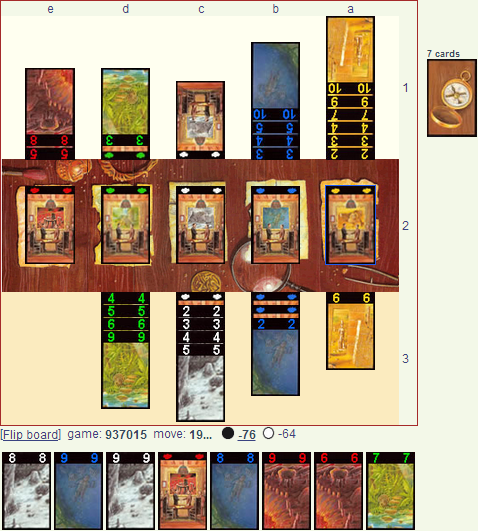 |
| You have -76 pts, 7 cards remain, what should you do this turn? |
Lost Cities Overview
In Lost Cities you are attempting to place cards in ascending order using investment cards to start an expedition that function as multipliers to generate higher scores. Each color you place a card in scores (Sum of card values minus 20 points) [multiplied by] investment cards. Additionally a bonus of 20 points can be added for playing eight or more cards in a color.
The Quandary

Currently we can play the Blue 8 & 9 for 51 points (8 + 9 * 3) and the White 8 & 9 for 34 points (8 + 9 * 2). Adding these totals to our current -76 points we find our current maximum score is 9 points. This is assuming we don't draw any of the cards we need along the way (see below).
Our opponent currently is sitting at -64 points and we can only speculate as to their holdings. There are six remaining cards that can help them, the White 6, 7 & 10, the Green 8 & 10 (We hold the Green 7) and the Red 10 (We hold the Red 9). The total of these cards is worth 92 points and when added to their current score they reach a maximum score of 28 points.
With 7 cards remaining we can play and draw from the deck twice, followed by drawing from the discard piles if we hit one of the additional cards we are looking for. This allows us to play a maximum of five cards before the game ends. We need the White 6, 7 or 10, or the Blue 6 or 7. The Yellow 8 is also a card we can use but we would pick it last for our dodge ball team on the playground.
As you can see our opponent may literally hold the upper hand. They can play from four to six cards depending on their pace of the game dependent on what cards they have remaining.
So where is the dilemma?
Do we play the Blue 8 (Hoping to draw the White 6, 7 or 10)
Or do we play the White 8 (Hoping to draw the Blue 6 or 7)
Weighing the Options
By playing the White 8 we hope to draw the Blue 6 which would be worth 18 points (bringing us to 27) or the Blue 7 which would be worth 21 points (bringing us to 30).
By playing the Blue 8 we hope to draw the White 6, 7 or 10, not only scoring us 12, 14 or 20 points respectively but also (if you noticed) bringing us to 8 cards in White and earning us a smooth +20 points. The worst of these cards nets us +32 points and brings us above our opponent's theoretical max score, so we can ignore marginal benefits and treat all three cards equally.
So you may be saying "This is simple, the three white cards are game winners, so Play the Blue 8 as there are only two blue cards that benefit us and one of those doesn't necessarily always win us the game.
You'd be correct. If this was in a vacuum. But we don't play board games in a vacuum. That would be strange and unnecessarily difficult. Lets roll out the context.
The Context (You thought you were done, didn't you?)
This game is currently in turn 19. A turn by this definition consists of each player taking a turn (So in baseball terms we are in the bottom of the 19th inning).
On turns 1 & 2 they played the Green Investment & Green 3.
On turn 3 they played the White Investment (I played the White 5 on turn 15).
On turn 8 they completed their blue expedition by playing the Blue 10 (I'll explain why this is important in a moment).
Inductive Reasoning
Given the above information we can assert several premises. This is against an experienced player so the following observations will usually hold true at this (late) point in the game.
- Players like to play the next sequential card so as to maximize their future outcome.
- Players likes to play an investment with an additional card of that color in hand for assurance.
- Players will hold useless cards until they can be safely discarded as to not benefit opponents.
In this case we could guess they would only play the White Investment card if they held another white card in their hand on turn 3. They would also have played a White 6 by now if they had it. They may or may not have played a White 7 by now if they had it but certainly not the White 10 (As they would forfeit the potential White 6, 7, 8 & 9 scoring possibilities).
Our opponent has no knowledge that we hold the Green 7, so they may elect to hold the Green 8 or 10 for now.
They have no use for any more Blue cards as they played their Blue 10 on turn 8, this does mean they have had 11 turns to accrue additional blue cards. We have no way to tell as they would retain these cards.
Conclusion
So should you play the White 8 or the Blue 8 or more importantly, does it actually make a difference in the outcome? I'll revisit this next time with several approaches in order to help identify the potential optimal decision.
Wednesday, April 3, 2013
April Game of the Month: War

Style and Gameplay
War is a deck-building card came that uses a standard 52-card deck (without jokers). Suit is ignored, and cards are ranked 2 (low) through ace (high). An equal number of cards is dealt to every player, forming each player's deck. Then, each player plays one card simultaneously, with the high card winning the round. One of the unique mechanics in War is that the winning card "captures" the other cards, adding them to the winning player's deck.
The most important mechanic, though, is the eponymous "War". When two cards tie, one (or more) cards are dealt face-down to increase the stakes of the war, then one is dealt face-up to resolve the battle. It's the only situation in which imperfect information exists in War, and it can be used to reinforce the strength of a deck--or to subtly steal a player's best cards.
War plays quickly, though play time can vary depending on how the war draws work out, and it can suffer from the need to constantly shuffle decks, particularly when relatively few players are playing. Plenty of variants exist, house rules are easy to apply, and the game scales well for two to six players.
Analysis and Anecdotes
Despite a simple set of rules and the use of a standard deck, War is far from a solved game. Its mathematics have been studied extensively, and a number of its aspects have been studied in detail, including finiteness, predictability, and periodicity. In particular, the rules for shuffle triggers and card addition upon winning a round are not standardized, introducing substantial potential for variance.
War has a propensity to create unpredictable situations and large swings in win probability after only a single move. In contrast to Euro-style board games, where strategic consistency is rewarded and a misplay on an early turn can unduly jeopardize a strategy for the rest of the game, War allows unexpected victories, and bad draws in early rounds can easily be erased later on.
Perhaps the greatest source of tension in War tends to be the climactic final battle, when one player is reduced to zero cards and must play out a war knowing it could be his last. This is another area where variants and house rules abound; sometimes, if a player is unable to send enough "troops" to a war, he simply loses, while other rules state that a player's final card can make a "last stand" and fight whatever cards the other players can throw at it.
Overall Impressions
Because of how versatile and widely known it is, War is an ideal time-passer, and it's fascinating to learn how each player has interpreted the game slightly differently. It's easy to get multiple games in, and since each game plays wildly differently, a single game of War that doesn't quite go your way isn't tough to recover from
2+ players, 10-20 minutes, free with a deck of cards.
And a very happy, if slightly belated, April Fools' from Ludi Berkeley!
Wednesday, March 13, 2013
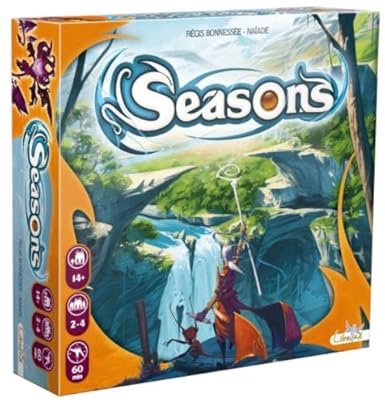
March Game of the Month: Seasons
Style and Gameplay
Seasons is a turn-based, tableau-building card game. You assume the role of a wizard trying to win a tournament and be crowned the next archmage of the game's exorbitantly high-fantasy setting. To do that, you need to accumulate the most "prestige points" (i.e., victory points), which are earned by playing cards and accumulating crystals, a sort of currency gained and lost throughout the game. And in order to play cards, you need to both increase your capacity for "summoning" and pay an appropriate amount of "energy".
Like so many card games of its generation, Seasons' clearest influence is Magic: the Gathering. As in Magic, most cards cost a certain number and color of energy to play, and cards are broadly sorted into ones that trigger once when played, trigger once per turn, or provide a constant-effect passive bonus. Add in an optional draft mechanic, and there's a lot in Seasons that Magic players will find familiar.
But Seasons isn't just a boxed Magic clone. There's a turn tracker, a score tracker, and player trackers; there are tokens, cards, and dice. As Steph pointed out, there are visual elements of a whole lot of different styles of board games represented in Seasons. The dice in particular are clever: a die roll at the beginning of each turn determines the sorts of actions that might be available that turn. It's as if the Governor in Puerto Rico rolled dice at the beginning of the round to decide which roles would be performed, instead of the players picking for themselves.
Because there are so many visual elements--and some iconography that's Race for the Galaxy-level confusing at first--it appears that Seasons has a massive barrier to entry. But that appearance can be deceiving; Steph and I went from being utterly confused to entirely understanding at least the basic rules within the span of two games. The box's estimate of an hour to play seems about right once you've gotten the hang of it, though the four-player game could last a lot longer than our two-player games did. There are a rather large number of turns--maybe an average of 15-18 per game--but since none takes very long, the game hardly ever drags.
The visual style, promised as beautiful, is mostly very impressive, with the card art in particular absolutely delightful. The production value on the dice could be better--the engraving-on-primary-colors feels very '80s. But overall, the consistency of the colors through all the visual elements is executed especially well, with a given color representing both a season and an energy type, and featuring prominently on cards that are associated with that energy type.
Analysis and Anecdotes
Seasons is one of those games that, even though you've mastered how to play, you can be awfully far from understanding the game on a deeper strategic level. During the "setup" phase of the game, you can take a pre-assembled starting deck, deal random cards to form a deck (not explicitly endorsed in the rules, but the approach that Steph and I took that seemed to work just fine), or play through a draft. Then, you split up your cards so that a few additional cards enter your hand every game "year". This is a lot of decision-making even before the real game starts, and it's a part of the game whose surface I've barely begun to scratch.
Probably the most novel element of Seasons is its turn tracker, which advances time in both seasons and years to create a nice ebb and flow of resources within a 7 Wonders-style "age" framework. The critical challenge of Seasons becomes aligning your cards--which cost certain colors of energy--with the season, during which certain colors of energy might be abundant, rare, or impossible to find. This restriction on energy ought to be the driving tension through the entire game, but we found that it's a little too easy to circumvent. There exist plenty of cards that let you subtract from energy cost requirements, gain energy from playing a card, gain energy once, etc., without paying attention to the energy "landscape" of the current season.
Closely related, another wonderfully innovative feature of the game is its variable length. The game ends at the conclusion of the third year, but based on player choices, that might come slowly or quickly. At a base level, the die roll every turn affects the temporal progress of the game. On top of that, at least one card exists that allows manipulation of the season tracker, and it's easy to envision a "rush" strategy that involves getting a few cards out quickly then moving the game to the end before anyone else has a chance to start an engine, but at least for now, the number of ways to manipulate the season tracker seems unfortunately small. Given that the variable length and season track are such unique elements of Seasons, it would be nice if there were more ways to interact with them.
I say "for now" because Seasons seems like a game that's designed specifically to expand easily. The base game already comes with a thirty-card "beginner" deck and a twenty-card "advanced" deck, acting like a mini-expansion of its own. Further twenty- to-fifty card decks could probably be released for relatively little cost but would be a facile way to keep Seasons fresh and interesting.
Overall Impressions
It almost seems disingenuous to give an opinion of Seasons having only played a few times, simply because there's so much there, and I'm not even close to understanding the strategic implications of all the facets of the game. For instance, there are a few options, like "transmute" or "choose one of two cards but at a price," that I haven't even used but are presumably in the game for some reason. That said, I am interested in learning those strategic implications, which is a good sign.
The thing I like most about Seasons already is that its complexity can be adjusted easily to match what the players are looking for. Want to play a quick game and see what you can make of nine random cards? Use the base deck and a random starting hand for each player. Want a much deeper strategic experience that you can mine for clever interactions? Use the whole deck and start with a draft.
The apparent visual complexity of the game might tend to scare away new players, but Seasons (like many games) is best learned by hacking through a few turns of it to get a feel for what all those odd symbols and pretty colors mean. If nothing else, Seasons is at least a pretty face--but I'm positive there's much, much more than that to it.
2-4 players, 60 minutes, $50 at a game shop or $37 on Amazon.
Friday, February 22, 2013
Resemblance Review: Keltis The Card Game
 |
| Keltis: The Card Game |
The sudden frequency of these comparable games in such a short period of time has enticed me to start a series of comparison reviews which may help you identify a new game with a game you may have already played.
If you haven't been paying close attention in the past five years, you may be taken aback by the sudden inundation of games with the title "Keltis" in them. This rapid proliferation transpired after the original Keltis title took home the Spiel des Jahres in 2008 and a market was born.
Although Keltis Sr. began this modern family tree, we need to go back to the original patriarch in order to fully understand the familial relationship.


Comparing Lost Cities to Keltis: The Card Game

Lost Cities has been one of my top ten games for most of the last decade. As a brief overview for those who are not familiar, each player initially draws eight cards from a deck of five colors representing five potential expeditions. Each color consists of cards numbered 1 through 10 along with 3 "investment cards".
Players play a card either start a new expedition by playing a card onto an empty color or add to an existing expedition, so long as the card is larger than the last. Players may alternatively discard an undesirable card into a discard pile shared by their opponent but risks helping their adversary. After playing a card, players may draw either from the deck or from the top of any discard pile.
Play continues until the deck runs out upon which scoring occurs. Each expedition for a player scores the sum of the cards played minus twenty points, representing an initial fixed cost of pursuing a breakthrough discovery or long lost treasure. Any investment cards offer a multiplication effect of 2x, 3x or 4x (1/2/3 investment cards). Finally, twenty points are added to an expedition if a player is able to play eight or more cards in a single color. Games take place over three rounds.
Lost Cities Analysis
Lost Cities has a number of impressive concepts that cause it to stand out from other card games. It features the concept of sunk costs (minus 20 to start an expedition) that can be increased with the initial placement of investment cards. There is constant risk assessment done each turn as one may have to lay down a low valued card with great uncertainty if they may be able to reach a break even point of that color.
Most of the difficulty for new and improving players comes from initial starting hands, if a player holds only investment cards and low numbers they can't be certain what colors are worth pursuing and what can be safely discarded. The end game gathers a great deal of excitement as the pacing element of Lost Cities keeps everyone on their toes - aiming to run out of cards right as the deck empties by slowing the pace to get all of their cards scored.
The downside is the scoring each round can be a bit lengthy for the time it takes to play. Multiple rounds mitigate the randomness caused by luck and award the better performance.

Keltis: The Card Game uses the established rules of Lost Cities with a few key changes. The five normal colors have one or more of each card in the deck numbering from 0 to 10 along with three "end cards" which close out a color for a player. Cards can be played ascending or descending, allowing for 0 or 10 to be equally attractive.
There is a sixth suit of grey cards that can be placed on your turn individually for a single point or placed on to your established runs to increase their value, but only if they match the value of the card most recently played (I can place my grey 8 on my recently played green 8 and then continue the run).
The new addition I enjoy most is that on your turn you may a numerical pair (e.g. two sixes) and receive a wishing stone of that number (e.g. six). Wishing stones increase your score by sheer quantity, and face value of each stone is irrelevant once captured. This provides some neat ways to both accelerate the game (drawing twice to replace your discarded pair) and a way to get rid of useless cards and refresh your hand with new options.
The most significant change with Keltis:TCG is the scoring. Rather than the face value of cards being used, the number of cards played in a given color determine your score. If you start a color and only place three cards, you score -2 and for each card above that your score increases in a non-linear format (four cards is worth +1 while nine or more cards nets you +10). Capturing zero wishing stones at the end of the game will score you -4 while having five will earn you +10.
Keltis: The Card Game Analysis
The initial experience with Keltis:TCG opened my eyes to new strategies, new areas of interest and a new way to manage my hand. It is a fresh take on a Knizia classic and a good game in its own right.
I love the wishing stones and grey cards which add these new scoring opportunities, but I don't care for the scoring as its a bit fiddly. In Lost Cities you celebrate when that third yellow investment card shows up after you'd been holding out for it over the last six turns, this excitement is gone from Keltis:TCG, you're only focused on color for the and card value is diminished.
The pacing element exists in two player Keltis:TCG, but it lacks the exciting tension. I feel I have time to do nearly everything I want and then some with two players. In Lost Cities I have roughly 22 cards to play and a mid-game evaluation of opening up a fourth expedition is a crucial decision as time is always running out. Three or four players eliminates the pacing strategy as if I delay the game my opponents will continue on their intended pace and I have significantly less control.
The risk assessment aspect is absent from two player, but I feel it would improve with each added player. You often can pick a color and go with it uncontested, and information is plentiful with the longer number of turns and more discarding taking place.
Conclusion
Keltis offers several stark improvements over Lost Cities, but overall I can't say I find the whole greater than the sum of its parts.
A hidden element of player interaction in Lost Cities that disappeared from Keltis:TCG is the ability to force sub-optimal decision making from an opponent. As much of the early to mid-game is discarding and locating cards to maximize value, one can force an opponent into a frustrating position. If I open with a red investment card and my opponent holds only a red four, they must either:
- a). hold it for an uncertain time period while playing other cards earlier than desired
- b). discard the card, giving me exactly what I want when I want it
- c). start a red expedition, taking a moderate risk that pulls attention from better color options.


Keltis: The Card Game
Originality (0.75/1.0) - Fresh ideas rejuvenate a gold standard
Theme (0.0/0.5) - Lost Cities has a debatable theme, this one isn't even close
Pure Fun (0.5/1.0) - Good by not great, not a game I'd reach for in many situations
"Re-play-ability" (0.5/1.0) - Additional strategic options are enticing, but blend together
Strategy/Luck Ratio (0.5/0.5) - Less useful cards can be turned into scoring option
Player Scaling (0.5/0.5) - 2 and 4 players offer an enjoyable variety, but plays best with 3
Parity (0.5/0.5) - The structured scoring leads to more scoring parity than Lost Cities
My Rating:
Overall 3.25/5.0 = 6.5 out of 10
Lost Cities registers at an 8.5 out of 10 for me. Keltis: The Card Game is a wonderful place to visit, but Lost Cities allows one to explore the greater depths with less complexity and is an entirely more accessible culture to discover.
Saturday, February 9, 2013
Strategy Spotlight Seconds: San Juan
 |
| Link to Matt's Strategy Post |
The idea that there is simply two primary routes in San Juan is initially a concern for lack of variety but in reality San Juan simply has an early demand on players to pick a strategy and run with it. I have always felt San Juan requires the ability to play both the "purple buildings" strategy and the "production buildings" strategy although in order to play either optimally one must adapt to cards dealt and play whichever strategy presents itself first.
While San Juan has some awesome cards with neat abilities, it comes as no surprise it is a game about victory point and key action selection. While I can't get into everything here, I have some tips which are the primary themes while executing the expanded ideas below (focusing on three or four player):
- We are aiming for at least 35 points. You can win San Juan with fewer and you can lose with more, but 35 points often puts you in a comfortable spot.
- What we build needs to either be VP/cost efficiency of 2/3 or better (Archive is 1/1, Tobacco Storage is 2/3) or offer a cost savings/income increase that will pay for itself within a few rounds (Quarry or Smithy with -1 cost reduction). We have 12 investments to select and we're looking for a good return on investment and/or quick payback period.
- Role selection is optimal early in the game in this order: Prospector, Builder, Councillor, Producer/Trader. This is probably commonly how it plays out but selecting producer/trader is drastically inefficient unless you have several silver smelters.
- With rare exception I will usually pass on the first build opportunity, this game is not about building your 12th building, its about having the most points when someone else does. I'm aiming to finish with 10 or 11 buildings although if a good combination of cards (explained below) come in succession it is possible to finish first with a large margin of victory due to superior income flow throughout the game. Try not to fall behind by more than two buildings to anyone as it is very difficult to stay within range.
"The City Hall Strategy"

Our first strategy is the more grandiose and technical to execute, but has more potential secondary strategies available. Our key opportunity cards here are the Carpenter and Quarry.
 I find this to be the most desirable combo in the game, as you can build several of our other VP/cost efficient cards such as the Gold Mine, Archive and Smithy without a quantity change to your hand. This enables you to select an alternate role selection such as Prospector or Councillor and still build when others select Builder. If dealt both, pass on building until you can build one without having to discard the other. The Carpenter is slightly better than the Quarry overall, but I'll never complain about having one over the other. The Carpenter is still worth building late in the game while Quarry is not.
Ideally we can build either of the Carpenter/Quarry early (skipping the first build opportunity to preserve options) and add the other at some point later in the game. At this point we are increasing our hand by looking for the low cost, points efficient cards listed above below in order to keep up with the pace of building while positioning ourselves better than our opponents via greater options.


Gold Mine is one of the best cards in the game as it often will pay for itself several times over in the game. The Archive is nice but here for the low cost and VP ratio. I realize the Smithy seems out of place as we don't intend to build any production buildings once we've selected our purple building path, but it is cost efficient and an easy build if it comes up in your hand.


The Prefecture, Tower and Market Hall are the next layer of this strategy. The Prefecture is an excellent piece of the puzzle, as it doubles our income from one of the frequently selected roles each turn, whether we select it or (hopefully) not. The tower is included here as it is efficient and with our selective approach to building, the income will be rolling in and the last thing we want to do is discard down to seven at the end of the round (a devastating offense in San Juan).

The Chapel is one of the secondary strategies in San Juan, although it has two prerequisites to make full use of it:
- A hand of at least 4 cards that is growing each turn even as you are building, making this an alternative to the Tower.
- A slower game pace in which players are building less frequently and with more efficiency (this is how you can beat an opponent using the very same build order I am listing here).
Keep in mind using the Chapel comes second to actually building each round, if your hand runs low don't utilize it as you may be a card short on building next turn. Even if you don't use it, the Chapel is not technically a bad building, but there is frequently an opportunity cost involved in building it.


The Statue, Victory column and Hero are the primary elements of the Monuments secondary strategy. At this point their points efficiency should be apparent, but as we have hopefully reduced their cost they are among the elite cards we can build late in the game. I would be willing to build the Statue as early as the fourth or fifth build if necessary but would hold the Hero until at least the ninth build assuming these actions would not diminish my hand entirely. They become more powerful with the Triumphal Arch although it is not necessary if hand size is limited.


The final layer of this strategy is to build at least one of the prized "Super Six" cards. The City Hall should come as no surprise as it will be worth 9-10 points at the end of the game if just a few things fall into place. The Palace may be worth 5-7 points which isn't bad if you haven't seen a City Hall all game. The Triumphal Arch really needs at least two of the monuments to be in place to be worthwhile, but you often don't have the luxury of picking and choosing in some games and it is an okay build in many situations.
"The Guild Hall Strategy"
I'm not fond of the Sugar Mill or Coffee Roaster. While they can likely pay for their added cost over the course of the game, their VP/cost ratio is below our expectation. I'm going to be selecting Producer/Trader as little as possible and I expect other players to do the same.


The Gold Mine is always an acceptable build in San Juan and with the Guild Hall strategy I would be willing to build the Chapel when income is flowing. Monuments such as the Statue or Hero probably aren't as effective as usual as the Guild Hall makes Tobacco storage and Indigo plants points monsters with the added benefit of a potential income source but I wouldn't rule them out. I would not build anything else not listed here.
Cards to Burn
The Black market and Library are the best of the remaining cards. I find the Black market marginally useful with the City Hall Strategy but not the Guild Hall strategy. The Library really dominates as the player count decreases as among the two roles strengthened most, Prospector & Builder, one will be available the majority of the time in a three player game and always in a two player game for you to select. I find the Library to be too large a cost commitment to be especially powerful with four players.
Aqueduct is in this upper category simply because it passes the points efficiency requirement. I should elaborate here as the Aqueduct is one of the most unique cards in the game as it can both eliminate the need to ever select Producer while also creating some neat synergies with Market Stand & Trading Post for when you come to the Trader role. It also has some neat uses with the Black market with the Guild Hall Strategy, allowing you to use Producer but never Trader and have an extra source of income that is inaccessible to your opponents when it comes time to build. But it doesn't fit well with our City Hall Strategy and thus I relegated it to the bottom tier of available cards.
The Poor house is probably a moderate opening card, but it is conditional in the build phase. Cards should be selected to build based on consistency and predictability rather than possible utilization.


I'll preface this by saying there is no perfect strategy in San Juan, certainly not the two I've listed above, but between these two strategies neither has a purpose for the cards below. None of these cards are VP/cost efficient and offer little utility to make up for it.


I'm at a loss to explain my dissatisfaction for the Crane, I don't like to rebuild over buildings that have already been selected for efficiency over the course of the game. Trading post, Market stand and Well each require either sub-optimal role selection (Producer or Trader) or synergy with another card in my sub par grouping (Market stand/Trading post and Well/Aqueduct) in order to succeed.
Conclusion
So what strategy is better, and which route would we take if given a strong opening hand such as Quarry, Carpenter, Smithy, Tobacco storage? I may defer to purple buildings as the potential for a Chapel strategy in a slower game, although the Smithy path churning out Indigo plants and Tobacco storage is fast paced and incredibly effective if others fall behind early and a Guild Hall falls into your sights.
I do think being a well rounded San Juan player is the most important aspect as I've rarely had the luxury of choosing, and San Juan always delivers its own twists and turns to your game plan.
Subscribe to:
Posts (Atom)