Showing posts with label Game of the Month. Show all posts

Saturday, May 4, 2013

May Game of the Month: Ascension: Rise of Vigil

I've posted about Ascension before; it remains one of our game night standbys, and with a new expansion debuting in the last month, it was inevitable that we'd pick it up. Rise of Vigil, like Storm of Souls before it, adds a new mechanic to the game. But this one is far more disruptive than Storm of Souls' Events, and it's not clear how much better it makes the game.

Style and Gameplay

Briefly, Ascension is a deck-building card game that might invoke comparisons to Dominion or Magic: the Gathering, depending on if you come from a Euro game or a competitive trading card game background. Cards in the deck are used to either get points (called Honor) or to get new cards, which are more efficient at getting points. The premise is simple, but the variation among the different cards is sufficiently big that it would be tough to cover here.

Rise of Vigil may or may not count as a proper "expansion"--it can either add to the base game or stand alone and be played by itself. Its new mechanics are Treasure and Energize, which work in the following way: when a Treasure card would be added to the center row, keep flipping cards until a non-Treasure appears, then put all the accumulated Treasure under it. When the non-Treasure is acquired or defeated, all the accumulated Treasure comes with it.

Treasure becomes part of a deck, but each Treasure card (in Rise of Vigil, there is only one card of type Treasure, the Energy Shard) replaces itself when drawn, so decks appear much larger than they really are. Energy Shards grant 1 Energy--that's a new resource type, in addition to Runes and Power, and a handful of Heroes and Constructs also grant Energy. If a certain Energy threshold is passed, some cards' Energize feature trigger. Energize triggers can be anything from reducing card acquisition costs to manipulating the size of the Honor pool.

Rise of Vigil therefore becomes heavily focused on the Energize mechanic, so much so that individual strategies (Lifebound Heroes, Mechana Constructs, etc.) are almost obsoleted. Having so many Energy Shards in your deck, while not decreasing deck velocity, does increase shuffling frequency to a surprisingly frustrating degree. Even so, a game of Rise of Vigil tends to be about as long as one of base Ascension: the "30 minutes" on the box is a clear lie, but 45-60 seems more reasonable.

Analysis and Anecdotes

We're not sure if we like Treasure and Energize yet, but we're leaning toward "no". Its biggest effect is to ramp up the game's variance. Absent any Treasure, a certain Hero in the center row may a moderately attractive proposition, but with a nice stack of five or six Shards under it, it can become game-breakingly good. The same goes for Energize triggers: sometimes you have twenty Shards in your deck and need three of them to make your deck function like it's supposed to, and you draw two.

Similarly, the high-end mechanics, many of which also depend on Treasure, seem way too good compared to those in previous sets. One acquires or defeats the entire center row; another destroys all opponents' Constructs. These "marquee" effects are few and far between, such that the average effect of a card is comparable to ones we're used to, but the deviation is broader. For a game that was already a little swingy in a design community where high-variance is a four-letter word, it's not a mechanical change that's appreciated.

In one game we played, I killed Herald of Doom after a particularly lucky Treasure draw (I had maybe 9 or 10 Energy in my deck and happened to draw 7 of them). I got all the cards in the center row. Then, as a replacement for one of the cards, our buddy Oziah here flipped, which I also acquired for free, since I was still at 7 Energy. There wasn't much question that I would end up winning that game, but it wasn't a particularly satisfying or exciting victory in that I didn't feel rewarded for either pursuing a dedicated strategy or adapting well to the changing game state.


Another time, someone (not me) picked up Lifebound Muse with seven Energy Shards under it on turn 1. Guess who won?


Rise of Vigil is supposed to integrate with the other Ascension "blocks," but it's unclear how well that would work. On one hand, it might make "get Energy" its own strategy, on parallel with "kill Monsters" or "make a lot of Constructs". On the other hand--and this is the scenario that seems far more likely--it might dilute the Energy Shards and the cards that require them so much to make them useless.

Overall Impressions

I like where Ascension is going with Rise of Vigil, but I fear the inspiration was much better than the execution. It's a way to change up the Ascension experience, which is always nice. but so far it seems like a change-up that simply introduces more randomness. A bit of tweaking might get Rise of Vigil to a more playable state, but for now, it's probably going to end up taking a back seat to Storm of Souls and the base game.

Rating

Aesthetics: 1.5. Ascension's absurdly high-fantasy theme won't be everyone's cup of tea, but it's clear throughout, and the game finally appears to have found its artistic tone.
Adaptability: 1.5. There's enough variety in the cards that you don't feel like you're playing the same game twice. Scales well mechanically from 2-6 players, but 5-6 takes a miserably long time.
Fun per time: 1.5. Usually fast enough that another game doesn't sound like a dreadful proposition. Downtime while waiting for other turns can get boring.
Strategic depth: 1. In principle, there's some strategy to be mined here, but more than any Ascension in the past, Rise of Vigil relies heavily on lucky draws.
Mechanics: 0.5. The new mechanics here have promise but are fraught with balance issues and may not play very nicely with the rest of the game.

Total: 6 / 10. According to BoardGameGeek's recommended rating, this means "Fair. Some fun or challenge at least, will play occasionally if in the right mood." That sounds about right--I'd nearly always prefer other incarnations of Ascension, but I can't rule out playing Rise of Vigil occasionally. Base Ascension gets a 7 / 10 for me.

(I'm experimenting with a new game rating system. If I like it, I'll post in the future about how it works and what some benchmarks are.)

1-4 players (1-6 with other sets), 45-60 minutes, $40 at a game shop or $30 on Amazon.

Wednesday, April 3, 2013

April Game of the Month: War

One of the all-time classics, War is a deeply intriguing game with almost limitless mathematical complexity. War couples extensive replayability with the chance to get back in the game on nearly every turn. It's a game that a child can master in minutes yet delights and frustrates adults all the same, and it's a natural choice for the April Game of the Month.


Style and Gameplay

War is a deck-building card came that uses a standard 52-card deck (without jokers). Suit is ignored, and cards are ranked 2 (low) through ace (high). An equal number of cards is dealt to every player, forming each player's deck. Then, each player plays one card simultaneously, with the high card winning the round. One of the unique mechanics in War is that the winning card "captures" the other cards, adding them to the winning player's deck.

The most important mechanic, though, is the eponymous "War". When two cards tie, one (or more) cards are dealt face-down to increase the stakes of the war, then one is dealt face-up to resolve the battle. It's the only situation in which imperfect information exists in War, and it can be used to reinforce the strength of a deck--or to subtly steal a player's best cards.

War plays quickly, though play time can vary depending on how the war draws work out, and it can suffer from the need to constantly shuffle decks, particularly when relatively few players are playing. Plenty of variants exist, house rules are easy to apply, and the game scales well for two to six players.

Analysis and Anecdotes

Despite a simple set of rules and the use of a standard deck, War is far from a solved game. Its mathematics have been studied extensively, and a number of its aspects have been studied in detail, including finiteness, predictability, and periodicity. In particular, the rules for shuffle triggers and card addition upon winning a round are not standardized, introducing substantial potential for variance.

War has a propensity to create unpredictable situations and large swings in win probability after only a single move. In contrast to Euro-style board games, where strategic consistency is rewarded and a misplay on an early turn can unduly jeopardize a strategy for the rest of the game, War allows unexpected victories, and bad draws in early rounds can easily be erased later on.

Perhaps the greatest source of tension in War tends to be the climactic final battle, when one player is reduced to zero cards and must play out a war knowing it could be his last. This is another area where variants and house rules abound; sometimes, if a player is unable to send enough "troops" to a war, he simply loses, while other rules state that a player's final card can make a "last stand" and fight whatever cards the other players can throw at it.

Overall Impressions

Because of how versatile and widely known it is, War is an ideal time-passer, and it's fascinating to learn how each player has interpreted the game slightly differently. It's easy to get multiple games in, and since each game plays wildly differently, a single game of War that doesn't quite go your way isn't tough to recover from

2+ players, 10-20 minutes, free with a deck of cards.

And a very happy, if slightly belated, April Fools' from Ludi Berkeley!

Wednesday, March 13, 2013

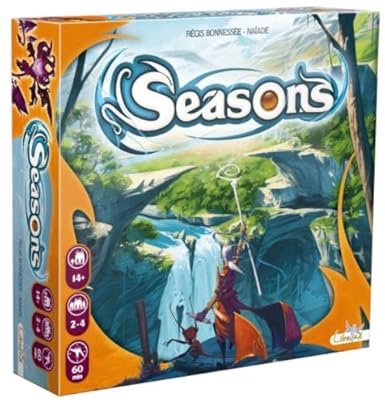
March Game of the Month: Seasons

At the beginning of the year, I resolved to expand my game collection this year. I've already made some progress toward that goal with San Juan, which was more or less an impulse purchase after a few friends mentioned I'd like it. Seasons, though, is a game I've had my eye on for a while--both Paste Magazine and my local gaming shop had excellent things to say about it, and the idea of a relatively quick, aesthetically beautiful card game is right in my gaming wheelhouse. I bought Seasons with the intention of playing it at an upcoming game night... then promptly forgot about it until far too late in the evening. Fortunately, Steph was around and up to the challenge of learning a new game.

Style and Gameplay

Seasons is a turn-based, tableau-building card game. You assume the role of a wizard trying to win a tournament and be crowned the next archmage of the game's exorbitantly high-fantasy setting. To do that, you need to accumulate the most "prestige points" (i.e., victory points), which are earned by playing cards and accumulating crystals, a sort of currency gained and lost throughout the game. And in order to play cards, you need to both increase your capacity for "summoning" and pay an appropriate amount of "energy".

Like so many card games of its generation, Seasons' clearest influence is Magic: the Gathering. As in Magic, most cards cost a certain number and color of energy to play, and cards are broadly sorted into ones that trigger once when played, trigger once per turn, or provide a constant-effect passive bonus. Add in an optional draft mechanic, and there's a lot in Seasons that Magic players will find familiar.

But Seasons isn't just a boxed Magic clone. There's a turn tracker, a score tracker, and player trackers; there are tokens, cards, and dice. As Steph pointed out, there are visual elements of a whole lot of different styles of board games represented in Seasons. The dice in particular are clever: a die roll at the beginning of each turn determines the sorts of actions that might be available that turn. It's as if the Governor in Puerto Rico rolled dice at the beginning of the round to decide which roles would be performed, instead of the players picking for themselves.

Because there are so many visual elements--and some iconography that's Race for the Galaxy-level confusing at first--it appears that Seasons has a massive barrier to entry. But that appearance can be deceiving; Steph and I went from being utterly confused to entirely understanding at least the basic rules within the span of two games. The box's estimate of an hour to play seems about right once you've gotten the hang of it, though the four-player game could last a lot longer than our two-player games did. There are a rather large number of turns--maybe an average of 15-18 per game--but since none takes very long, the game hardly ever drags.

The visual style, promised as beautiful, is mostly very impressive, with the card art in particular absolutely delightful. The production value on the dice could be better--the engraving-on-primary-colors feels very '80s. But overall, the consistency of the colors through all the visual elements is executed especially well, with a given color representing both a season and an energy type, and featuring prominently on cards that are associated with that energy type.

Analysis and Anecdotes

Seasons is one of those games that, even though you've mastered how to play, you can be awfully far from understanding the game on a deeper strategic level. During the "setup" phase of the game, you can take a pre-assembled starting deck, deal random cards to form a deck (not explicitly endorsed in the rules, but the approach that Steph and I took that seemed to work just fine), or play through a draft. Then, you split up your cards so that a few additional cards enter your hand every game "year". This is a lot of decision-making even before the real game starts, and it's a part of the game whose surface I've barely begun to scratch.

Probably the most novel element of Seasons is its turn tracker, which advances time in both seasons and years to create a nice ebb and flow of resources within a 7 Wonders-style "age" framework. The critical challenge of Seasons becomes aligning your cards--which cost certain colors of energy--with the season, during which certain colors of energy might be abundant, rare, or impossible to find. This restriction on energy ought to be the driving tension through the entire game, but we found that it's a little too easy to circumvent. There exist plenty of cards that let you subtract from energy cost requirements, gain energy from playing a card, gain energy once, etc., without paying attention to the energy "landscape" of the current season.

Closely related, another wonderfully innovative feature of the game is its variable length. The game ends at the conclusion of the third year, but based on player choices, that might come slowly or quickly. At a base level, the die roll every turn affects the temporal progress of the game. On top of that, at least one card exists that allows manipulation of the season tracker, and it's easy to envision a "rush" strategy that involves getting a few cards out quickly then moving the game to the end before anyone else has a chance to start an engine, but at least for now, the number of ways to manipulate the season tracker seems unfortunately small. Given that the variable length and season track are such unique elements of Seasons, it would be nice if there were more ways to interact with them.

I say "for now" because Seasons seems like a game that's designed specifically to expand easily. The base game already comes with a thirty-card "beginner" deck and a twenty-card "advanced" deck, acting like a mini-expansion of its own. Further twenty- to-fifty card decks could probably be released for relatively little cost but would be a facile way to keep Seasons fresh and interesting.

Overall Impressions

It almost seems disingenuous to give an opinion of Seasons having only played a few times, simply because there's so much there, and I'm not even close to understanding the strategic implications of all the facets of the game. For instance, there are a few options, like "transmute" or "choose one of two cards but at a price," that I haven't even used but are presumably in the game for some reason. That said, I am interested in learning those strategic implications, which is a good sign.

The thing I like most about Seasons already is that its complexity can be adjusted easily to match what the players are looking for. Want to play a quick game and see what you can make of nine random cards? Use the base deck and a random starting hand for each player. Want a much deeper strategic experience that you can mine for clever interactions? Use the whole deck and start with a draft.

The apparent visual complexity of the game might tend to scare away new players, but Seasons (like many games) is best learned by hacking through a few turns of it to get a feel for what all those odd symbols and pretty colors mean. If nothing else, Seasons is at least a pretty face--but I'm positive there's much, much more than that to it.

2-4 players, 60 minutes, $50 at a game shop or $37 on Amazon.

Tuesday, February 5, 2013

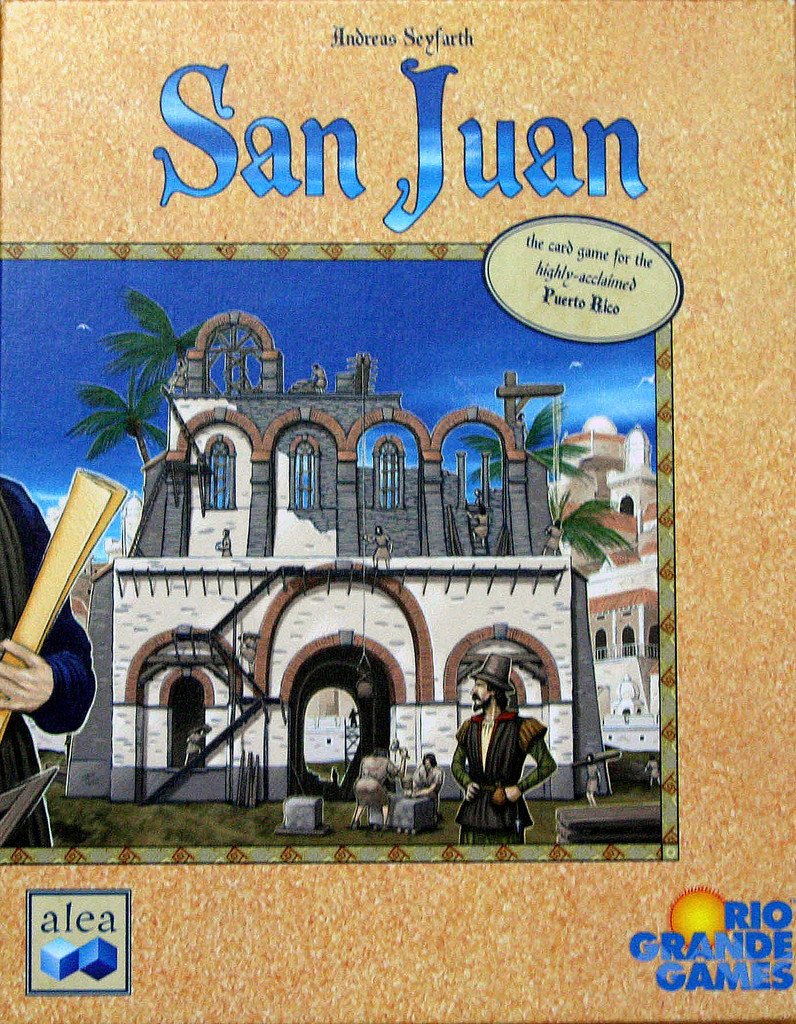
February Board Game of the Month: San Juan

Over the Christmas holidays, I had no fewer than three people independently tell me that San Juan was an awesome game, and given my deep and abiding love for Race for the Galaxy and my impressed (if fearful) admiration for Puerto Rico, I'd especially love it. After a fortuitous run-in with my department's normally stingy key office, I found myself with a bonus $40 in my pocket. I decided there was a worse way to spend it than on San Juan and a latte, and though the latte was drunk long ago, I finally got a chance to play San Juan last weekend.


Style and Gameplay

San Juan is a tableau-building card game (not really a board game, despite the post title) and was among the first card game to use the "role selection" mechanic that has now been adapted by Race for the Galaxy and a handful of other games. As similar as Race and Puerto Rico are to each other, San Juan is more similar to both: legend has it that both Race and San Juan grew out of an attempt to create a card-game version of Puerto Rico. Indeed, the theme of San Juan is essentially the same as in Puerto Rico: you're a colonial-era governor trying to build the economy of San Juan by constructing buildings and plantations.

San Juan's game play is straightforward: on each turn, every player selects a "role," allowing you to draw cards from a common stock, construct buildings, produce "goods" on your plantations, or sell your goods for more cards. Like in Puerto Rico, once a role is selected, every player can perform an action within the role (i.e., everyone may build when someone selects Builder) but whoever selected the role gets a small "privilege" (like building at a reduced cost). Allowing everyone to act within a given role drastically reduces the "lockout" problem that plagues Agricola, where your entire game may be ruined in turn 3 because someone takes a stone ahead of you.

The most brilliant part of San Juan's design is that is dispenses with two Euro-game mainstays, currency and victory points. Victory points are present, and in fact the way to win the game, but they're entirely contained within your buildings, not as separate tokens. And currency doesn't exist at all: in order to play cards, you must discard other cards. Therefore, the biggest strategic decision (aside from the role selection) in San Juan comes in choosing which cards you want to hang on to for later development and which you're comfortable discarding immediately.

Our first game was a 4-player game; two of us had played both Race for the Galaxy and Puerto Rico, one had played Race but not Puerto Rico, and the fourth had played neither. The three of us who had experience with Race and/or Puerto Rico grasped the game immediately; it took our fourth a few turns to figure out what was going on, but the game started running smoothly at around turn 4. It clocked in at under an hour, right in line with the box's prediction of "45-60 minutes".

Analysis and Anecdotes

Given its nearly identical play style, it's hard not to compare San Juan directly with Race for the Galaxy. Judging from the discussion at BoardGameGeek, it seems almost imperative that you pick sides and prefer one game over the other, but in reality the two games are so similar that there's no reason not to like them both. The crucial difference between the two, aside from some rather minor mechanical differences, is that there are more cards in Race--the decks are almost exactly the same size, but Race has far more kinds of cards and fewer repeats.

Therefore, San Juan is less disposed to random variance than Race for the Galaxy might be, a fact that delighted the "gamier" gamers among our group. If you need a certain card as the lynchpin of your strategy, you're proportionally more likely to get it in reasonable time. But both San Juan and Race for the Galaxy are "reactive strategy" games, rewarding you more for adapting your strategy to the board state rather than trying to chart a course a priori.

On the flip side, the number of viable strategies for winning San Juan seems like it could be small: basically, you need to pursue some variation of either the production route or the building route. One of the best parts of Race (or other card games with lots of cards, like 7 Wonders) is discovering small but clever interactions; San Juan's deck is sufficiently limited that in any given game, each player is likely to see all the cards that exist in the whole deck.

San Juan worked fine with four players. The rules are identical for three and four, with some alterations for two. Normally, rules alterations are a surefire reason to assume the game would be less good under that condition, but there seems to be a fair amount of consensus that San Juan actually "shines" with two people instead of three or four.

The one mechanic I'm least crazy about (incidentally, the one that's most different from Puerto Rico or Race) is the trading market. The first few times that produced goods are sold, the prices are semi-random, but afterwards, the prices cycle, introducing a memory-game element into trading. In a reasonably fast-paced game that rewards reactive strategy, it's tough to see how the additional requirement to memorize strings of numbers makes the game any more fun.

Overall Impressions

At the moment, I'm really into San Juan. I strongly prefer reactive to proactive strategy games, and shorter games to ridiculously long games (though I've vowed to reexamine that in 2013!) so everyone who told me I'd love San Juan, you were correct. And I feel like I can't give an adequate strategic analysis until I've seen about a dozen more games of it because there's probably a vast depth to the game that I haven't even begun to scratch yet.

But the biggest reservation I have about San Juan is how long I'll continue to be really into it. While I could see it holding my interest (and a spot near the top of my games rotation) for years, I can also see it getting stale in a few months, if the strategic options really are as limited as I fear they might be.

Even if San Juan ceases being the Next Big Thing in my game collection quickly, though, it has a lot going for it that I won't stop appreciating, including straightforward instructions, elegant mechanics, and a low profile (literally all you need to play: a deck of 110 cards and a handful of role and market tiles!). At the very least, San Juan's floor is an easy and quick "gateway" game for Euro-style card games, the same function Carcassonne and Settlers of Catan often fulfill for Euro board games. And if Race for the Galaxy is any comparison at all, San Juan's ceiling is much higher than that.

2-4 players, 45-60 minutes, $30 at a game shop or $21 on Amazon.

Tuesday, January 1, 2013

January Board Game of the Month: Dixit

Plenty of Spiel des Jahres winners and nominees are pure-strategy games, the kind that exemplify the Euro-game genre and reward intensely mathematical strategizing. They're awesome games, and they've led to the countless hours of scrutiny and nitpicking that qualifies as fun among a bunch of engineering grad students. Every once in a while, though, the Spiel des Jahres award goes to a game like Dixit that, despite absolutely no math or strategy behind it, is engaging and complicated and worthy of the title of "game of the year".

Style and Gameplay

Dixit is a card-collecting game that draws inevitable (and entirely appropriate) comparisons to Apples to Apples. Like Apples to Apples, every player has a hand of cards; on each turn, every player selects one card that fits the turn's theme the best. The mechanics are a bit different from Apples to Apples--instead of the "active player" deciding which card fits best, all the players vote on which one belonged to the "active player". Dixit's greatest improvement over Apples to Apples is a track and  mechanism for scoring, keeping Dixit to a manageable length by having an endgame condition within sight.

The scoring system also provides some incentive for the "active player" to create clues that are guessable but not immediately obvious. If a clue is too easy or too hard, the "active player" scores no points. The real trick to Dixit is to hit somewhere in the middle: anything from a clever interpretation to an inside joke to a slightly abstract or off-kilter narrative can do the trick.

Probably the most remarkable part of Dixit is its beautiful artwork, a style somewhere between fairytale storybook and surreal epic fantasy. Different people looking at the same card, or looking at the same card from a different angle or in a different context, can interpret it in vastly different and imaginative ways. The impetus is always on the "active player," rather than a randomly selected "green card," to suggest an interpretation for a card, so there are some cards that don't speak to a player and may go unused the entire game. But the vast majority of them inspire something wonderful: a story, a reference, or even a mere flicker of word-association.

Analysis and Anecdotes

Another point of similarity Apples to Apples, the only real way to gain an advantage in Dixit is to know the people you're playing with very well. Upon seeing a card with a picture of a knight riding out of the pages of a book, my dad gave the clue "woeful countenance". Having played in the musical Man of la Mancha together, I immediately understood the reference, but my mom and girlfriend were not so informed. Similarly, I had just been to the mall with my girlfriend, where we saw a carousel; when she gave the clue "a trip to the mall," I knew the carousel card had to be hers.

Depending on the group of people playing, Dixit could take a number of different turns, ranging from the imaginative to the idiosyncratic, filled with artistic allusions or recounting of hilarious stories from college. It would be easy enough to rig Dixit, to give each picture a phrase specific to it and use the same one every time, but that would be missing the point. And playing through the same deck of cards with the same people multiple times could wear out a lot of the game's novelty: there was a fantastic sense of discovery turning over each card and seeing it for the first time. Asmodee, Dixit's creators, understand that (and have a good business model) and have released a number of expansion decks.

Dixit does take a bit of getting used to; there's a fine line between "too obvious" and "too obtuse". In our first game, we tended, accidentally, toward "too obvious," but we assumed that if we'd played more games, we would have gotten the hang of making appropriately specific clues. And the game could stand to be a little more interactive--for most of the game, there's very little being said except for when the "active player" reveals which card was his or hers. The first game of Apples to Apples I played was like that too; then we discovered how important and fun it was to advocate for your own card. Presumably, Dixit is even more fun once people become comfortable enough with it to start advocating and arguing with the active player.

Overall Impressions

Yes, Dixit is basically "Apples to Apples with pictures". No, that's not a bad thing. This is another game that probably won't appeal to those looking for a deeply strategic gaming experience. But as a social game, suitable for playing with your family or colleagues or acquaintances, Dixit excels in the same way that Apples to Apples does. It helps to know your fellow players well, but it helps more to play with people who are imaginative and creative.

The only obstacle to Dixit's continued playability is running out of interesting picture cards, and when that happens, it's simply time to buy a new deck. Until then, I'm excited to keep delving into Dixit, discovering new and fantastic stories each time.

3-6 players, 30-45 minutes, $35 at a game shop or $25 on Amazon

Monday, December 3, 2012

December Board Game of the Month: Puerto Rico

After an online narrative RPG, a party-oriented card game, and a month of gaming totally devoted to history puzzle-hunting, Board Game of the Month is back with the Euro-gamiest of all Euro games: Puerto Rico. Despite its reputation and prominence among board gamers, I didn't play it for the first time until a recent game night hosted by my friend Phil. After playing for the first time, I quickly developed a love-hate relationship with it: though it's very difficult for a first-time player to make any headway with Puerto Rico, it's easy to see why the game is so well-regarded in the community.

Style and Gameplay

Puerto Rico is a turn-based city-building game. You play the role of a territorial governor in colonial-era Puerto Rico, and your task is to build your city and its farms to become the most prosperous. The game uses a standard "victory point" mechanic, and both goods from your farm and buildings in your city count for victory points in the final scoring. There are strong similarities to both Agricola and Race for the Galaxy, and in many aspects, Puerto Rico plays like a middle ground between those two games.

The actual mechanics of Puerto Rico's gameplay are mostly straightforward: to build your city, you can create buildings and grow crops in plantations. Buildings cost money to create and require citizens to operate; you make money by selling the crops you grow, and a limited number of citizens immigrate to the island every turn. Certain buildings allow growing more expensive crops, while others make it easier to attract citizens or to build even more buildings.

Much of Puerto Rico's decision-making comes in deciding which crops to grow and when to sell them. Sometimes it makes sense to invest heavily in expensive crops, while other times, it's better to move quickly through lower-value ones; sometimes you need to sell crops for money, and sometimes it's better to trade them for victory points. Other strategies can get by without growing crops at all. Like all the best games in the genre, Puerto Rico strongly rewards formulating a consistent strategy and pursuing it through the end of a game; like all the best games in the genre, that's particularly difficult.

Analysis and Anecdotes

A (possibly apocryphal) story about Puerto Rico's development is that it and Race for the Galaxy grew out of the same development process and a disagreement between the designers. That's especially plausible having played both games. One core mechanic shared between the two is "phase selection," where each player chooses an action to perform (like "Explore" to draw cards or "Develop" to make a new building), and every player performs each selected action, with a bonus to the player who selected that action. For example, if one player chooses to "Explore," everyone draws cards, but the player who picked "Explore" gets an extra card. The result is a free-form and largely non-interactive game where each player can develop a strategy and not have other players interfere with it.

In contrast, Agricola, another game that has plenty in common with Puerto Rico, limits each action to one player per turn: only one person can take stone, only one player can build fences, and so on. Puerto Rico lies somewhere in between: while only one player can get the "bonus" from any given phase, all players can play in all phases. That makes Puerto Rico a less frustrating game in general than Agricola but one that requires more anticipation of other strategies than Race for the Galaxy.

Puerto Rico is not an easy game to learn, even for a player who's had experience with similar games. That was reflected in the scores of the very first game I played, with Raphael (who had the most experience with the game) winning easily and me (the only person playing for the first time) bringing up a miserable rear. Although it's easy to appreciate that winning the game requires a consistent strategy, it's not so easy to get an idea of what that strategy might be until you've played through the game a few times.

Something in particular that got me into trouble was not building toward the end-game buildings aggressively enough, and then not accounting for the need to move my citizens into my end-game building to "activate" it. Like Race for the Galaxy, 7 Wonders, and a host of other Euro games, Puerto Rico's scoring ramps up in later turns, making end-game plays generally more valuable than early-game plays. The consequence is that it's important to anticipate the end of the game coming and to prepare for it in time to maximize the value of your late plays, another skill that's difficult having never played the game before.

Overall Impressions

There's a whole lot to Puerto Rico, and the most clever part of its design is that two players can be pursuing completely independent strategies and be successful in both--but interact just enough to impact how successful each of those pursuits are. Fans of Race for the Galaxy should appreciate all the similarities between Puerto Rico and Race; fans of Agricola or of stiflingly low-variance board games in general will be drawn to the utter lack of randomness in Puerto Rico. Along the lines of Agricola, it's a more proactive game than the more reactive Race for the Galaxy, so even though the mechanics are similar, the approaches to winning Puerto Rico and Race for the Galaxy are very different.

Regardless of personal preferences for proactive vs. reactive, or moderate vs. low variance, or interactive vs. isolated-strategy games, Puerto Rico is consistently in BoardGameGeek's top five best board games for a reason. At the very least, it's worth playing because it's a mainstay in the genre; at best, it's a game whose depth of strategy and multiple viable approaches will draw you in enough times to actually become good at it.

2-5 players, 90 minutes (or 120 if there are new players), $45 at a game shop or $29 on Amazon

Thursday, October 4, 2012

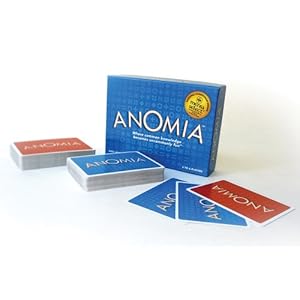
October Game of the Month: Anomia

After the conclusion of last Saturday's mini-puzzlehunt, we wanted to play a game that we could all participate in. Someone suggested Anomia, a quick party-friendly card game. I had never played before, but I enjoyed it enough to make it October's Game of the Month.

Style and Gameplay

Anomia is a word-association game with a card-collection mechanic. Each card is printed with the name of a category (such as "TV shows" or "cleaning products") and a symbol (for instance, a yellow diamond or a purple wavy line). On your turn, you flip over a card from a central deck and put it face-up in front of you. The next person draws the next card and so on, until two players have face-up cards with the same symbol.

That triggers a "face-off" between the two players: the first person to name an item that fits into the other person's category wins, takes the card, and gets a point. For example, say I'm showing the card "US presidents" with a blue pound sign, and you flip the card "lakes" with a blue pound sign. If you say "Thomas Jefferson" before I say "Superior," you take my card and get a point. There are a few more rules about cascading face-offs and wild cards, but that's the basic gist.

Once the entire deck has been run through, the game is over. Each game lasts only about 20 or 30 minutes, so it's easy to play multiple games. It works especially well to play two or three games each using a different deck so the decks don't get "stale".

The most obvious stylistic comparison to Anomia is Scattergories, another word-oriented game that involves quickly and creatively putting objects into categories. There's a memory-game component to Anomia as well: the more of the board state you've committed to memory, the better chance you'll have of reacting to a face-off trigger. And there's even a hint of Fluxx, as you might have to act off your turn, and the rules can change dramatically without any warning.

Something non-obvious that Anomia does well is that even though it claims to support 3-6 players, we played with 7, and it worked just fine. Possibly even more than the 4-to-5 player threshold, 6-to-7 players is a line that board games don't often cross. Aside from the awesome 7 Wonders, Anomia is one of the few games I've played recently that supports seven players and doesn't lose anything.

Analysis and Anecdotes

There isn't much "strategy" around in Anomia, but that's not the same thing as saying there's no skill. Being good at Anomia definitely requires being skilled at word-association and having a fast mental reaction time, and a little outside-the-box thinking doesn't hurt either. About the only strategy that works is to immediately shout out an answer when a face-off triggers, even if it's based on an incomplete or altogether incorrect reading of a card. Probably the most hilarious moment in our game came when the card "condiment" was drawn... and I gleefully shouted "Asia!", having misread it as "continent". I was assured there's no penalty for it, other than shame--and shameful it was.

Most of the categories are pretty well-designed, requiring a second or two of thought before someone nails it. Some of them, though, are so narrow they're difficult. We were playing with a rule that a given answer could only satisfy a category once, even across multiple games. After "Grand" and perhaps "Bryce," how many "famous canyons" are there?

But by far the most interesting categories were so broad they were difficult to solve. "First name" should be trivially easy--everyone has one--but Claire and I both stared at the card in horror for at least three seconds before she realized she could just say "Claire". Even worse was "noun," which might as well be a Saturday Night Live Celebrity Jeopardy category, and still took several seconds for an answer to come out.

The biggest drawback to Anomia is its replayability. Any given session of Anomia is realistically limited by the number of cards you have--once you've seen them all once or maybe twice, it's time to move on to a different game. And it's not the sort of game you can play every night and have it feel different every time--the mechanics and cards are always the same. Where the game does feel different is when it's played with different people, who might be able to give a hilarious or insightful answer you've never heard before.

Overall Impressions

Anomia excels in having incredibly simple rules that lead to fast-paced and amusing situations. It's light on optimization decisions or classic strategy, but it's a nice change of pace from Euro-style games and manages to test skills that the "heavier" strategy board games often ignore. Anomia is also a rare game that lasts exactly as long as it claims to last (or even clocks in slightly shorter) and that you get excited about the idea of playing again once you've finished your first game.

The replayability issue probably prevents Anomia from being the sort of game that you play at every weekly game night with the same group of people and have it stay engaging. But as a game to get to know people, as an occasional "palate-cleanser" between deep-strategy board games, or at a party/with family/with friends who aren't necessarily avid gamers, Anomia can be a whole lot of fun.

3-6 players, 20-30 minutes, $16 at a game shop or $13 on Amazon.

Friday, September 7, 2012

September Game of the Month: Dramagame Velvet Sundown

September's Game of the Month looks a little different than usual. A few weeks ago, I got an email from Elina Arponen of Tribe Studios with an invite to beta-test their game, Dramagame Velvet Sundown. (If it's a bit of a mouthful, it's only because Velvet Sundown is the first "scenario" in the Dramagame model.) Rather than a board game, this one is totally electronic.

Style and Gameplay

Dramagame is an online multiplayer roleplaying game. If one of the primary "axes" of roleplaying games is mechanical vs. narrative, then Dramagame is so far to the "narrative" side that at times it feels less like a game than like an interactive fiction exercise. That's not a bad thing, and it's intentional: there are few if any mechanics in Dramagame, and the stated goal is not to win or lose but to create an interactive, social shared experience.

A session of Dramagame--called a "show" to emphasize its narrative quality--lasts 45 minutes and can accommodate between 4 and 11 players. Each player is randomly assigned one of 11 characters, so chances are good that each individual game will turn out differently than the last. Unlike in many roleplaying games, there are zero NPCs; all the characters are player-controlled, and all the stories are player-driven. Much of the game is spent simply chatting with other characters, and the experience is the best when the most people are confident roleplayers.

To keep it a "game" at all, there are specific "quests" and tasks that each character is given. All of them involve interaction with other people: trading items, verifying identities, stopping trouble from breaking out, even uncovering hidden conspiracies. The only mechanical thing about it is that each item has a specific function, and deciding whether or not to use them can drive the story in vastly different directions.

Each show lasts only 45 minutes, so Dramagame emphasizes quickly establishing a character and jumping right in to make progress on your quests. As simple initial quests are completed, other more complicated ones can emerge; the best games of Dramagame weave a web that unites all of the characters into some dense tangle of plot lines. Shows are short on purpose; the game is designed for people who can't necessarily dedicate many hours per night to gaming but want to have a meaningful game experience anyway.

Analysis and Anecdotes

I've only been able to play through one show of Velvet Sundown, and even then I couldn't finish it because of some internet issues on my end. Still, it was great to see the game "work" as advertised--everyone quickly dug right in to the roleplaying and aggressively pursued their characters' goals. I got randomly assigned to play Mary, the first mate of the ship the game takes place on, and I was immediately alerted to three things I was supposed to work on: checking passports in my capacity as an officer of the ship (which seemed legitimate enough), scanning the IDs as an undercover agent of a corporation (which seemed a bit less so), and getting my flirt on with a dude named Cooper and convincing him to write me some poetry.

And that was only me--each of the four other characters presumably had their share of secret agendas too. It was a whole lot, almost an impossible amount, to get done in 45 minutes. That's probably intentional, too. If every character simply and quickly completes their quests, then there's no more narrative tension. As long as everyone still has something to work on, then something is still happening in the story. There was a lot of "you scratch my back, I'll scratch yours" that emerged in my game, which makes enough sense but was still fascinating to watch given that "winning" isn't exactly the point of the game.

Elina says she and her team were influenced not only by computer games and RPGs but also by board games and even improv theater. There's a strong flavor of point-and-click adventure games, where one of the goals is to use items in combination or on other characters in creative ways. And the roleplaying side reminded me a whole lot of Burning Wheel, where each character is motivated by a set of personal beliefs and goals, and the game is about working with other characters to get that accomplished.

It's obvious that Velvet Sundown, and the whole Dramagame model, is still a work in progress. Tribe has clearly thought about their setting, and its details and back story, but so far not much of that detail has made it into the game. Similarly, the luxury yacht that the game takes place on doesn't have a ton of personality of its own; it would be nice to have an excuse to explore the ship and interact with it somehow. Tribe's plan is to work a lot more with Velvet Sundown, developing new features and content, and perfecting the model before moving on to develop new scenarios.

Overall Impressions

Dramagame is probably not going to appeal to everyone. There's not a lot of "play" in it, so Euro-game aficionados who delight in mathematically optimizing each turn of a board game probably won't find much here. Neither will RPG fans who are looking to play through eighty hours of an epic story and attain godlike powers by the end. But that's not exactly who the game's developers are targeting. Finally, if you're a hardcore console gamer interested in cutting-edge graphics and a lot of action, Dramagame might not be your thing.

On the other hand, if you're time-constrained and would like to have a meaningful, entertaining experience in a short time, you'll probably like Dramagame. Same goes if you've ever played a point-and-click adventure and wished it were multiplayer, or if the most fun RPG sessions you've ever played didn't involve a single die roll. Right now, the community is small and friendly--you might just as likely play with strangers from Denmark or the game's lead programmer--and everyone is excited and eager to hear feedback. At this point, there might be sort of a lot of feedback to give, but once Dramagame has time to grow, it should only get more fun.

Online, 4-11 players per game, 45 minutes, 13 EUR (about $17)

Wednesday, August 1, 2012

August Board Game of the Month: Kingdom Builder

This month's Game of the Month also happens to be the Spiel des Jahres winner for 2012. It's estimated that the Spiel des Jahres winner can expect to increase its sales by several hundred thousand, and it seems to have worked in my case: when Alan walked into Games of Berkeley to buy Bohnanza, I went with him and walked out with Kingdom Builder simply because of the award.

Style and Gameplay

Kingdom Builder is a classic spatial, territory control game played on a randomly generated map with thousands of possible configurations. The basic goal of the game is to place settlements on tiles in such a way that they earn you the most points, and one of the game's most intriguing mechanics is its scoring system; every game features three randomly selected "goals" that decide how the game is going to be scored. There are elements of Go and Othello in the game's tile placement, and it resembles Civilization and other "settlement" games in that there are some special tiles that are especially advantageous to settle adjacent to. Between the randomness of the board and the 120 different ways the scoring can sort out, it's virtually guaranteed you'll never play the same game of Kingdom Builder twice.

One striking aspect of the game is its tiny rulebook. There are basically three rules in Kingdom builder: you place three settlements per turn, settlements must be on terrain matching a random card you draw, and settlements must be adjacent to existing settlements if possible. Over the course of the game, you can acquire special actions that allow you to break those rules--for instance, by placing an additional settlement or by allowing you to move a settlement to a non-adjacent tile. The "special actions" vary with the board, so every game features a practically unique set of those as well.

Most of Kingdom Builder's variability is in its setup and decided before the game even starts, but there's some variance in the game as well, which comes from the terrain cards. Those present one of the biggest optimization decisions in the game: you can choose either to use one or more of your "special actions" and keep the same terrain card, or forgo using them to draw a new one. If you're "stuck" in an unfavorable part of the map, it's sometimes advantageous not to use any special abilities so you can "escape" in the next turn.

In principle, the game moves very quickly, because each player is often locked into a small set of possible actions based on where they're already settled and what terrain they're allowed to settle on that turn. The special actions slow things down a bit simply because you have more options, and games with fewer players tend to move more slowly because players have access to relatively larger areas of the board.

Analysis and Anecdotes

The very best thing about Kingdom Builder is its variable setup, especially its completely random approach to how each game will be scored. It's tough to think of another board game that doesn't have a constant scoring mechanic, and that feature alone probably does the most for the game's replayability. Aside from merely adding up points differently, games that have different goals are going to have different strategic feels. For instance, a game where the goal is to make large settlements in all four corners of the board is going to play much differently than one where the goal is to create isolated settlements along the grid's obliques.

Although the terrain card deck can seem frustratingly random--especially if you draw the same type of terrain card several times in a row--it's entirely your choice whether you want to draw a new card or if you're comfortable playing your special actions and maintaining your current spot on the board. We've only played a handful of games, but it seems like the way to go is to build up your options over the course of the first few turns, taking new terrain cards every time. Then, once you've built enough of an "engine," it doesn't matter what terrain card you have because you're able to exploit synergies among your special actions.

Kingdom Builder's balance seems pretty good with the sole exception of the "Paddock" special action. It lets you break basically all the rules of the game, allowing you to tunnel through unsettlable tiles and settle on tiles not adjacent to your own settlements, regardless of the terrain they're on. We've only encountered Paddock once, and it seemed like it was ludicrously unfair, though our data set is admittedly small.

One last thing about Kingdom Builder that board game veterans will notice is its designer, Donald X. Vaccarino, the man behind the Dominion dynasty. At Ludi Berkeley, we're particularly interested in similar dynamics and mechanics across apparently dissimilar games, so this one was particularly intriguing to analyze with respect to its cousin Dominion. Clearly, they're very different games that don't at all resemble each other aesthetically, but the theme of "no two games are going to play the same way even though you're using the same rules" is obvious in both.

Overall Impressions

A big selling point of Kingdom Builder ought to be its ease of play, and it mostly delivers, especially in its speedy setup and end-game scoring. In a group of gamers less inclined to analyze every decision and attempt to optimize every element of every turn, the game probably does move along as quickly as it's supposed to. And I suppose it's not really Kingdom Builder's fault that a group of engineering grad students is naturally going to do exactly that.

Kingdom Builder is very easy to learn, even for people who aren't already into "Euro-games," but there's enough replayability to satisfy even experienced gamers for a long time. The part of the game I'm least enthusiastic about is its flavor--it might have the most bland name of any board game I've played, and but for its Spiel des Jahres, I probably wouldn't have thought to be interested in it. And I wish its scoring goals and special actions were slightly more thematic; it's easy to reduce everything in the game to its base mechanics. Luckily, those base mechanics are really fun, and it's not hard to see why Kingdom Builder was honored as the best game of the past year.

2-4 players, 60+ minutes, $60 at a game shop or $42 on Amazon.

Sunday, July 1, 2012

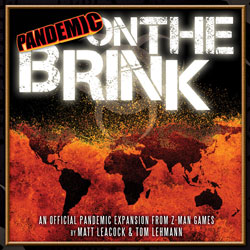
July Board Game of the Month: Pandmic (On the Brink)

Every month, Ludi Berkeley will post its Board Game of the Month: a new game that we've played recently, an old game we like, or an upcoming game we're excited about. This month's is Pandemic: On the Brink, a new-ish expansion to an older game that we've liked for a while.

Style and Gameplay

Pandemic is a multiplayer strategy game where the players take on the role of experts trying to save the world from pandemic disease. The game takes place on a world map, with major cities across the world serving as the "spaces" on the board. Even though it looks like one at first glance, it's not a territory control game per se--the point of the game is essentially to prevent diseases from "controlling" cities. Cities can be infected with any of a number of diseases; it's the players' job to treat the diseases and eventually develop cures for them. Players' roles are randomly assigned, with each providing a small bonus; for instance, the Medic is especially good at treating disease, while the Scientist is especially efficient at developing cures. When the players develop cures for all the diseases, they win. There are a (frustrating) number of ways to lose Pandemic, some of which I'll talk about later from my close personal experience with each.

The mechanic that distinguishes Pandemic from other strategy board games is that it's cooperative rather than competitive. In other words, the players all win together or lose together. That means players have an unparalleled ability to plan strategy together and look for synergies among their various roles. Other games (Settlers of Catan, Carcassonne, etc.) encourage temporary and shifting alliances, but Pandemic may be unique in its unconditional cooperation among players. For that reason, Pandemic is one of the best games out there to heal feelings that Settlers hurt or to make sure everyone at the table is equally engaged.

The expansion, On the Brink, is more of a collection of extra options and scenarios you can add to the base game than one massive chunk of gameplay. It adds extra player roles and event cards (events come up occasionally and randomly, and they allow you to bend the rules in a small, clever way). There are some aesthetic improvements--the expansion provides petri dishes to store your game pieces; these don't affect the mechanics at all but sure do appeal to my inner wannabe microbiologist. There's an extra Epidemic card for increasing the difficulty to "legendary" (Epidemics also come up occasionally and randomly, but they ruin your day; increasing the number of Epidemic cards is the how to increase the game's difficulty).

One addition that's easy to overlook but actually quite important is the extra rules for playing with five people. Four to five players is a jump that a lot of board games seem unwilling to make, but it can be an important one if you're playing with four of your friends.

But the bulk of the content in the expansion is the addition of three extra "scenarios" that add complexity--and a certain degree of difficulty--to the game. "Virulent Strain" gives one of the diseases even more fun and exciting ways to wreck you. "Mutation" adds a fifth disease that plays by its own cheater rules. And "Bio-Terrorist" turns one of the players against the other, taking the side of the diseases.

Analysis and Anecdotes

One of the best things about this expansion is how modular it is. Want to play with the base rules, no extra scenario, but with additional options for player roles? You can do that. Want to go completely over the top and play with five players, two scenarios, and a boatload of possible events? You can do that too.

Most of the additional roles and events have a very "expansion" feel to them, something that's common not just to board games but also to roleplaying supplements and video game expansions. They're more "situational" than the mechanics in the base game, they tend to have lots of words, and they generally require more specific strategy to use them rather than being generally useful. All that said, they represent more options, and in the hands of experienced gamers, those options will be discovered and exploited, contributing to a slight "power creep" for every expansion added. My gaming group isn't nearly experienced enough with On the Brink yet to have optimized the new roles and events, but we've already found a few synergies, and it seems that powergaming could eventually become far more possible in the expansion than in the base game.

Basic Pandemic was pretty well balanced for 2-4 players, and you get the feeling that the balance might be just a little off for 5. In the one game we played with 5 players, it felt like I got one or two turns too few and that too much of the deck was already in play at the beginning (because each player starts with a couple of cards). But it wasn't enough to destroy the game, and I'll gladly take a turn too few for the chance to include another player.

We haven't tried--and probably will not try, at least for a while--the "legendary" difficulty. We won the "hard" (i.e., six Epidemic cards) version exactly one time, and that involved a lot of things going exactly right for a group of experienced players. Another wonderful thing about Pandemic is that it represents a definite challenge when played at its most difficult, even if you've played it a lot before, because you can't predict how any individual game is going to unfold. Has anyone actually tried the "legendary" difficulty, and if so, did you come close to winning?

We have, however, played two of the scenarios, and enjoyed them both even though we ended up losing both times. The first one we played was "Mutation," and a poor early-game draw doomed us almost immediately. I was playing with Zach, who had played before; Alan, who hadn't but plays other games with us pretty often; and Joe, who only plays occasionally. We decided to go with the "easy" difficulty (four Epidemics) but with the extra challenge of the mutation (which adds three Mutation cards). Our first three card draws were Mutation, Mutation, Epidemic--in a deck with dozens of cards, the first three draws were three of the seven that did terrible things. One of those ways I mentioned to lose this game is to have eight "outbreaks" of disease occur; we saw four before everyone had finished their first turn, and it didn't take long to pile on four more.

Our second experience with On the Brink went a little better, but we still lost. This time, we played "Virulent Strain" with five people, four of whom (Zach, Tom, Josh, and I) knew the game pretty well, so we decided on "medium" difficulty. Almost right off the bat, we got hammered with "Government interference," which made it tough to move through the region infected by the virulent strain. We played through most of the game pretty well, but ran out of cards in our draw pile at the end (another of the many ways to lose), so it seemed that the interference slowed us down the half turn that we would have needed to win.

One moral of the On the Brink story is that the extra scenarios represent not just more things going on in the game but also extra difficulty. In basic Pandemic, "easy" mode is straighforward enough that it's not tough to win even in a group of all new players, and "medium" is fairly readily tackled by a group that's played before. Minus the scenarios, I would have expected to win both of those games, but the extra twists kept us from getting there both times. But they were fun, which is what really counts. We'll be playing both of these scenarios again--certainly until we figure out how to win them--and I'm particularly excited to try my hand at a little bio-terror. (Strictly in-game, that is.)

Overall Impressions

It's tough to say whether any of these scenarios will become my preferred method of playing Pandemic, but it's nice to have the option to rotate them in with the "vanilla" game. This is one of the better board-game expansions out there, mostly because of all the options it gives you and all the ways in which it lets you customize your game. For the most part, the new content integrates smoothly into Pandemic, which is something that can't necessarily be said of all game expansions. Even though Pandemic never felt "stale" per se, On the Brink manages to reinvigorate it while still feeling like Pandemic.

For a group of new players, I'd recommend playing basic Pandemic a few times to see if it's your thing and get the hang of it before moving on to the expansion. If you're an experienced player playing with completely new players, it might be best to introduce the group to basic Pandemic before adding in the more complicated scenarios. And established fans of Pandemic won't be disappointed--this expansion keeps everything good about the game and adds ways to make it more interesting.

2-5 players, 45-60 minutes, $35 at your local game shop or $25 on Amazon. Not a stand-alone game--requires Pandemic to play.