Friday, April 26, 2013

RPG Report: Fate of the Norns

Fresh off a successful Kickstarter campaign, the Fate of the Norns RPG system is gearing up to release its core rulebook. In advance of it, the guys behind Fate of the Norns put out a quick mid-level adventure showcasing the system, which my friend Joe picked up and started running. We had our first session yesterday, and it seems promising so far.

Character Creation

The Fafnir's Treasure module included pre-generated characters--and the core rulebooks that describe how to make a character don't seem to exist yet--so we didn't get much experience with character creation. Each of the pre-gens came with six combat attack powers, six allocated skill ranks, and a handful of passive abilities. Presumably, during actual character creation, you could choose which combat powers or skills you character was trained in. Because the characters started at level 10 (where a commoner might be level 1, and an important figure in town might be level 5), they were a little complicated to understand at first, and without seeing the underlying mechanics, it was impossible to figure out exactly how level affects a character's abilities.

One choice we did get to make was the "Void Rune" power, which is a lot like a theme in D&D 4th Edition. It gives a character one additional combat power and one additional skill training, plus it binds your character to either the Physical, Mental, or Spiritual attribute. Interestingly, unlike in virtually every RPG system out there, there are no ability scores, only skill trainings and the Void Rune binding.

Core Mechanics

Another huge departure from tabletop RPG convention is a complete lack of dice. Instead of making checks (as in D&D) or building dice pools (as in Burning Wheel or a host of other d6 games), whenever a task is attempted, a character casts his runes. drawing a certain number of marked tokens from a pool. (With the 10th level characters, that number, called Destiny, was 2; it presumably increases with level.) For each token that matches the attribute that the GM determines, the character logs a success, with an automatic success granted for the Void Rune's binding and for skill ranks.

For example. say a character wanted to interpret an omen. The GM might say to test Spirit against difficulty 3. The character's Void Rune is bound to Spirit (1 automatic success), he is trained in Omens and Portents (1 automatic success), and he draws one Physical rune (nothing) and one Spiritual rune (1 success). The character passes the test and is able to interpret the omen correctly. Whether intentionally or not, the system mimics that of D&D Next in that it decouples stats from skills--a GM could just as easily call for a Mental test to read the omen, and a character would still be able to apply the skill training--and it makes skill training valuable in that automatic successes are very powerful.

Combat

With no dice, combat becomes a lot more about doing things than trying to do them. It can be a welcome change from a system like D&D, where between one third and one half of your actions are wasted because of poor die rolls. At the start of each round of combat, each character's runes are cast, determining which abilities can be used that round. Limiting which abilities are available in a given round is a bit of a two-edged sword: it cuts down analysis paralysis at the expense of reducing a player's ability to plan his character's turn ahead of time.

One of the more innovative elements of combat in Fate of the Norns is the option to attach runes to others and create "rune chains". Depending on the power, a rune chain might allow a power to affect more targets or ones farther away, to increase its damage, or to maintain it beyond the current round. The rules are still a little rough, so it's occasionally difficult to determine the proper application of these "meta tags," but it's a neat mechanic that gives a productive out to an otherwise-useless ability. Having no dice to dictate "misses," extra runes can also be expended to defend against attacks.

When you do get hit, your runes start slowly migrating towards death, meaning that your combat effectiveness decreases once you've been wounded a lot. It's a system that lots of D&D house rules have tried to implement, mostly unsuccessfully, but that feels natural and intuitive here. The game's "difficulty" can be adjusted on the fly by changing the number of spaces on a character's wounds must progress before dropping into the "death" zone.

Fate of the Norns uses a hex grid battle mat. It's my first experience with a hex grid system, and frankly, it makes a lot more sense than the square approach favored by recent editions of D&D, fixing the diagonal problems of 3rd Edition (too much math) and 4th Edition (unrealistic geometry).

Flavor and Roleplaying

Nordic, Viking-flavored games are easy sells, and rightly so. Sagas of adventure, iconic monsters, and epic conflicts permeate the mythos, making an ideal setting for a roleplaying game. We haven't gotten into--and probably won't get much into--advancement or getting too deeply invested in the game world, which is fine for a one-off adventure but a critical part of a more fleshed-out roleplaying system. The description of the Nordic archetype for each character is nice, giving at least a glimmer of personality to get you started, plus giving each character a clear lineage from the myths.

Bottom Line

Fate of the Norns still has some work to do. Even beyond the absent character creation and advancement rules, the rules are inconsistent in a few places and undefined in others--for example, there appear to be no rules for suffering wounds outside of combat, and it's completely unclear how long certain effects last in battle. But those rough patches aren't unexpected given that Fafnir's Treasure is essentially an open beta for the system.

The runecasting mechanic is novel if nothing else, but at least at first glance, it seems plenty capable of supporting a full-fledged roleplaying system every bit as well as dice. Expending unused runes to perform miscellaneous actions or to enhance attacks in combat takes some getting used to at first but ends up working smoothly and logically. Skill tests seem unnecessarily subject to variance since every rune drawn gives only a 1/3 chance of success, but the bright side is that your character really does excel at thing she's trained in.

I'm looking forward to playing through the rest of Fafnir's Treasure; if the system continues to hold up after a few sessions (and if the core rulebook ever actually shows up), it would be interesting to delve deeper into character creation and customization. The group I played with consists of four veteran gamers, and we picked up the rules in about half an hour--it's not the elegant simplicity of "roll a twenty-sided die and add a number to it," but it came together reasonably quickly, it was easy to get excited about, and I enjoyed my first session with the game enough to at least see what else it can do.

Wednesday, April 17, 2013

A Quandary: A Lost Cities Endgame Decision

Recently I have been limited to gaming done online due to time constraints. The current source is a turn based site in which players can log in periodically and make a move, slowly making progress in many games. Playing games in this manner isn't an ideal, but it does provide the additional time to deliberate over some interesting situations in some of my favorite games.

I came across a tough decision in one such game that I wanted to do a write up on as I have had difficulty finding the optimal decision. I've included a quick synopsis of game play but if you are already comfortable feel free to skip the overview.

I present to you my most recent quandary:

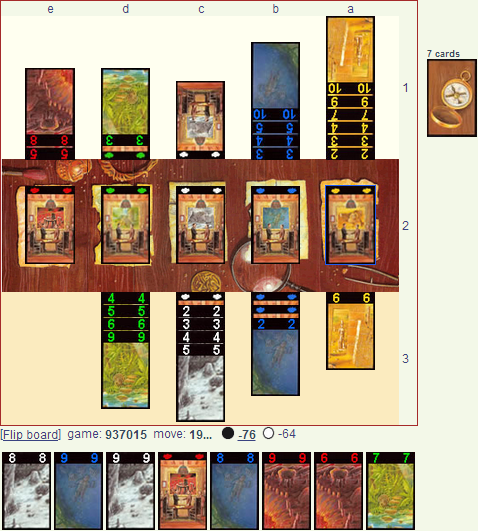
You have -76 pts, 7 cards remain, what should you do this turn?
Lost Cities Overview

In Lost Cities you are attempting to place cards in ascending order using investment cards to start an expedition that function as multipliers to generate higher scores. Each color you place a card in scores (Sum of card values minus 20 points) [multiplied by] investment cards. Additionally a bonus of 20 points can be added for playing eight or more cards in a color.

The Quandary

First let me lay out the cards we should be focused on, first lets look at the cards we currently have and find our current maximum possible score.


Currently we can play the Blue 8 & 9 for 51 points (8 + 9 * 3) and the White 8 & 9 for 34 points (8 + 9 * 2). Adding these totals to our current -76 points we find our current maximum score is 9 points. This is assuming we don't draw any of the cards we need along the way (see below).

Our opponent currently is sitting at -64 points and we can only speculate as to their holdings. There are six remaining cards that can help them, the White 6, 7 & 10, the Green 8 & 10 (We hold the Green 7) and the Red 10 (We hold the Red 9). The total of these cards is worth 92 points and when added to their current score they reach a maximum score of 28 points.

With 7 cards remaining we can play and draw from the deck twice, followed by drawing from the discard piles if we hit one of the additional cards we are looking for. This allows us to play a maximum of five cards before the game ends. We need the White 6, 7 or 10, or the Blue 6 or 7. The Yellow 8 is also a card we can use but we would pick it last for our dodge ball team on the playground.

As you can see our opponent may literally hold the upper hand. They can play from four to six cards depending on their pace of the game dependent on what cards they have remaining.

So where is the dilemma?

Do we play the Blue 8 (Hoping to draw the White 6, 7 or 10)
Or do we play the White 8 (Hoping to draw the Blue 6 or 7)


Weighing the Options

By playing the White 8 we hope to draw the Blue 6 which would be worth 18 points (bringing us to 27) or the Blue 7 which would be worth 21 points (bringing us to 30).

By playing the Blue 8 we hope to draw the White 6, 7 or 10, not only scoring us 12, 14 or 20 points respectively but also (if you noticed) bringing us to 8 cards in White and earning us a smooth +20 points. The worst of these cards nets us +32 points and brings us above our opponent's theoretical max score, so we can ignore marginal benefits and treat all three cards equally.

So you may be saying "This is simple, the three white cards are game winners, so Play the Blue 8 as there are only two blue cards that benefit us and one of those doesn't necessarily always win us the game.

You'd be correct. If this was in a vacuum. But we don't play board games in a vacuum. That would be strange and unnecessarily difficult. Lets roll out the context.


The Context (You thought you were done, didn't you?)

This game is currently in turn 19. A turn by this definition consists of each player taking a turn (So in baseball terms we are in the bottom of the 19th inning).
On turns 1 & 2 they played the Green Investment & Green 3.
On turn 3 they played the White Investment (I played the White 5 on turn 15).
On turn 8 they completed their blue expedition by playing the Blue 10 (I'll explain why this is important in a moment).

Inductive Reasoning

Given the above information we can assert several premises. This is against an experienced player so the following observations will usually hold true at this (late) point in the game.
  • Players like to play the next sequential card so as to maximize their future outcome.
  • Players likes to play an investment with an additional card of that color in hand for assurance.
  • Players will hold useless cards until they can be safely discarded as to not benefit opponents.
In this case we could guess they would only play the White Investment card if they held another white card in their hand on turn 3. They would also have played a White 6 by now if they had it. They may or may not have played a White 7 by now if they had it but certainly not the White 10 (As they would forfeit the potential White 6, 7, 8 & 9 scoring possibilities).

Our opponent has no knowledge that we hold the Green 7, so they may elect to hold the Green 8 or 10 for now.

They have no use for any more Blue cards as they played their Blue 10 on turn 8, this does mean they have had 11 turns to accrue additional blue cards. We have no way to tell as they would retain these cards.


Conclusion

So should you play the White 8 or the Blue 8 or more importantly, does it actually make a difference in the outcome? I'll revisit this next time with several approaches in order to help identify the potential optimal decision.

Wednesday, April 3, 2013

April Game of the Month: War

One of the all-time classics, War is a deeply intriguing game with almost limitless mathematical complexity. War couples extensive replayability with the chance to get back in the game on nearly every turn. It's a game that a child can master in minutes yet delights and frustrates adults all the same, and it's a natural choice for the April Game of the Month.


Style and Gameplay

War is a deck-building card came that uses a standard 52-card deck (without jokers). Suit is ignored, and cards are ranked 2 (low) through ace (high). An equal number of cards is dealt to every player, forming each player's deck. Then, each player plays one card simultaneously, with the high card winning the round. One of the unique mechanics in War is that the winning card "captures" the other cards, adding them to the winning player's deck.

The most important mechanic, though, is the eponymous "War". When two cards tie, one (or more) cards are dealt face-down to increase the stakes of the war, then one is dealt face-up to resolve the battle. It's the only situation in which imperfect information exists in War, and it can be used to reinforce the strength of a deck--or to subtly steal a player's best cards.

War plays quickly, though play time can vary depending on how the war draws work out, and it can suffer from the need to constantly shuffle decks, particularly when relatively few players are playing. Plenty of variants exist, house rules are easy to apply, and the game scales well for two to six players.

Analysis and Anecdotes

Despite a simple set of rules and the use of a standard deck, War is far from a solved game. Its mathematics have been studied extensively, and a number of its aspects have been studied in detail, including finiteness, predictability, and periodicity. In particular, the rules for shuffle triggers and card addition upon winning a round are not standardized, introducing substantial potential for variance.

War has a propensity to create unpredictable situations and large swings in win probability after only a single move. In contrast to Euro-style board games, where strategic consistency is rewarded and a misplay on an early turn can unduly jeopardize a strategy for the rest of the game, War allows unexpected victories, and bad draws in early rounds can easily be erased later on.

Perhaps the greatest source of tension in War tends to be the climactic final battle, when one player is reduced to zero cards and must play out a war knowing it could be his last. This is another area where variants and house rules abound; sometimes, if a player is unable to send enough "troops" to a war, he simply loses, while other rules state that a player's final card can make a "last stand" and fight whatever cards the other players can throw at it.

Overall Impressions

Because of how versatile and widely known it is, War is an ideal time-passer, and it's fascinating to learn how each player has interpreted the game slightly differently. It's easy to get multiple games in, and since each game plays wildly differently, a single game of War that doesn't quite go your way isn't tough to recover from

2+ players, 10-20 minutes, free with a deck of cards.

And a very happy, if slightly belated, April Fools' from Ludi Berkeley!

Saturday, March 30, 2013

International Table Top Day and Quick Reviews

March 30th is International Table Top Day in which participants are asked to go out to local coffee shops  or join a gathering of other gamers to try new games and support the hobby. This is a wonderful cause that I hope picks up steam in future years.

In celebration of this I wanted to do some quick reviews of some games that were new to me in the first quarter of this year for which I was not able to write a full review due to time constraints.

The order below is based on my expectations from highest to lowest.

Despite its contemptuous branding in the gaming community, I had heard great things about Monopoly Millionaire Deal and its older sibling Monopoly Deal. I haven't played the original Monopoly Deal but after reviewing its rules two games appear to differ on the victory condition and possibly some minor differences in cards.

I tried it with several player counts and while it works okay with three or more the main problem is on full display with two players: you don't have many meaningful decisions. That is not to say you have no influence on the game, timing is important and identifying when a "Just Say No" action-blocking card is likely in someone's hand is a fun mystery. The game just didn't seem to be as compelling as I had anticipated, although it is a good experience for what it is: a twenty minute fast paced card game.

Monopoly Millionaire Deal Verdict: 4.5 out of 10


I decided in February I had brushed off the idea of trying Memoir '44 for too long and I gave it a try. I found out I had been robbing myself of quite an experience. This was my first encounter with Richard Borg's Command and Colors system and I loved how simple and intuitive it is. It takes the sometimes laborious decision making of a tactical military operation and divides it into smaller more palatable turns ripe with the interesting decisions we all are seeking.

I'd recommend those that have not tried it specifically because of previous disinterest to check this game out at least once or twice. At the worst you will find it may not be your favorite type of game but you won't be disappointed.

Memoir '44 Verdict: 9 out of 10


I've had the opportunity this year to finally play enough Bolide to form an opinion.

While the replay-ability concern is mitigated with additional tracks, I'm still not sure if there is enough here to make it a need in every game collection. I think it is a good game whose concept is actually more interesting than the execution when it comes to the game play.


Bolide Verdict: 6 out of 10

Keltis Ór appears to remain unpublished at this time but I had a chance to try an online version. As I'm not a particularly big Keltis enthusiast or have much experience with dice games I had low expectations but I was pleasantly surprised.

Keltis Ór plays quickly and has plenty of options to weigh each turn against one another and the scoring is tense. It was an enjoyable experience each time I played it although I'm not sure if it has the long term staying power over similar dice games or even its siblings in the Keltis family.

Keltis Ór Verdict: 7 out of 10

Tuesday, March 19, 2013

SimCity: Discussion and Review

As a kid, SimCity 2000 was the first "real" (i.e., just too old for Oregon Trail) computer game I remember getting into, so it was with great enthusiasm that I pre-ordered the new SimCity (in a very iPad move, just called "SimCity"). I didn't have the chance to play it until more than a week after its release. That might have been the most serendipitous delay in the history of my video gaming career.

Much has been made of SimCity's failings in its first week, and since I never experienced them, I'm not going to beat that particular dead horse any more. The other head of the Ettin of internet rage over SimCity is its "always online" feature. I concur in part, but for a different reason. In contrast to how everyone else on the internet apparently feels, I'm intrigued by the interactivity, and I totally accept the "no city exists in a vacuum" premise of the game. (I don't at all buy the argument about using DRM to control player behavior.)

Where the "always online" feature can run into trouble is when the connection falters. Even in 2013, internet coverage is not perfect. Whether EA is having problems on their end, or Comcast decides to deliver me a hiccup in service, I can't always log in to Origin to play the game. It's a little frustrating that when an outage like that happens, I'm barred from playing the game. Worse is when the outage happens mid-game, which leads to your game instantly closing and losing whatever progress you made since you lost your connection. More sensibly, the game could make a local backup and upload it to the global game when the connection was restored, but this functionality doesn't seem to exist.

Once you're actually in the game, SimCity plays similarly to most of its predecessors, with a bigger emphasis this time around on the "region" or group of cities than just one city. Cities in the same region can cooperate by specializing: one might become a mining and drilling town, another might focus on culture and tourism, and a third might specialize in education and high-tech manufacturing. SimCity is all about identifying the optimal course to grow your town, so in many ways, it's a purer "game" than many video games like RPGs or shooters. It's filled with optimization decisions: immediate profit versus investment for the future, balancing the needs of your residential versus industrial interests, how much you can get away with taxing your businesses before they all get out of town.

Those decisions are not easy to make. Here's a representative story that well encapsulates my SimCity experience so far. I noticed that my approval among my medium-income residents was dropping like a rock, and the chief complaint had to do with how germy my town was. My favorite of the complaints was "get rid of the source of these germs NOW!" Of course, nobody bothered to tell me what the source of the germs actually was.

I eventually tracked it to a single garbage incinerator I'd installed on one of my dumps (to make my residents stop complaining that garbage was piling up). The air pollution was making my Sims sick, a reasonably predictable consequence. So I built up health coverage, but that didn't entirely solve the problem. Meanwhile, my Sims were getting less and less happy, which made them less willing to put up with the exorbitant taxes I'd forced them to pay, and it turned quite a few of them to crime, so I opened a handful of new police stations. Between the costs of health care and police and reduced taxes, my city started running at a massive loss, and I ended up abandoning the town.

In that case, I learned from my mistakes, and I'll be able to play less terribly next time. A few mistakes I haven't learned how to fix. In particular, it seems impossible to apportion the zones in your city correctly; I cover block after block of my town with residential zoning, and I still have a permanent worker shortage in my factories. And it's actually impossible to prepare for natural disasters. I'm not sure what kind of coastal city has two tornadoes run through its downtown in its first two years of incorporation, but I can't blame my Sims for not wanting to live there.

That's to say nothing of the zombie outbreak, which is the single most frustrating and debilitating disaster in the game. Though it was apparently modeled after a flu outbreak, no flu outbreak has ever destroyed 137 buildings in a single night and bankrupted a town the next day. Disasters do help to add some tension to the game, but they happen far too too frequently, and there's too little that can be done about them in advance.

Mostly, though, the challenges in SimCity seem like ones that can be overcome and that can be learned after playing enough. Despite the increased emphasis on continuous, interconnected operation of cities, SimCity might turn into a game I play more like a strategy board game, where I "play a game of SimCity" and see if I do better than I did last time, rather than "play SimCity" and continue the story I started telling before.

Though it appears at first that SimCity has little replay value, there is significant "end game" content in the very expensive "great works" buildings that can be built in cooperation with other cities in the region, and multiplayer with your friends could end up being a lot of fun as you discover new ways to specialize and synergize. SimCity had its issues, but it's worked through nearly all of them; it has its flaws, but most of its mechanics are solid enough--and there's just enough nostalgia there--that the game is worth playing.

Saturday, March 16, 2013

2013 MIT Mystery Hunt: "Mergers"

As a sort of epilogue to the Hunt, Steph and I decided to tackle one last puzzle, "Mergers," when she was in town last week. It was one that we considered trying at the end of the Hunt proper; we ran out of time back then, but after the answers were released, I peeked at the solution method (but not the answers themselves!) to make sure we were on the right track, and it actually seemed solvable.

What we did

The bracket at the bottom of the page is meant to be filled in with various words, starting from the ones listed at the top of the page. Those words are linked by common association of some sort. For example, Windy + City = Chicago. Then, the words we generated by matching needed to be paired with other words, and so on, so Chicago + Rapid Transit = L, and L + Roman = Fifty. We filled in nearly the entire top half of the bracket and made some inroads toward filling in the bottom, but we couldn't ever place "Nadia," "Information," "Mac OS X," or a few others.

What we should have done

Exactly what we did, but more of it. The biggest hangup we came across was not knowing exactly what to do with "Twenty" and "Point Count". We thought it might have something to do with contract bridge, but it turned out the answer was the much more generic "Score". Then, "Score" was supposed to match with "Nadia" to give "Ten".


Would we ever have figured it out?

Possibly. Had we wanted to devote a whole lot of time to it, we could have tried all the remaining words in combination, and we might have been able to divine something eventually. I'm not sure if we realistically would have gotten the "Ten" clue described above. Even tougher was the last connection, "Chester" plus "Age" to get "Man," supposedly a "prepend" (to get "Manchester" and "Manage"); both struck us as more than a little arbitrary.

What can this puzzle teach about good design?

The solution to puzzles should be sufficiently specific that there's only one feasibly correct answer. Even though this puzzle featured good "checkpoints" (unlike many of the Mystery Hunt puzzles), the connection between "Point Count" and "Twenty" was weak and nonspecific enough that I wouldn't have thought to link them with "score". On the other hand, "Mergers" did this very well in most of its clues: "Windy" and "City" together couldn't have meant anything but "Chicago," and we knew we were on the right track when we could link "Copper" and "Tin" together to make "Bronze".


That concludes (for now!) the series on the 2013 Mystery Hunt, but if we decide that any of the other puzzles look interesting and possible, we'll write about them here.

Friday, March 15, 2013

UrbanQuest: San Francisco

A few months ago, I stumbled across something particularly cool on Google Offers: a discount on an "UrbanQuest," pitched to me as an Amazing Race-style urban scavenger hunt. Combine my favorite guilty pleasure reality show (at least my favorite not involving Gordon Ramsay) with my newfound obsession with love for puzzlehunting, and it seemed like a can't-miss.

The premise is simple. You buy a pdf scavenger hunt from the good people at UrbanQuest, and it leads you through part of a city, generally a neighborhood (like San Francisco's North Beach, the setting for this quest) or district (like Fisherman's Wharf) or chunk of town associated with some landmark (like Boston Common). Along the way, you visit both the big touristy attractions and smaller, more secluded places you might have missed completely otherwise.

Once you've gathered all the clues, you can use them to solve a little meta-puzzle, which will unlock a word or phrase. And when you put that word or phrase into the UrbanQuest website, your reward is a reservation made in your name at a local restaurant, giving you yet more chance to see the local sights.

I hadn't had an occasion to run the quest I bought until last week, but I was so excited by the concept that I immediately volunteered to playtest UrbanQuest's unreleased quests. I can't go into the details of what I tested, but I'll compare the experience of running a "beta" to this one, my first "finished" quest that I had the chance to play. I decided that Steph's visit to the Bay area was all the excuse I needed to launch the quest, called "San Francisco City Link". So once she was here, we picked the sunniest day of a cloudy March week and headed into the city to scavenge through North Beach, also known as San Francisco's Little Italy. I'd been to North Beach before, of course, but I'd never spent much time in it, and I'd certainly never seen all it had to offer.

The directions dumped us in Washington Square, and no sooner had the quest started than did I learn something new about San Francisco: that little patch of green space in front of Saints Peter and Paul Church is called Washington Square. We walked around the square a bit, hit up a couple of monuments that gave us our first clues, and (in an especially Catholic detour) spent a few minutes in quiet contemplation of the gorgeous inside of the church.

From there, it was off to Coit Tower, where we tackled probably the toughest clue on the quest, a spot-the-differences that stretched across the murals inside the Tower's ground floor. We took another detour--this one more sightseeing than spiritual--up the Tower, which wasn't part of the quest but enough worth seeing that we went anyway.


An artsy Pantheon-esque shot of the top of Coit Tower

We took the back exit out of the Tower, not the one that least west toward Columbus, but the one that leads east down Telegraph Hill. What a beautiful place:


This is what it looks like walking down from Coit Tower looking out onto the Bay.


Julius Castle apparently used to be a restaurant popular with celebrities. It looks sort of defunct these days, but it's still a really cool building that I'd never seen before.


Someone actually lives here, as seen by the "private property" sign. Sadly, it is not me.

One thing that always stuns me about North Beach is its relative serenity situated half a mile away from Chinatown in one direction and half a mile away from Pier 39 in the other, probably two of the city's most crowded and overwhelming tourist areas. It was even more peaceful and isolated on the less-beaten path through the neighborhood. After stopping to grab some more clues from an art deco-style mural on the side of an apartment building and an old rusty tuba mounted outside a music shop, the quest led us to Dante's baseball mural.


We didn't get the whole story, but it seemed that Dante was a local legend and a mentor to young baseball players. He passed away in 2005, but his old players are still in the stands at the bottom of the mural. Such a nice piece of local flavor is only a block or two off Columbus, yet it's another part of the neighborhood I never knew about.

After Dante's, we headed to the Shrine of St. Francis to translate some Italian, and finally stopped at a North Beach intersection I'd walked through before but never stopped to appreciate exactly how awesome it was:


Our last clue was another spot-the-differences amongst the words that had fallen out of the books and were embedded in the ground. Then, we stopped at a local espresso shop to solve the metapuzzle, a relatively tame one (by metapuzzle standards) that involved a bit of computation and anagramming. Our reward was the reservation made in our name at the Mona Lisa restaurant, one of many Italian places nestled on Columbus. (You can choose from a list of about ten restaurants when you initiate the quest. You don't know exactly which one you'll be going to, but you get a short description, and a mid-priced Italian place that wasn't particularly fancy was exactly what we were looking for.)


I'm notoriously terrible at restaurant-picking, especially in an environment like North Beach with so many tasty restaurants so close to each other, so it was really nice to have a restaurant decided for me at the end of the day. (It didn't hurt that the seafood linguini was fantastic.)

Steph and I had a ton of fun working through this, and we were pleasantly surprised at the diversity of destinations included on the quest, both well-known landmarks and secluded buy lovely pieces of art. Our major critique was that we would have liked the quest's final clue to have taken us somewhere convenient to work through the metapuzzle; we didn't exactly mind having to duck in and grab an espresso, but in neighborhoods where streetside cafes are less common, this might have become an issue.

Compared to the playtest I did a few months ago, it was certainly more fun working with a partner, and it helped to have another set of eyes looking at the trickier puzzles, especially the intensely visual ones that require spotting fine details (and these seem to be a favorite of UrbanQuest's). Neither quest was particularly difficult from a puzzle standpoint, with the most difficult tasks requiring counting details on pictures or finding out-of-the-way signs that aren't easily spotted. The San Francisco City Link

That said, the puzzle design on both quests was very good. Constant checkpoints ("you'll pass two boats on your right," "you should see a doorway with a diamond-shaped archway," etc.) ensure that you're on the correct path, which is important (and undervalued) in puzzlehunting, and even more important when you're in an unfamiliar part of a city. Every puzzle was absolutely solvable and valued discovery more than obscure solution extraction. If you're a gamer who relished every moment of the 2013 MIT Mystery Hunt, then UrbanQuest might not be exactly what you're looking for in a puzzling experience, but it's otherwise a great experience for puzzlers and urbanites alike.

I have been nothing less than entirely impressed with UrbanQuest in all my interactions with them--even when I had a problem redeeming my Google Offers code, one of UrbanQuest's employees resolved my issue within 12 hours. UrbanQuest is a wonderful method for discovering a new part of a city, and I wouldn't hesitate to buy another quest for the next place I visit--whether it's new to me or I've been there a dozen times before, I know I'd find something new, and get the change to solve a few puzzles along the way.