In the previous post, I discussed my experience DMing the War of Everlasting Darkness season of D&D Encounters. In this and the next post, I'm delving a bit deeper into the math behind 4E--and why some of the season's grand experiments worked better than others.
War of Everlasting Darkness's "schtick" was that it would play around
with some of the "sacred cows" of 4th Edition, especially the concept
of the fixed-encounter adventuring day and the contributions of magic items to character statistics. It
was a noble experiment, attempting to feature the "exploration" and
"interaction" pillars of D&D as heavily as the "combat" pillar, and
using magic items more for their flavor than for their mechanical
effect, two concepts that feature heavily in D&D Next.
4E
(and to a lesser extent, every edition of D&D that has preceded it)
is based around the concept of the "adventuring day," the idea that the
characters have a certain slate of abilities they can use every day,
and once those are exhausted, it's time to go to sleep and get back into
it tomorrow. Therefore, DMs face a tight balancing act: too many combat
encounters in one day, and the difficulty ramps exponentially with
each; too few, and each is trivially easy. Most "adventuring days" in 4E
are assumed to have four combat encounters, give or take, and
Encounters has dutifully implemented exactly three to five combat
encounters per adventuring day in nearly every season until this one.
It
turns out that 4E is exquisitely balanced to handle exactly the right
number of combats per day: characters have just enough powerful
daily-use abilities to make it through the day, but not so many that
combat becomes far too easy. When the system works, it works
brilliantly: at every level of the game, combat has a flavor of peril
and a sense that things could go terribly awry, but rarely does it
become overwhelmingly and frustratingly difficult.
War
of Everlasting Darkness, though, turned this assumption on its head, to
mixed results. Each adventuring day had a number of combat encounters
that could happen. But sometimes combat only triggered if the
characters acted a certain way or said a certain thing. Sometimes a
usually-hostile monster wouldn't be so bent on killing the characters if
they'd handled a past situation particularly deftly. And sometimes,
three branches of the same tunnel could lead to an easy combat, a hard
combat, or no combat at all, essentially at random.
As a
result, most adventuring days this season had too few combat encounters
compared to the "four per day" heuristic. That typically resulted in
one of two outcomes. In some cases, when the players knew they'd only be
facing one or two combats of any significance in the day, all the
characters could use their most powerful daily-use abilities at once,
and combat was over practically before it started. On the other hand,
sometimes the module over-compensated for this eventuality by making that
once-daily encounter far too difficult.
In 4E, you gain around a
3-4% increase per level to the average d20 roll, not to mention
increases in damage and new powers that let you do cool things. An
encounter four levels above the characters' level is entirely winnable
but on the order of 30% more difficult--since you're less prepared to
deal with the monster, and the monster is simultaneously more prepared
to deal with you. That translates into a lot of battles won or lost more
on luck than on clever strategy or careful planning. Winning because of luck is the least satisfying way to win, and losing because of it is the most frustrating way to lose. 4E in its "sweet spot" is very good at avoiding those outcomes. It's clear that War of Everlasting Darkness saw 4E operate quite far from that comfort zone.
In
other words, if your game is a heavily structured one, based on
definite combats that will absolutely happen, then 4E is a
fantastic rule set for your game. For other situations, it works less
well. What if the characters are on a long journey and the DM wants them
to have one single combat encounter in a given day, fighting some
trolls in a roadside ambush? What if the characters are in some tight
spots but opt to talk through them or run away rather than fight it out?
Or what if the characters have a bellicose streak and create combat
where you didn't plan on one existing?
4th Edition is
much more poorly suited to running those sorts of games. And there's a
lot to be said for those sorts of games: they appeal to players who are
interested in non-combat situations. They give characters who are built
around something rather than fighting a chance to shine. Most
importantly, the game feels a lot more organic when the characters are
working things out their own way rather than being conducted along the
DM Railroad.
Being witness to this great experiment has
led me to appreciate something unique about roleplaying games compared
to other categories of games. When you alter the math in a board game,
you're altering the mechanics, and that's it. If you make the starting
cost of coal in Power Grid 2 Elektro rather than 1, all you've done is
make coal power plants a comparatively worse early-game strategy. You
haven't changed the narrative tone of the game.
In D&D and in other roleplaying games, though, when you alter the math, you've altered not only the mechanics but also the narrative tone. In making 4E so explicitly structured around the correct number of combat encounters per adventuring day, 4E became very much about combat encounters. That, in turn, encourages players to create characters best served to engage in combat encounters. A version of D&D less carefully balanced on the precipice of the perfect adventuring day would result in not only the (mechanical) change in how the adventuring day played out but also the (narrative) change in what the experience of playing 4E is like.
This isn't a knock on 4th Edition. To its credit, its balance really is very good, as long as its strictures about including the correct number and difficulty of combats per adventuring day are obeyed. But because in a roleplaying game, the math is intrinsically tied to both the mechanics and the narrative, 4th Edition is simply more capable of handling certain styles of gaming than others. In the third and final post in the series, we'll look at how another D&D concept, the math behind magic items and "inherent bonuses," and how it might affect the look and feel of D&D Next.
Thursday, January 10, 2013

D&D Encounters: War of Everlasting Darkness (Part 1: the Season)
Last December, D&D Encounters concluded probably its most ambitious experiment yet: an arc of three seasons that told different sides of the same (very drow-y) story. The first, Web of the Spider Queen, started the story with the PCs as crusading anti-drow heroes; the second, Council of Spiders, turned the tables and had the PCs play as a bunch of villainous drow. The third and most recent (and most ridiculously named), War of Everlasting Darkness, wrapped things up by putting the PCs back on the anti-drow side, though the drow were mostly a background, behind-the-scenes threat for a sizable chunk of the season.
This seven-month-long drow arc saw quite a few D&D firsts for me: the first time I've played the game with my girlfriend (!), the first time in my twelve-year history with the game that I've actually played as a drow character, and the first time I've DMed an extended 4th Edition campaign. I was an early supporter of 4th Edition, believing that it was just as fun as the game's previous incarnations (albeit in a different way), but the constant Encounters grind of "make a 1st-level character, advance to 3rd, and do it all again" started to get old. When our usual Encounters DM, Matt, offered to let me DM this season, I jumped at the chance, mostly to get to do something different for a change.
The Season
Structured entirely differently from previous Encounters seasons, this one had us play eight sessions, with each character gaining a level after every one. That meant we actually got to explore levels 4-8, unprecedented in Encounters-land. The leveling schedule was clearly accelerated, with all the experience-point math hand-waved, but neither players nor DM seemed to mind too terribly much. It was yet another piece of evidence in favor of a DMing strategy I prefer: keep the XP behind the scenes, and tell players when they've gained a level. No player likes being 50 XP short of a new level, and no DM wants to have to design his game around that possibility.
I found the game exceedingly easy to run, though that's not saying much since the War of Everlasting Darkness module told me what to do at every turn. To keep the game dynamic, I did go "off-module" more than most DMs might have: if the characters had a clever solution to an ostensible combat encounter that didn't involve fighting, I let them pursue it. If they had a creative skill to use in a skill challenge that wasn't explicitly enumerated in the module, I let them use it.
My table composition changed more drastically from week to week than I might have liked: one week, we had twelve people show up with all the combat roles at least doubly covered, and we had to split into two tables. The next week, without warning, we were down to three (naturally, two of whom were playing strikers). But lack of continuity is a hallmark of Encounters, often leading to more humorous self-effacing comments (looks like Marshall's character was too busy drinking with his new dwarf buddies to join us this time!) than actual confusion. And in a season like this one, where each session happens in a different place and time, it's even more plausible that a certain character might be missing.
All in all, I had a fantastic time DMing. Of course, the situations I created and the story I told was only part of it. A far bigger reward was knowing my players had a good time. Comments like "we quit our other weekly game because Encounters here has much better DMs" and "I really appreciate all the extra work you've put into this game beyond just what's in the book" make me know I've done a good job.
Wednesday, January 9, 2013
A Quick Probability Conundrum: Follow-up
Last week, I posed the question "if I have twelve cards numbered 1-12, draw three per day without replacement, record their numbers, and then replace them and shuffle, how many days will it take before I should expect to see all twelve?" I was interested in seeing either a simulated or analytical result, and I got convincing ones of each.
Analytical solution
My friend Angelo is an astrophysics/applied math double major, so it's pretty safe to say he's better at math than I am. Here's his analytical solution to the problem, slightly limited by the "three cards per day" restriction.
P(x) = (# of strings of length x that contain each digit between 1 and 12 at least once) / (number of total possible strings of length x)
= 1 - ((# of strings missing 1 or more digit) / (12x))


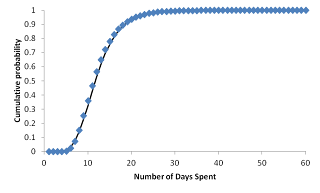
Actually, as he points out, this yields the number of cards you'd need to look at, not the number of days--but that's easy enough to fix by dividing by three. Here's the plot of the analytical cdf:
which appears to cross P(x) = 0.5 around card number 35, or roughly 11 or 12 days. Here's his analytical pdf along with a simulation (n = 10000):

They're a little off, and the simulation isn't quite smooth at n = 10000, but the agreement is reasonably good. For the "magic number" of P = 0.5, Angelo's analytical solution gives 11.7 days, and the simulated solution gives 12.7. Here's his full write-up.
More simulations
I did a simulation of my own with the following logic: start with an array of twelve zeros, pick three of those zeros at random to become ones, and repeat the process until all the zeros are ones. Then do the whole thing over again, 50000 times. My simulation was done in MATLAB. Here's the distributions I came up with:

I get basically the same shape as Angelo's graphs, though the extra 40000 simulations helps make the pdf a lot smoother. It's most likely to take 11 or 12 days, and the mean value of the pdf is 12.7, just like with Angelo's simulation. Strangely, my cdf crosses P(x) = 0.5 at x = 11.7 days, exactly one day too soon, so it's likely I messed up the integration of the pdf.
I got a nice verification of my simulation from another friend, Forrest, who actually does numerical simulations for a living, so there's a good chance his is far more rigorous than mine. I don't have his simulation code, but after one million simulations, his cdf looks similar enough to mine (note the change in scale on the x-axis):

Forrest concludes that the "magic number" is somewhere between 11 or 12, putting his best estimate at 11.3.
Conclusion
The analytical solution and all three simulations put the P = 0.5 threshold somewhere between 11 and 13 days, and the mode or most likely occurrence of both pdfs is essentially a tossup between days 11 and 12. If we're looking for a single numerical answer to the question, I'm putting it at day 12: you're most likely to have seen all twelve cards on day 12. (Follow-up question: is it a coincidence that the number of the "critical" day is also the number of cards in the stack?)
Other interesting facts: it is in fact possible to be done on day 4, but it appears to be exceedingly rare. Only once in 50000 trials (or 0.002% of the time) did my simulation see all twelve cards in only four days. It's equally rare to have to spend more than 50 days: one simulation in 50000 (again, 0.002%) took 57 days to complete, but no other simulations took longer than 48 days.
Thanks to everyone who helped solve this problem! I'm both pleased and amazed that I found such an abstract, academic problem that is nevertheless relevant to real-world game design.
Analytical solution
My friend Angelo is an astrophysics/applied math double major, so it's pretty safe to say he's better at math than I am. Here's his analytical solution to the problem, slightly limited by the "three cards per day" restriction.
P(x) = (# of strings of length x that contain each digit between 1 and 12 at least once) / (number of total possible strings of length x)
= 1 - ((# of strings missing 1 or more digit) / (12x))

Actually, as he points out, this yields the number of cards you'd need to look at, not the number of days--but that's easy enough to fix by dividing by three. Here's the plot of the analytical cdf:

which appears to cross P(x) = 0.5 around card number 35, or roughly 11 or 12 days. Here's his analytical pdf along with a simulation (n = 10000):

They're a little off, and the simulation isn't quite smooth at n = 10000, but the agreement is reasonably good. For the "magic number" of P = 0.5, Angelo's analytical solution gives 11.7 days, and the simulated solution gives 12.7. Here's his full write-up.
More simulations
I did a simulation of my own with the following logic: start with an array of twelve zeros, pick three of those zeros at random to become ones, and repeat the process until all the zeros are ones. Then do the whole thing over again, 50000 times. My simulation was done in MATLAB. Here's the distributions I came up with:


I get basically the same shape as Angelo's graphs, though the extra 40000 simulations helps make the pdf a lot smoother. It's most likely to take 11 or 12 days, and the mean value of the pdf is 12.7, just like with Angelo's simulation. Strangely, my cdf crosses P(x) = 0.5 at x = 11.7 days, exactly one day too soon, so it's likely I messed up the integration of the pdf.
I got a nice verification of my simulation from another friend, Forrest, who actually does numerical simulations for a living, so there's a good chance his is far more rigorous than mine. I don't have his simulation code, but after one million simulations, his cdf looks similar enough to mine (note the change in scale on the x-axis):

Forrest concludes that the "magic number" is somewhere between 11 or 12, putting his best estimate at 11.3.
Conclusion
The analytical solution and all three simulations put the P = 0.5 threshold somewhere between 11 and 13 days, and the mode or most likely occurrence of both pdfs is essentially a tossup between days 11 and 12. If we're looking for a single numerical answer to the question, I'm putting it at day 12: you're most likely to have seen all twelve cards on day 12. (Follow-up question: is it a coincidence that the number of the "critical" day is also the number of cards in the stack?)
Other interesting facts: it is in fact possible to be done on day 4, but it appears to be exceedingly rare. Only once in 50000 trials (or 0.002% of the time) did my simulation see all twelve cards in only four days. It's equally rare to have to spend more than 50 days: one simulation in 50000 (again, 0.002%) took 57 days to complete, but no other simulations took longer than 48 days.
Thanks to everyone who helped solve this problem! I'm both pleased and amazed that I found such an abstract, academic problem that is nevertheless relevant to real-world game design.
Monday, January 7, 2013
Game Ratings: Measuring Quality in Gaming (Part I)

During my latest re-evaluation I realized I've gone 6 months without giving a thorough explanation of games I enjoy. How can I expect others to follow my thoughts if I keep my game evaluations to myself?
Now before I get into my rating scale (which may elicit plenty of fair criticism), let me explain my criteria in order to rate a game.
1. I play every game at least 3 times before rating it.
2. I decline the opportunity to rate a game if I still don't feel I have a grasp of the depth of the game, no matter how many times I've played it. A great example is Go, for which I have played maybe six full games and always feel I'm probably unqualified to play.
3. I do not rate games who are ambiguous to grade - I'd give the concept of Poker at least a 9.5/10 but there are so many variations I could never come to a consensus on a rating for the BGG page "Poker". I also play Warhammer 40k, but that is a game for which the experience is almost entirely determined based on opponent, terrain, painting/modelling, etc, certainly difficult to quantify with a single number.
4. I do rate games for which I have only played a virtual version implementation. I only do so if the implementation demonstrated great quality and encompassed the "spirit" of the game.
5. I do not rate card games played with an ordinary deck of cards. They are almost endless and I try to reserve my ratings for the evaluation of the hard work and creativity that went into the intellectual property on the market. This may sound a bit sanctimonious but I promise I don't intend for it to be.
Originality (Up to 1.0 pt)

Sample Ratings:
1.0 - Samurai, Dominion, Roborally
0.5 - Modern Art
0.0 - Cube Checkers

Theme is a bit easier to judge; a game usually either has a fitting theme or it doesn't. I do give partial credit for trying, and so even if a theme isn't ideal I will give a quarter point if it improves enjoyment beyond just an abstract.
Sample Ratings:
0.5 - Spy Alley, Mr. Jack, Streetsoccer
0.25 - Tally Ho, Cleopatra & the Society of Architects
0.0 - Mancala, Liar's Dice
Pure Fun (Up to 1.0 pt)

Sample Ratings:
1.0 - Lost Cities, Carcassonne the Castle
0.75 - Hungry Hungry Hippos, Ticket to Ride
0.25 - Ra, En Garde
"Re-play-ability" (Up to 1.0 pt)
I don't believe this is a word but it does have expressive value until we find a suitable replacement. Its hard to imagine a game being fun but not "re-playable" in a sense that it isn't worth playing over and over. What I am identifying is are there multiple strategies that make a game worth playing specifically to try to achieve and is there enough player driven chaos to warrant a different game experience. Modular boards and card variety give points as do optional inclusions and alternate rule sets.

1.0 - Can't Stop, Vegas Showdown, Ingenious
0.5 - Jambo, Blokus, Ponte del Diavolo
0.0 - Shut the box
Strategy to Luck Ratio (Up to 0.5 pt)
The purpose of this category is to help value how well a game measures up to its intended quantity of luck and impact of strategic decisions. I'm certainly not alone in my disdain for three hour games whose outcome is largely impacted by luck. My intention is to differentiate games whose style seems to indicate they are comprised of significant strategy when they are actually closer to a lottery drawing each time they are played.

Now this is hardly a deal-breaker for a game with a length of 15 to 20 minutes, but it does demonstrate how sometimes games can appear to be vastly more strategic than how they often play out. It's not a negative for a game like Yahtzee to be very luck driven as the initial impression is congruent with that idea. Games get this the full points in this category by default unless they prove otherwise by not giving adequate ability to mitigate luck.
0.5 - Diamant, Backgammon, Scrabble
0.25 - Simply Suspects, Uno
0.0 - Pokemon TCG, The Royal Game of Ur
I've broken this post into two parts as it has become lengthier than expected. In Part II I will discuss the final two criteria in my process for evaluating board games and delve into some criticisms of this particular grading scale. In the meantime, what do you think? Can games be graded based on preset guidelines or is the purpose lost when many judgments are subjectively swayed anyway?
Friday, January 4, 2013
A Quick Probability Conundrum
In my discussion of Kingdom Builder yesterday, I mentioned that only after a few months of playing the game did we finally draw all twelve of the scoring objective cards, and that seemed unusual. That got me thinking: how unusual is it really? How many games of Kingdom Builder should I expect to have played before I encountered all twelve at random? Here's the same problem, rephrased to make it more general:
I have twelve cards, each marked with a different integer 1 through 12. The cards are identical except for the markings. Every day, I draw three cards at random, without replacement. I record the number on each card then replace the cards into the deck. Then, I shuffle the deck. The next day, I repeat the same steps: draw without replacement, record the numbers, replace, and shuffle. We'll say for the sake of argument that I shuffle thoroughly enough to make the deck truly random, and that today's picks are independent of what yesterday's were.
How long should I expect to keep drawing cards before I've drawn all twelve? A couple of attributes of the probability distribution are intuitively obvious. The minimum number of days would be four: if you drew three different cards for each of four different days, you would get to twelve. But that has to be a pretty unlikely event; by day three, you're more likely than not to repeat at least one number. At the other end, the distribution should trail toward infinity: after an infinite number of days, you're guaranteed to have drawn all twelve, but the "guarantee" only comes at infinity. After a hundred days, or a thousand, it's less and less likely but still possible that there's one recalcitrant card that hasn't shown up.
I'd be interested in seeing the entire probability distribution, either the pdf (differentiated form) or cdf (integrated form). In particular, I want to know where the cdf crosses 0.5--that is, at what day it becomes more likely than not that I have seen all twelve. It would be an easy enough system to model, but I'm also interested in an analytical solution if it exists.
Thursday, January 3, 2013
Old Games Revisited: January 2013
When we published our review and discussion of Kingdom Builder, one of our readers gave a great suggestion: in addition to our first-impression style review, it might be interesting to go back and write a more detailed review later on, incorporating more discussion of strategy and how our opinions of the game have changed over time. Discussing strategy and particular optimization decisions is coming; it's on my list of resolutions for the new year. But the idea of revisiting old games to see how well they've held up or how our approach to them has changed is especially intriguing, since a particular game could lose its luster after playing it only a few times, or the strategic implications of a game might only become clear after running through it once or twice.
Kingdom Builder
 Kingdom Builder has been a frequent installation in our all-too-seldom game nights thanks to its straightforward mechanics and reasonably fast play. The analysis paralysis I mentioned in the initial review has abated a bit as we've gotten more familiar with the rules, which has made Kingdom Builder quicker and more fun. We're still getting new combinations of map tiles and scoring objectives--in fact, in our most recent game, we drew the "Citizens" objective for the first time ever--so the game continues to feel fresh. Most importantly, we haven't played with the disastrous combination of Paddock and Hermits again, but we have played with both Paddock and Hermits alone, and the game worked just fine.
Verdict: Kingdom Builder is still good. Now that the rules are more familiar to us, and now that we've identified the rare combinations of mechanics that break the game, it's actually getting better. Almost as importantly, Kingdom Builder is short enough that we can play it multiple times in the same night and engaging enough that we actually want to.
Small World
 My co-author Alex first introduced me to this fantasy-themed territory-control game, and I played it again for the first time in a couple of years when we got together over the Christmas holidays. Like Kingdom Builder, Small World features enough mechanical combinations that each game feels different from the last, which is emerging as a pattern for making games continue to shine far past their purchase date. Another similarity to Kingdom Builder is that some of these combinations are far more powerful than others, but such game-breaking scenarios seem rare.
Verdict: I still enjoy Small World also, but it's clear to me that it would require several, perhaps dozens of, play-throughs before you could develop anything approaching an optimal strategy. That, combined with Small World's inherent low variance, could make this another game that's worth coming back to. I'd love to try Small World in its iPad incarnation; like Ticket to Ride, this game has to be more fun when the computer takes care of the constant but unexciting numerical computation for you.
Tongiaki
 Another one I first played with Alex, Tongiaki is a constant fixture in our game days due to its low-pressure environment and hilariously, constantly shifting alliances. We've played this one enough that we have developed some ostensibly optimal strategies: some of us like the "build up your forces on a single island" approach while others go with "explore outward as much as possible," and above everything else, "keep 5-point islands to yourself at all costs." Of course, like finches in the Galapagos with no external pressure, we've converged onto the same strategy without knowing how anybody else does it, and it would be fascinating to play Tongiaki with a new player just to see what new strategies emerge.
Verdict: we're not playing Tongiaki for the deeply complex tactical experience; as far as I can tell, we've exhausted all the possible strategies at this point, and we know that winning it is as much a function of variance as of good gameplay. Instead, the reason we keep coming back to it is that it's fun to make your friends' boats sink, and it's a refreshing "palate-cleanser" between more demanding games.
Blokus
 More of a visual puzzle game than a strategy board game, I've played Blokus with a few different groups but most recently with my parents. It's worth playing mostly because it tests a completely different set of skills than the intensely mathematical strategy contained in most of the Euro games in our arsenal. The real strategy behind the small 1x1 square piece is starting to become clear (use it to escape jams in enemy territory!). Also becoming clear is the game's biggest limitation: despite the rules workarounds for two- and three-player games, it really does need four players to work correctly.
Verdict: Blokus is a game that is probably going to appeal to an entirely different set of people than the "heavy" Euro games will, and it's a bit unusual in that it doesn't neatly fit into the strictures of "Euro" or "American die-roller" or "party". Play this one if you're into visual-spatial puzzlers. Don't play it if you don't have exactly four people.
Kingdom Builder

Verdict: Kingdom Builder is still good. Now that the rules are more familiar to us, and now that we've identified the rare combinations of mechanics that break the game, it's actually getting better. Almost as importantly, Kingdom Builder is short enough that we can play it multiple times in the same night and engaging enough that we actually want to.
Small World

Verdict: I still enjoy Small World also, but it's clear to me that it would require several, perhaps dozens of, play-throughs before you could develop anything approaching an optimal strategy. That, combined with Small World's inherent low variance, could make this another game that's worth coming back to. I'd love to try Small World in its iPad incarnation; like Ticket to Ride, this game has to be more fun when the computer takes care of the constant but unexciting numerical computation for you.
Tongiaki

Verdict: we're not playing Tongiaki for the deeply complex tactical experience; as far as I can tell, we've exhausted all the possible strategies at this point, and we know that winning it is as much a function of variance as of good gameplay. Instead, the reason we keep coming back to it is that it's fun to make your friends' boats sink, and it's a refreshing "palate-cleanser" between more demanding games.
Blokus

Verdict: Blokus is a game that is probably going to appeal to an entirely different set of people than the "heavy" Euro games will, and it's a bit unusual in that it doesn't neatly fit into the strictures of "Euro" or "American die-roller" or "party". Play this one if you're into visual-spatial puzzlers. Don't play it if you don't have exactly four people.
Bad Quarterback League: Scoring Analysis
Despite our league's earlier tweaks to the BQBL draft and weekly matchup structure, we used the Grantland standard scoring rules, mostly because Grantland's weekly posts tabulate the score for us--plus, none of us wanted to go through the exercise of coming up with an alternate scoring system, and we wouldn't know how to "fix" it even if the balance were off. Throughout this season, though, a few imbalances in the scores became especially clear.
1. Too much difference between "interception" and "interception return for TD"
Maybe a receiver runs a wrong route, maybe he just gets beat, or maybe he catches a bad break, but there's some element of bad quarterback play in just about every interception. But whether a pick turns into a pick-six isn't just on the quarterback. It's a function of very many things including field position, proximity of other players, and speed/size/ball-handling skill of the intercepting defender, not to mention a bit of luck.
In other words, the quarterback has basically nothing to do whether an interception is returned for a touchdown or for no gain whatsoever. It's not as if the egregiously terrible throws result in defensive touchdowns while the merely bad throws result in simple interceptions.
 This is the Bad Quarterback League, though, and we do want to reward miscues, poor decisions, and errors by the QB that hurt the team. There's no question that a pick-six hurts a quarterback's team more than a regular-flavor pick--and there's no question that it's more fun to watch Brady Quinn put points on the board for the other guys than for Kansas City--so some premium for "interception return for TD" over "interception" makes sense. But the standard scoring for an INT-TD, 25 points, is much higher than the score for an INT, 5 points. That seems like too much of a premium for something largely out of a quarterback's control.
2. Too much difference between "interception return for TD" and "fumble return for TD"
An interception and a fumble are functionally the same: both are rooted at least in part in poor decision-making or bad ball control, and both result in your team not having the ball anymore. That's bad, and it results in 5 BQBL points in both cases. An INT-TD and fumble returned for a touchdown are functionally the same, too: both cost your team six points.
In standard BQBL scoring, though, the INT-TD is worth 25 points, while the fumble-TD is worth a mere 10. They're equally harmful to your team, and they result from equally bad quarterbacking, so it only makes sense that they should have the same BQBL value too.
3. Sometimes you earn more points for fumbling than for keeping the ball
 Mark Sanchez is backed up against his own end zone. He drops back, looking for some receiver downfield but doesn't find one. Eventually, he hears the foreboding footsteps of a 280-pound defensive lineman bearing down on him, and he knows he has no play. Sanchez takes the sack, goes down in the end zone, and gives up two points. He earns your BQBL team 20 points!
In another version of this sad tale, Sanchez tries to make a play, pitching out to Shonn Greene, but dropping the ball on the ground instead of completing the lateral. The astute defensive lineman falls on the fumble, and Sanchez has now given up six points. But he only earns your BQBL team 10.
Like we've just talked about, a fumble returned for a touchdown is worth 10 points in BQBL, regardless of how long that return happens to be. Getting sacked for a safety in the end zone is worth 20. That's an especially bad quarterback play, because a quarterback on top of his game should always throw the ball away rather than take the sack and the safety. But here's another case where the BQBL score doesn't necessarily accurately reflect just how badly a quarterback has been playing. Giving away six points is always worse than giving away two, so a lost fumble in the end zone should always be worth more than getting sacked for a safety.
4. Completion percentage doesn't always tell the whole story
There's a nice little BQBL windfall (5 points) for completing less than half of your passes, and even more points for completion percentages under 40 (15 points) or 30 (25 points). And clearly, there needs to be some cutoff if the BQBL is going to award points for poor completion percentage. But is a quarterback who completes 18 of 35 passes really having a better day than the one who completes 17 of 35? How about the one who completes 4 of 10?
 Consider Sam Bradford's Week-5 brilliance, in which he completed 7 of 21 passes. Seven. On twenty-one attempts. Bradford did get the rare sub-40-percent bonus, but so would a quarterback who completed 17 of 43, which is awful but somehow doesn't seem as bad. The 17-for-43 guy at least tried the whole game. Mr. 7-for-21 might not have.
5. "Benched" needs a more consistent definition
 Sometimes, "benching" is obvious: John Skelton's 4 interceptions and 18.2 quarterback rating earn Ryan Lindley a ticket into the game. That's worth a cool 35 BQBL points. The Seahawks' 35-point lead in the same game earns Russell Wilson a trip to the bench and Matt Flynn some playing time; that's worth zero points.
It's not always as clear, though. Aaron Rodgers' 219 yards and 81.9 rating were probably among the worst in his career, but pulling him with 5 minutes to go in the game had as much to do with the Packers' offensive futility and not wanting him to get injured as with his mediocre play. Blaine Gabbert's 7-for-19 and a whopping 53 yards was a truly miserable performance, but his giving way to Chad Henne in the 4th quarter had at least as much to do with a legitimate injury as with his stats.
Most decisions in the BQBL are obvious because they're quantitative, but this one is a little subjective, so awarding it is a tougher call. For a player to earn "benched" points, he must have been pulled by the standard of sufficiently poor play. That requires a judgment call, and it's important that the judgment be applied in the same way in every case.
Recommendations for future BQBL seasons
1. Too much difference between "interception" and "interception return for TD"
Maybe a receiver runs a wrong route, maybe he just gets beat, or maybe he catches a bad break, but there's some element of bad quarterback play in just about every interception. But whether a pick turns into a pick-six isn't just on the quarterback. It's a function of very many things including field position, proximity of other players, and speed/size/ball-handling skill of the intercepting defender, not to mention a bit of luck.
In other words, the quarterback has basically nothing to do whether an interception is returned for a touchdown or for no gain whatsoever. It's not as if the egregiously terrible throws result in defensive touchdowns while the merely bad throws result in simple interceptions.
2. Too much difference between "interception return for TD" and "fumble return for TD"
An interception and a fumble are functionally the same: both are rooted at least in part in poor decision-making or bad ball control, and both result in your team not having the ball anymore. That's bad, and it results in 5 BQBL points in both cases. An INT-TD and fumble returned for a touchdown are functionally the same, too: both cost your team six points.
In standard BQBL scoring, though, the INT-TD is worth 25 points, while the fumble-TD is worth a mere 10. They're equally harmful to your team, and they result from equally bad quarterbacking, so it only makes sense that they should have the same BQBL value too.
3. Sometimes you earn more points for fumbling than for keeping the ball
In another version of this sad tale, Sanchez tries to make a play, pitching out to Shonn Greene, but dropping the ball on the ground instead of completing the lateral. The astute defensive lineman falls on the fumble, and Sanchez has now given up six points. But he only earns your BQBL team 10.
Like we've just talked about, a fumble returned for a touchdown is worth 10 points in BQBL, regardless of how long that return happens to be. Getting sacked for a safety in the end zone is worth 20. That's an especially bad quarterback play, because a quarterback on top of his game should always throw the ball away rather than take the sack and the safety. But here's another case where the BQBL score doesn't necessarily accurately reflect just how badly a quarterback has been playing. Giving away six points is always worse than giving away two, so a lost fumble in the end zone should always be worth more than getting sacked for a safety.
4. Completion percentage doesn't always tell the whole story
There's a nice little BQBL windfall (5 points) for completing less than half of your passes, and even more points for completion percentages under 40 (15 points) or 30 (25 points). And clearly, there needs to be some cutoff if the BQBL is going to award points for poor completion percentage. But is a quarterback who completes 18 of 35 passes really having a better day than the one who completes 17 of 35? How about the one who completes 4 of 10?
5. "Benched" needs a more consistent definition
It's not always as clear, though. Aaron Rodgers' 219 yards and 81.9 rating were probably among the worst in his career, but pulling him with 5 minutes to go in the game had as much to do with the Packers' offensive futility and not wanting him to get injured as with his mediocre play. Blaine Gabbert's 7-for-19 and a whopping 53 yards was a truly miserable performance, but his giving way to Chad Henne in the 4th quarter had at least as much to do with a legitimate injury as with his stats.
Most decisions in the BQBL are obvious because they're quantitative, but this one is a little subjective, so awarding it is a tougher call. For a player to earn "benched" points, he must have been pulled by the standard of sufficiently poor play. That requires a judgment call, and it's important that the judgment be applied in the same way in every case.
Recommendations for future BQBL seasons
- Reduce INT-TD scoring to 10 points. This brings it in line with fumble-TD and reduces a scoring discrepancy based largely on factors out of the QB's control.
- Keep "sacked in the end zone for a safety" scoring at 20 points, but add the condition that if a quarterback fumbles as he's sacked, he gets the full 20 points anyway. This eliminates the QB "incentive" for losing the football.
- Add a scoring mechanism for completing a sufficiently small number of passes, perhaps "fewer than 10 completions: 10 points".
- Retain the 35-point score for benching, but don't award it in cases of injury or when the benched QB's team has no chance of winning the game anyway. Maybe "benched before the 4th quarter" or something similar.
Subscribe to:
Posts (Atom)