Wednesday, January 2, 2013

Fresh Themes for the New Year

Link to game on Boardgamegeek.com
Happy New Year!

I've got a bit of an annual routine during the holidays, I like to clean things up in preparation for the upcoming year.

I've been revising my collection over the past year, looking to sell or trade away a few of the games I feel less and less compelled to bring out and looking to eliminate some redundancy in the collection. Of course this is all short lived and I've been spending some of the last few months already looking for suitable replacements.

Theme is often a make or break aspect of a new game on the market for me. I pass over Mediterranean merchants, Middle Ages worker placements, Abstract construction titles and Nineteenth Century Train games all the while knowing I'm missing out on some great gaming, but unable to persuade myself and others to give them a try. Lets take a look at a few themes in particular that have caught my eye recently.

The Great Fire of London
Synopsis:

Fresh off a successful reprint Kickstarter campaign, The Great Fire of London appears to have gained a whole new audience just in time for 2013. Players control buildings and battle to control the flames from swallowing their property while innocently steering it toward the their opponents.

Why do I LOVE this theme?

Fire is a natural villain and while it isn't quite an untapped theme, it does allow for interesting options with thematic mechanics. I particularly enjoy the historical element of this as it blends history with the feelings of tragedy as your stomach drops when your key stronghold turns into ashes.

Link to game on Boardgamegeek.com
The Perfect Heist
Synopsis:

Functioning as low level criminals, players slowly increase their notoriety by taking down increasingly tougher challenges alone until they reach a point in which they have to trust one another in order succeed.

Why do I LIKE this theme?

While also sounding like a movie theme, I love games that have some negotiation element to them, but who aren't entirely dedicated to it. What better way to evoke charismatic negotiations among backstabbing players than with a guild of thieves?

Link to game on Boardgamegeek.com
Salmon Run
Synopsis:

Due out in 2013, Salmon Run is a race up stream for  players as they play special abilities and avoid obstacles on the way to their breeding grounds.

Why do I LOVE this theme?

Why not? I like a good racing game every now and then and at least this one has a great purpose. I think the modular boards is always a neat aspect for replay value and it looks like a neat gateway game.

Link to game on Boardgamegeek.com
Quarantine
Synopsis:

Players fight an epidemic by adding on to their hospital in order to keep up with the incoming patients. Players bid on hospital add-ons in an attempt to best

Why do I LIKE this theme?

The idea of improving infrastructure of a hospital in order to keep up with demand is appealing to me. As a tile laying game it could be great or fall flat with me but the theme definitely would get me in the door for a play to see how infectious the game really is.


Link to game on Boardgamegeek.com
Startup Fever
Synopsis:

Players juggle the role of an entrepreneur by jumping into a start up company and attempting to hire the best personnel from opponents. Players hire engineers to improve the product, salespeople to sell the product and executives to improve productivity.

Why do I LOVE this theme?

As an aspiring entrepreneur I really enjoy the idea of pursuing a scarce pool of talent and battling with opponents to keep them on board. As employees stay their costs increase as they become vested in the company. I think its a great business concept to develop and I hope the gameplay lives up to it.

Thirteen Gaming Resolutions for 2013

Happy 2013 from Ludi Berkeley! To ring in the new year, and to celebrate the start of the Ludi Berkeley's full year, here are thirteen gaming resolutions I'll try to follow in 2013.

    1. Host and attend more game nights. I'm in an engineering graduate program in the San Francisco Bay area. It's likely that at no time in my life will I be in such a board-game friendly situation, and I've done a less good job taking advantage of that in 2012 than I did in 2011. There is no reason that my apartment shouldn't be packed to the walls with board gaming at least once per month.


    2. Expand my collection. It's always the goal of any board gamer--or video gamer, movie buff, or avid reader--but in 2012, the only new additions to my collection were Pandemic: On the Brink and Kingdom Builder. The grad student stipend isn't one of fantastic wealth, but neither is it a shackle to poverty, and acquiring three or four new games in the new year seems reasonable. I already have my eye on Seasons, which is beautifully designed, has similar mechanics to 7 Wonders and Ascension, and has been recognized as the best new game of 2012.


    3. Play the Spiel des Jahres winners and nominees. Either the Spiel des Jahres overall winner (Kingdom Builder in 2012, Dominion in 2009, and so on) and/or the Kennerspiel des Jahres ("Enthusiast Game of the Year"; 7 Wonders in 2011, Agricola in 2008, and so on) tends to be very, very good and a lasting fixture in board game years after its award. I'm making a point of getting in on the ground floor with both the Spiel des Jahres and the Kennerspiel des Jahres, and the more of the nominees I can also play, the better.


    4. Tackle more of the BoardGameGeek top 20. Despite the changing tastes of gamers and the weekly entries of new games, the top 20 games on BoardGameGeek remain surprisingly constant from year to year. I've played Agricola, Power Grid, Dominion (and its expansion Intrigue), 7 Wonders, and Race for the Galaxy, and I was able to add Puerto Rico this year. Some of the games on there are expensive (Eclipse at $99 MSRP) or don't look like my cup of tea (Twilight Struggle, a two-player war game). But they're all at the top of their game (so to speak) for a reason. At the top of my list among these games include Le Havre, Caylus, and Ora et Labora.

    5. Be less scared of very long games. Agricola isn't my favorite board game out there, but that has as much to to with its length as its unforgiving mechanics. Power Grid is without a doubt one of my five favorite board games. I end up enjoying every minute of it every time I play, but all too often I veto it because it takes too long. And I adore the immersive aesthetic and beautiful artwork in La Citta, but all too often I let it get vetoed because it takes too long. It's time to dust off these evening-killers and accept that we're only going to get one game in.

    6. Get around to playing video games I purchased in 2012 (or longer ago). I'm not as huge a video gamer as I was in middle or high school, but I own a Playstation 3 and a PC well-suited to playing video games, plus plenty of games to play on both. I started but didn't finish Skyrim's Dawnguard expansion (and haven't scratched Dragonborn yet). I loved Mass Effect 1 and 2 but haven't even installed 3 yet despite having pre-ordered it back in the spring. And that used copy of Bioshock I picked up along with my PS3 has been sitting patiently on the shelf for more than two years now.

    7. Delve deeper into low-leverage indie gaming. Heartfelt storytelling, innovative gameplay, fantastic aesthetics, and a focus on experience rather than difficulty are a set of ideals very much in vogue in independent game design these days--and a set of ideals that very much appeals to me. I've been unfortunately out of the loop playing this sort of game for the past several years, and I want to get back into it. In particular, I'm interested in getting hooked on a point-and-click adventure game, King's Quest or Monkey Island style.

    8. Play at least one game of 1000 Blank White Cards. Essentially do-it-yourself Fluxx, 1kBWC is the ultimate in creative party gaming. Artists have a chance to create pretty pictures, comedians and raconteurs can entertain and engage, and us gaming geeks can play around with clever mechanics and rules interactions. I've loved the game since high school and have played it scant few times since college.


    9. Play-test D&D Next. Here's a chance to do something exactly in my wheelhouse: delve into the underlying design decisions behind the next iteration of the greatest and most popular tabletop RPG out there. I've followed the open beta since its beginning back in May but, despite my best efforts to organize a group, haven't been able to actually sit down and play it. 2013 might give me a better chance, as the next season of Encounters includes the D&D Next beta among its optional rules.

    10. Play a D&D Lair Assault. The name "Lair Assault" has always put me off: it implies that it's going to be a session of combat and nothing else, within a version of D&D that's soundly criticized (sometimes fairly) as focusing too much on combat. However, all of my D&D-playing friends who have done Lair Assaults have reported having a great time, and with 4th Edition starting to make its exit, now is as good time as any to give one a shot.

    11. Attend more puzzlehunts. September and October gave me the chance to play through two, one hosted by my friends in real life, another hosted by Ken Jennings and the Smithsonian online. I had an incredibly fun time with both, and I'm excited to try playing a live-action hunt on a larger scale, like MIT's or Berkeley's.


    12. Blog more about game strategy. One idea I had starting this blog was to relate specific situations and anecdotes from games and pose them to the blog's readers, asking for a wider audience to consider the optimum strategy. (Exactly how much is power plant 13 worth in Power Grid?) Ludi Berkeley has been all too light on that sort of post so far.


    13. Redesign the blog. The neutral gray was a placeholder layout I picked back in June when I started the blog, and unfortunately I haven't had time to make it more interesting-looking. Expect an aesthetic explosion in the New Year!

    Let me know what your gaming resolutions for 2013 are, and I wish you good luck in fulfilling all of them! I appreciate everyone who's followed along with the blog so far, and I encourage you to follow the blog and spread the word about it if you've enjoyed reading.

    Bad Quarterback League: Awards Ceremony

    It was a decent season for me in "real" fantasy football. Abandoning the Ravens defense after the tragic and simultaneous loss of Ray Lewis and Lardarius Webb, stomaching the up-and-down lurches of Reggie Bush, tolerating the merely mediocre consistency of Ray Rice and Jimmy Graham, and riding the surprising success of Robert Griffin III right into the playoffs, I lost the championship game but still managed a respectable second-place finish in our eight-team league.

    But riding the unsurprising failure of the Kansas City Chiefs offense to a similar second-place finish in the Bad Quarterback League was almost as rewarding, not to mention much more hilarious. With the NFL's regular season finished, most of our bad quarterbacks' seasons are too, and it's high time to award the most distinguished teams by draft performance, weekly wins, and overall score.

    For a recap on how we set up our BQBL league, see the introductory post; for a reminder on how scoring works, we used Grantland standard scoring.


    Draft Performance

    To evaluate draft performance, I developed a metric called "Draft Strength". In brief, Draft Strength measures the difference between where a team was drafted in our draft and where a team ranked by total points at the end of the season, i.e. where the team should have been drafted if we all had perfect information and complete foresight at the beginning of the season.

    A positive Draft Strength means that a team was a "steal" (drafted in a late spot but scored well), while a negative Draft Strength means that a team was a "bust" (drafted early but didn't produce). A Draft Strength near zero means the team was taken near where it "should have" been. Each of the sixteen teams we drafted has its own Draft Strength, and each player has a Draft Strength that's simply a sum of their two teams' scores.

    It's a useful metric because it rewards having found the "hidden talent" late in the draft that wasn't necessarily available early on. For example, a team that was picked first overall and scored the best would have a Draft Strength of 0, but a team that was picked tenth overall and scored fifth-best would have a Draft Strength of 5.

    Top performers by Draft Strength were the Kansas City Chiefs (drafted 9th but scored 2nd; DS = 7), the Tennessee Titans (drafted 13th but scored 7th; DS = 6), and the Jacksonville Jaguars (drafted 7th but scored 4th; DS = 3). The highest-scoring undrafted team was the Chicago Bears (scored 5th). The worst Draft Strength went to the Washington Redskins (drafted 16th but scored 30th; DS = -14). Our top scorers by player were


    1. Josh Howe, Jacksonville Jaguars and Tampa Bay Buccaneers, DS = 2
    2(t). Alex Harkey, Arizona Cardinals and Oakland Raiders, DS = 0
    2(t). Matt Pavlovich, St. Louis Rams and Kansas City Chiefs, DS = 0


    Weekly Wins

    Each week, every player's two teams' scores were added together to give a player's weekly score. Weekly Wins measures how many weeks each player had that week's highest score. While a single three-hundred point performance might have catapulted a team and a player into the season victory, the number of Weekly Wins awards consistently bad quarterback play every single game.

    Top teams contributing to Weekly Wins were the Arizona Cardinals (highest score 4 weeks), the Miami Dolphins (highest score 2 weeks), and the St. Louis Rams (highest score 2 weeks). Undrafted teams that won the highest score in a week were the Baltimore Ravens, Chicago Bears, Dallas Cowboys, and San Diego Chargers. Winning the most weeks in our draft were

    1(t). Josh Howe, Jacksonville Jaguars and Tampa Bay Buccaneers, 4 weeks
    1(t). Alex Harkey, Arizona Cardinals and Oakland Raiders, 4 weeks
    3. Matt Pavlovich, St. Louis Rams and Kansas City Chiefs, 3 weeks


    Total Score

    The grand prize in the BQBL was the Total Score, the sum of every interception, fumble, sub-100-yard passing game, and mid-game benching across the season. No averaging for consistency or correcting for draft position here, Total Score takes into account every poor decision and blown play from the entire season.

    Highest-scoring individual teams were the Arizona Cardinals (666 points), the Kansas City Chiefs (551 points), and the New York Jets (516 points). The highest-scoring undrafted team was the Chicago Bears (349 points), and the lowest-scoring drafted team was the Washington Redskins (31 points). Our final standings were


    1. Alex Harkey, Arizona Cardinals and Oakland Raiders, 883 points
    2. Matt Pavlovich, St. Louis Rams and Kansas City Chiefs, 773 points
    3. Josh Laber, New York Jets and Seattle Seahawks, 674 points

    4. Josh Howe, Jacksonville Jaguars and Tampa Bay Buccaneers, 664 points
    5. Tom Dursch, Miami Dolphins and Tennessee Titans, 564 points
    6. Alan Berger, Minnesota Vikings and Cincinnati Bengals, 524 points
    7. Andrew van Devender, Buffalo Bills and Indianapolis Colts, 480 points
    8. Zach Baer, Cleveland Browns and Washington Redskins, 256 points


    Recap

    Lots of players in our draft went with questionable young quarterbacks: of the sixteen teams selected, five (Cleveland Browns, Miami Dolphins, Seattle Seahawks, Indianapolis Colts, Washington Redskins) started the season playing rookie quarterbacks and four more (Minnesota Vikings, Jacksonville Jaguars, Cincinnati Bengals, Tennessee Titans) started with sophomores. Some of the young QBs panned out, others proved to be actually good quarterbacks. But by far the standout performers this season were the Cardinals, Chiefs, and Jets, teams plagued with both injury and quarterback controversy between middling-to-bad veterans and unknown backups.

    Perhaps that observation will inform the strategy for next year; I had a lot of fun tweaking the system and running the behind-the-scenes math, almost as much fun as I did rooting for Brady Quinn to commit turnovers. Thanks to everyone for playing, and I hope to do it again!

    If you're interested, take a look at our final scorecard, and check back tomorrow for an analysis and breakdown of the scoring system.

    Tuesday, January 1, 2013

    Quick Impressions: Scotland Yard

    Last Sunday, Alex and I had a bit of a reunion with our old college gaming buddies Jeff and Hershel. We played some old favorites (Tongiaki and Small World) and also had the opportunity to try out one that was new (to us), Scotland Yard. It's actually an older game by modern board game standards: having won the 1983 Spiel des Jahres, it's a rare '80s strategy game that endures in popularity today. Released before the Settlers of Catan-led explosion in the popularity of Euro-style games around the turn of the century, Scotland Yard lacks the contemporary Euro-gamey feel of skill/chance balancing and constant player re-balancing and multiple paths to victory but presents a complex and intriguing strategic foundation for three decades of Euro games.

    In Scotland Yard, one player takes on the role of the notorious criminal Mr. X, and the rest of the players play detectives trying to track him down. Scotland Yard is essentially graph theory put into board game form; each player occupies one vertex of a fictionalized street map of London, and if a detective ever occupies the same position as Mr. X, the detectives win as a team. But if Mr. X evades capture for twenty-four turns, he wins. The rules are simple: players move from vertex to vertex via a variety of modes of transit, but each player only has a limited number of "tickets" for each mode. The big catch is that Mr. X shows up only once every three to five turns, with the detectives left to guess where he has gone in the interim.

    From a game design perspective, the most distinctive thing about Scotland Yard is that it's a pure-strategy, practically zero-variance game. The only random element in Scotland Yard is its initial setup, where each detective and Mr. X can start on one of about twenty different spots on the map (there are two hundred in total). Afterwards, there's no chance in the game at all; every move has to take place on an ever-expanding graph of possible moves.

    The strategy quickly becomes for the detectives to fan out and reach Underground stations (which allow the fastest movement across the map) until Mr. X shows himself, then try to cast a tightening net around Mr. X. As a result, the game's difficulty is a direct function of how many players there are. Some of the distribution of turns and tickets is rebalanced for more or fewer players, but in general a game with three players (or two detectives) becomes very easy for Mr. X to win, while a game with six players (five detectives) is a lot tougher.

    We played with three detectives plus Mr. X, and for about seventeen turns, we detectives were thoroughly beaten. When Mr. X revealed himself at turn 18, though, we were able to narrow down his location such that when he made a mistake at turn 19, we had all his possible routes of escape covered and won the game. It was a slightly less-than-fulfilling way to win, taking advantage of an unforced error rather than putting together a brilliant strategy, and but for that ill-advised trip on the Underground, we surely would have lost.

    Scotland Yard is built around one simple mechanic, and it executes that mechanic very well. The complete lack of variance during the game leads to some nice intensity as you pit your strategic skills and bluffs directly against those of your friends. It would be a tough game to play more than once of in a single sitting--partially because it's easy to reach a saturation point with the limited mechanics, and partially because the strategizing actually does get a little mentally taxing. But it plays quickly, and it's easy enough to teach to non-gamers, making it a viable alternative to Puerto Rico for a group you'd normally play Anomia with.

    3-6 players, 30-60 minutes, $40 at a game shop or $28 on Amazon

    January Board Game of the Month: Dixit

    Plenty of Spiel des Jahres winners and nominees are pure-strategy games, the kind that exemplify the Euro-game genre and reward intensely mathematical strategizing. They're awesome games, and they've led to the countless hours of scrutiny and nitpicking that qualifies as fun among a bunch of engineering grad students. Every once in a while, though, the Spiel des Jahres award goes to a game like Dixit that, despite absolutely no math or strategy behind it, is engaging and complicated and worthy of the title of "game of the year".

    Style and Gameplay

    Dixit is a card-collecting game that draws inevitable (and entirely appropriate) comparisons to Apples to Apples. Like Apples to Apples, every player has a hand of cards; on each turn, every player selects one card that fits the turn's theme the best. The mechanics are a bit different from Apples to Apples--instead of the "active player" deciding which card fits best, all the players vote on which one belonged to the "active player". Dixit's greatest improvement over Apples to Apples is a track and  mechanism for scoring, keeping Dixit to a manageable length by having an endgame condition within sight.

    The scoring system also provides some incentive for the "active player" to create clues that are guessable but not immediately obvious. If a clue is too easy or too hard, the "active player" scores no points. The real trick to Dixit is to hit somewhere in the middle: anything from a clever interpretation to an inside joke to a slightly abstract or off-kilter narrative can do the trick.

    Probably the most remarkable part of Dixit is its beautiful artwork, a style somewhere between fairytale storybook and surreal epic fantasy. Different people looking at the same card, or looking at the same card from a different angle or in a different context, can interpret it in vastly different and imaginative ways. The impetus is always on the "active player," rather than a randomly selected "green card," to suggest an interpretation for a card, so there are some cards that don't speak to a player and may go unused the entire game. But the vast majority of them inspire something wonderful: a story, a reference, or even a mere flicker of word-association.

    Analysis and Anecdotes

    Another point of similarity Apples to Apples, the only real way to gain an advantage in Dixit is to know the people you're playing with very well. Upon seeing a card with a picture of a knight riding out of the pages of a book, my dad gave the clue "woeful countenance". Having played in the musical Man of la Mancha together, I immediately understood the reference, but my mom and girlfriend were not so informed. Similarly, I had just been to the mall with my girlfriend, where we saw a carousel; when she gave the clue "a trip to the mall," I knew the carousel card had to be hers.

    Depending on the group of people playing, Dixit could take a number of different turns, ranging from the imaginative to the idiosyncratic, filled with artistic allusions or recounting of hilarious stories from college. It would be easy enough to rig Dixit, to give each picture a phrase specific to it and use the same one every time, but that would be missing the point. And playing through the same deck of cards with the same people multiple times could wear out a lot of the game's novelty: there was a fantastic sense of discovery turning over each card and seeing it for the first time. Asmodee, Dixit's creators, understand that (and have a good business model) and have released a number of expansion decks.

    Dixit does take a bit of getting used to; there's a fine line between "too obvious" and "too obtuse". In our first game, we tended, accidentally, toward "too obvious," but we assumed that if we'd played more games, we would have gotten the hang of making appropriately specific clues. And the game could stand to be a little more interactive--for most of the game, there's very little being said except for when the "active player" reveals which card was his or hers. The first game of Apples to Apples I played was like that too; then we discovered how important and fun it was to advocate for your own card. Presumably, Dixit is even more fun once people become comfortable enough with it to start advocating and arguing with the active player.

    Overall Impressions

    Yes, Dixit is basically "Apples to Apples with pictures". No, that's not a bad thing. This is another game that probably won't appeal to those looking for a deeply strategic gaming experience. But as a social game, suitable for playing with your family or colleagues or acquaintances, Dixit excels in the same way that Apples to Apples does. It helps to know your fellow players well, but it helps more to play with people who are imaginative and creative.

    The only obstacle to Dixit's continued playability is running out of interesting picture cards, and when that happens, it's simply time to buy a new deck. Until then, I'm excited to keep delving into Dixit, discovering new and fantastic stories each time.

    3-6 players, 30-45 minutes, $35 at a game shop or $25 on Amazon

    Monday, December 24, 2012

    Board Game Design: Identifying Multiple Paths to Victory (Part III)

    Conclusion of Part I & Part II.

    Card games offer a special approach to game driven chaos through a randomized deck. An individual card will often have a range of usefulness relative to the other cards in your hand. In a game of five card draw, there is a straightforward desire for higher value cards and a single deuce can often be discarded without thought. If given an initial hand beginning with a pair twos, suddenly an additional two would add tremendous value. Card games all utilize this to some degree.

    In Dominion, many players are impressed with the ability to “build your own machine” deck construction mechanics. I was enamored with the idea that it embraced the aspect of unproductive cards with an all or nothing approach of victory cards. In the base game victory cards are a hindrance for the duration of the game until final scoring in which they are the only means in order to win. Everyone who has played even one game of Dominion has experienced the dreaded mostly green hand for which the actions on a turn are severely diminished. Dominion was the first instance of an all-or-nothing approach to the usefulness of cards I had observed in game design.

    The brilliance of the design of the Pokemon Trading Card game is often overshadowed as it was glanced over by many and dismissed as merely an extension of the Pokemon brand. Cards were collected and traded based on the notoriety of the Pokemon, the holographic Charizard being the Holy Grail for many. If you were anything like me in the 1990’s, you never played a game of the Pokemon TCG by the written rules. If that is the case, chances are that trainer cards were passed over and energy cards were trashed completely.

    Many collectible card games require an element of structure in the pregame ritual of deck building. Pokemon was unrestrained as the only requirement was that the deck must be comprised of 60 cards. A balance deck needed several categories of cards but there were no restrictive guidelines as to what could be included. Cards ranged from basic pokemon who were your primary method of representation in the battle arena; energy cards which fueled attacks and special actions and trainer cards which allowed common card game actions such as access to your discard pile and drawing additional cards for future use.

    The Pokemon TCG is another prototypical example that falls within our framework for multiple victory conditions. Over the course of the game basic pokemon cards are played into your "bench", of which one is selected as an active pokemon. The primary strategy involves switching your active pokemon with those on your bench in order to utilize key advantages and minimizing weaknesses. Upon depleting the hit points of one of your opponent's pokemon, you receive one of six "prizes" which consist of 6 random cards dealt from your deck before the game.

    Our first victory condition in this series of articles is our tactical victory, taking advantage of the primary actions in the game. In the Pokemon TCG this victory condition is met by knocking out all of your opponent's active and benched pokemon, in such a way that they have none available during a game. This condition can be more easily achieved with a deck designed to get a lot of pokemon out quickly onto your bench that have moderate attack strength in order to take down an opponent who builds up to that powerfully evolved Charizard. An interesting risk is made if a deck is based on a low quantity of powerful basic pokemon, risking those cards being stuck as an out of reach "prize" or on the bottom of the draw deck.

    The prize function operates as an interesting method of facilitating chaos in the game. As not all cards can be drawn through normal play, for the risk averse players it insists upon a deck built on duplication and multiples of the most crucial cards for a given strategy. Achieving all six of the prizes is a simplified element of the set collection victory path in our design structure. It certainly doesn't express the expected aspects of set collection such as like-kind accumulation and zero-sum depletion but it does fit the criteria in a loosely defined manner and satisfies the basic requirement of set collection of a particular item.

    Our final strategic pathway of an hourglass victory is a common structure in card games in one form or another. In many collectible card games when a player's deck is depleted this triggers victory for this player or more often, the opponent. In the Star Wars Collectible Card Game, when a powerful character card is defeated it has a "damage" number which causes additional attrition beyond that card. This function consists of discarding a number of cards equal to the "damage" number indicated on the card, usually relative to strength and functional as a balancing mechanism. In Pokemon, this is much more simpler and deck management is more often under control of each player based on drawing and reshuffling discarded cards back into the deck with special actions. Once a players deck has been exhausted, that player has been defeated.

    I look forward to seeing how these three primary methods of victory will continue to be explored and expanded going forward in game design. I thank you for reading and I hope this series of articles has enriched your analysis of these game types, and thus encouraging a bright gaming future. 

    Monday, December 3, 2012

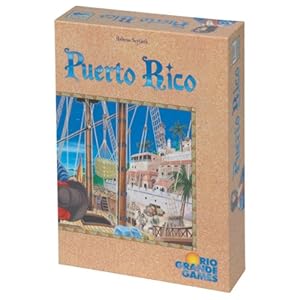
    December Board Game of the Month: Puerto Rico

    After an online narrative RPG, a party-oriented card game, and a month of gaming totally devoted to history puzzle-hunting, Board Game of the Month is back with the Euro-gamiest of all Euro games: Puerto Rico. Despite its reputation and prominence among board gamers, I didn't play it for the first time until a recent game night hosted by my friend Phil. After playing for the first time, I quickly developed a love-hate relationship with it: though it's very difficult for a first-time player to make any headway with Puerto Rico, it's easy to see why the game is so well-regarded in the community.

    Style and Gameplay

    Puerto Rico is a turn-based city-building game. You play the role of a territorial governor in colonial-era Puerto Rico, and your task is to build your city and its farms to become the most prosperous. The game uses a standard "victory point" mechanic, and both goods from your farm and buildings in your city count for victory points in the final scoring. There are strong similarities to both Agricola and Race for the Galaxy, and in many aspects, Puerto Rico plays like a middle ground between those two games.

    The actual mechanics of Puerto Rico's gameplay are mostly straightforward: to build your city, you can create buildings and grow crops in plantations. Buildings cost money to create and require citizens to operate; you make money by selling the crops you grow, and a limited number of citizens immigrate to the island every turn. Certain buildings allow growing more expensive crops, while others make it easier to attract citizens or to build even more buildings.

    Much of Puerto Rico's decision-making comes in deciding which crops to grow and when to sell them. Sometimes it makes sense to invest heavily in expensive crops, while other times, it's better to move quickly through lower-value ones; sometimes you need to sell crops for money, and sometimes it's better to trade them for victory points. Other strategies can get by without growing crops at all. Like all the best games in the genre, Puerto Rico strongly rewards formulating a consistent strategy and pursuing it through the end of a game; like all the best games in the genre, that's particularly difficult.

    Analysis and Anecdotes

    A (possibly apocryphal) story about Puerto Rico's development is that it and Race for the Galaxy grew out of the same development process and a disagreement between the designers. That's especially plausible having played both games. One core mechanic shared between the two is "phase selection," where each player chooses an action to perform (like "Explore" to draw cards or "Develop" to make a new building), and every player performs each selected action, with a bonus to the player who selected that action. For example, if one player chooses to "Explore," everyone draws cards, but the player who picked "Explore" gets an extra card. The result is a free-form and largely non-interactive game where each player can develop a strategy and not have other players interfere with it.

    In contrast, Agricola, another game that has plenty in common with Puerto Rico, limits each action to one player per turn: only one person can take stone, only one player can build fences, and so on. Puerto Rico lies somewhere in between: while only one player can get the "bonus" from any given phase, all players can play in all phases. That makes Puerto Rico a less frustrating game in general than Agricola but one that requires more anticipation of other strategies than Race for the Galaxy.

    Puerto Rico is not an easy game to learn, even for a player who's had experience with similar games. That was reflected in the scores of the very first game I played, with Raphael (who had the most experience with the game) winning easily and me (the only person playing for the first time) bringing up a miserable rear. Although it's easy to appreciate that winning the game requires a consistent strategy, it's not so easy to get an idea of what that strategy might be until you've played through the game a few times.

    Something in particular that got me into trouble was not building toward the end-game buildings aggressively enough, and then not accounting for the need to move my citizens into my end-game building to "activate" it. Like Race for the Galaxy, 7 Wonders, and a host of other Euro games, Puerto Rico's scoring ramps up in later turns, making end-game plays generally more valuable than early-game plays. The consequence is that it's important to anticipate the end of the game coming and to prepare for it in time to maximize the value of your late plays, another skill that's difficult having never played the game before.

    Overall Impressions

    There's a whole lot to Puerto Rico, and the most clever part of its design is that two players can be pursuing completely independent strategies and be successful in both--but interact just enough to impact how successful each of those pursuits are. Fans of Race for the Galaxy should appreciate all the similarities between Puerto Rico and Race; fans of Agricola or of stiflingly low-variance board games in general will be drawn to the utter lack of randomness in Puerto Rico. Along the lines of Agricola, it's a more proactive game than the more reactive Race for the Galaxy, so even though the mechanics are similar, the approaches to winning Puerto Rico and Race for the Galaxy are very different.

    Regardless of personal preferences for proactive vs. reactive, or moderate vs. low variance, or interactive vs. isolated-strategy games, Puerto Rico is consistently in BoardGameGeek's top five best board games for a reason. At the very least, it's worth playing because it's a mainstay in the genre; at best, it's a game whose depth of strategy and multiple viable approaches will draw you in enough times to actually become good at it.

    2-5 players, 90 minutes (or 120 if there are new players), $45 at a game shop or $29 on Amazon